1
1
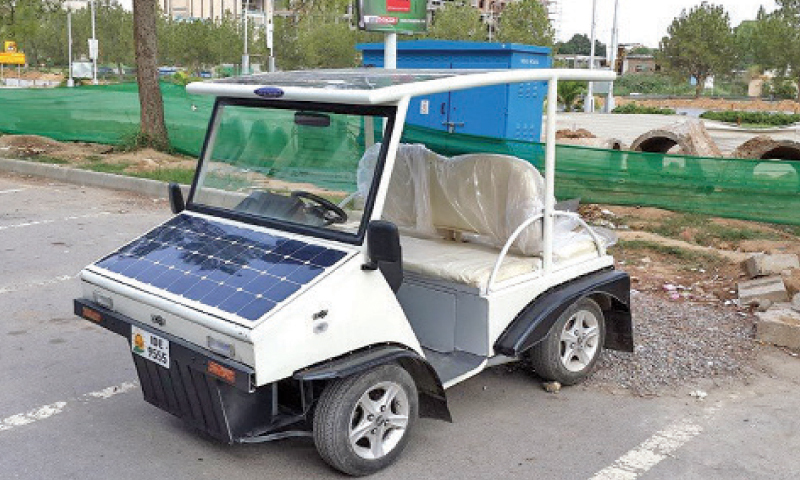

ISLAMABAD: No beauty in looks, the doorless car parked by the roadside in a city commercial area still attracts inquisitive looks of passersby.
It is a solar-powered prototype vehicle, produced by Ageco company, which dreams of mass producing it to revolutionise public and private transport in sunny Pakistan.
On Monday, the company crossed the threshold when a technical committee of the Pakistan Standards and Quality Control Authority (PSQCA) approved the technology and standards of this alternate energy car without engine.
Industrial production of the solar vehicles can get underway after the federal government’s Engineering Development Board also approves its design and technology as safe and road-worthy.
Possibly the most pleasant outcome would be refitting, or replacing the three-wheeler motor rickshaws in the country with solar hybrid electric motor operated kit.
That would rid the cities and towns of the environmental and noise pollutions the present day rickshaws produce. “Our golf cart-looking solar vehicles are completely Pakistan-made and can be used to go to work, or take children to schools, or in place of the motor rickshaws,” said the company’s managing director.
A solar rickshaw would pay its price of Rs150,000 within a year as a study by the manufacturers of the solar hybrid electric motor kit showed that the owners of petrol-run rickshaws spend between Rs12,000 and Rs15,000 a month on the fuel and maintenance of their vehicles.
According to manufacturers, the solar vehicle would run 80 kilometres on full charge. The kit’s battery consumes roughly four units - 1,000 Watts makes up one unit - and would be charging when the vehicle is running in the sun. Extra distance can be covered by adding extra batteries. The golf cart model has solar panels fitted on the bonnet and roof, and on the doors too in the covered car model.
Spare parts for the vehicles, which have a plastic body on a metal frame, would be no problem as they are entirely made in Pakistan.
An official of the Pakistan Standards and Quality Control Authority said the technology promised many benefits but mainly reduced pollution and speeds on the roads and lower oil import bill for the country.
Published in Dawn, October 30th , 2014