24
24


ISLAMABAD: Adviser to Prime Minister on Foreign Affairs and National Security Sartaj Aziz said on Monday that the recent border incident would not affect relations between Pakistan and Iran.
“Improvement in relations with Iran would continue,” Mr Aziz told media personnel on the sidelines of China-Afghanistan-Pakistan Trilateral Dialogue.
Know more: Pakistan asks Iran not to ‘externalise’ its problems
The dialogue was organised by Pakistan-China Institute in collaboration with Konrad Adenauer Stiftung (KAS). It was the first session of the dialogue among think-tanks of the three countries in Pakistan. Its earlier edition took place in China and the next would take place in Afghanistan.
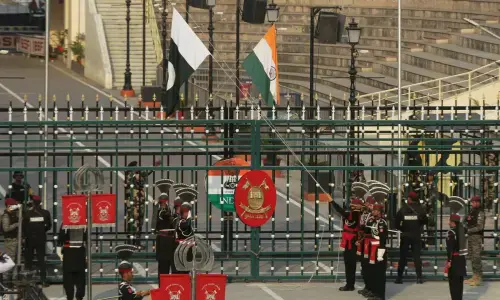
Mr Aziz’s comments came as Pakistan and Iran have summoned each others’ ambassadors to lodge protests over a border incident.
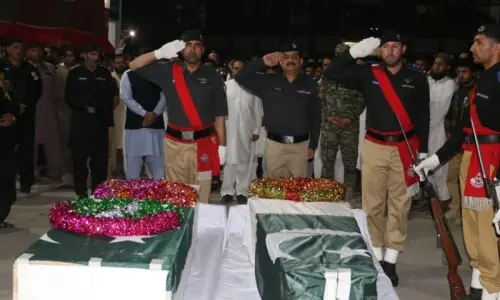
A Pakistani Frontier Corps soldier was killed by shelling from Iranian troops.
The Iranians, however, want Pakistan to stop “terrorists and rebels” who they allege have sanctuaries in Pakistan’s Balochistan province and commit activities after crossing into Iran’s province of Sistan-Baluchestan.
Answering questions about the incident on the Pak-Iran border, the adviser said ties with Tehran had improved ‘significantly’ after Prime Minister Nawaz Sharif’s visit to Iran in May this year. There was also progress on the Iran-Pakistan gas pipeline, he added.
Mr Aziz described the border shootings as “very unfortunate”.
He blamed the incident on “large number of militant groups” and “criminal elements” operating in the border area.
He said the way forward lay in better border management both at local and higher levels.
Earlier speaking at the conference, Mr Aziz asked India and other countries to stop interference in Afghanistan.
He said the countries competing for influence in Afghanistan should instead compete in the country’s reconstruction.
“We cannot afford to have a ’90s like situation,” he said while referring to the instability in Afghanistan that followed the Soviet withdrawal.
On improvement in Pak-Afghan ties, he stressed that the starting point would be a commitment by both sides not to allow the use of their territory against each other.
He noted that Pakistan and China shared a vision of peaceful and stable Afghanistan and could effectively help in addressing challenges facing the war-torn country.
Chairman of Pakistan-China Institute (PCI) Senator Mushahid Hussain Sayed said: “The purpose of the dialogue wasn’t only academic discussion”, but to come up with some practical recommendation as a way forward.
PCI Executive Director Mustafa Hyder Sayed suggested a five-point proposal as a way forward in cooperation among China, Afghanistan and Pakistan — institutionalisation of trilateral dialogue between think-tanks; setting up of a joint trilateral counter-terrorism task-force; establishment of a joint trilateral task-force; holding youth summer camps; and convening a trilateral media conference.
Published in Dawn, October 21st , 2014