

The garden imagery in art has always been a spring of inspiration. Nature in ancient beliefs was a source of mysterious forces to be propitiated by artists who gave meanings beyond symbols to flowers, trees and water, the primeval source from which all life began. The practical ancient Romans had garden friezes created on the walls of their rooms to cool their imaginations during the hot Roman summers. In Asia the Mughal rulers created gardens divided by water into four sections, and the garden image continued to inspire painters and poets.
Curated by Amra Ali, the exhibition titled ‘Sabza o Gul’ (flowers, greenery, and foliage) brings a contemporary view of the garden in art with the collective work of seven artists: Zarina Hashmi, Meher Afroz, Ghalib Baqar, Madiha Sikander, Farook Mustafa, Naz Ikramullah and Irfan Hasan.
Their work explores the theme of the display harmoniously, creating individual reflections. As the curator of the exhibition Amra Ali explains, “The notion of a garden as centre within an art gallery, proposes to draw on locations of contemporary aesthetics that may otherwise remain distant …”
Sabza o Gul brings a contemporary view of the garden in art
Hashmi is a well-known artist based in New York, US. Viewing the artist’s work one discovers the museum quality etchings and woodcuts often explore themes of loss with a haunting diaristic style. Her work in show is a magnificent woodcut titled ‘Rani’s Garden’ paying homage to her beloved sister who resided in Karachi. The Tate Gallery, London, in 2012 showed a series of her work titled “My Home” it was dedicated to Rani as she said, “Wherever Rani is, there is my home.”
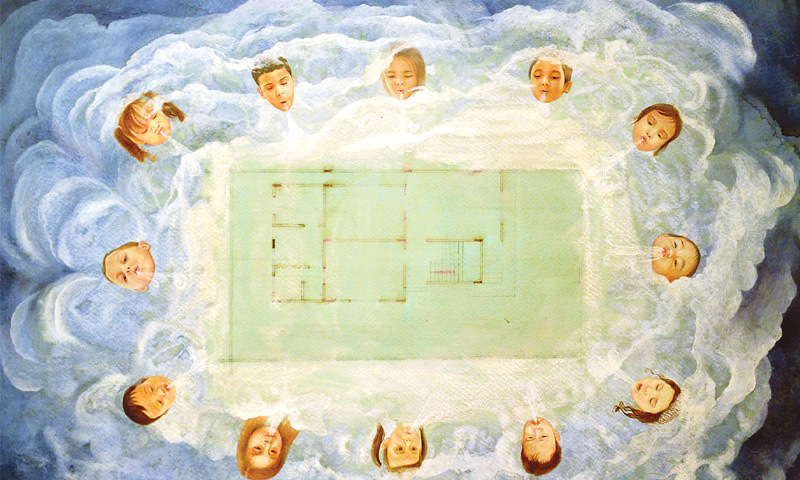
Exploring themes of loss and connection, Sikander’s reference to her childhood home painted with gouache on wasli was titled ‘Gulshan Wala Ghar’. Here she had sketched a map of the house — room by room and surrounding the house one discovers childhood portraits of siblings and cousins who, emerging from the clouds of a background sky, blow their breath upon the house. The artist also contributed a treasure of childhood, a book by Robert Louis Stevenson — A Child’s Book of Poetry. Placed inside a glass case, the book is open at a page where Sikander had painted a beautiful rose. The tone of Madiha’s work has the power to take the past and to hold it still for a while.
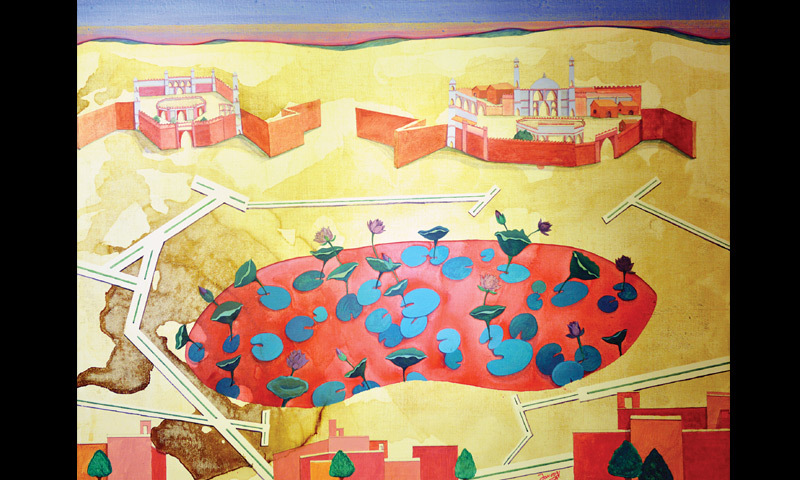 |
| Yume no machi I, Farooq Mustafa |
Viewing the brilliant watercolour paintings of Baqar was a visual delight. One of the acclaimed, early water colourists from the Karachi School of Art, he went on to take a masters in Urdu literature from Karachi University. His art is based on a love of art and poetry, the exploration of his media with hues and patterns playing important roles.
The mixed media artwork of Farooq Mustafa has a unique and personal approach combining aspects of his years with the National College of Arts, Lahore, and a postgraduate research degree in visual arts from the University of Tsukuba, Japan. Dividing his time between Lahore and Japan, the artist showed a brightly hued, garden aspect decorating a landscape of seemingly Mughal miniature architecture. An exciting fusion of Mustafa’s varied art experience.
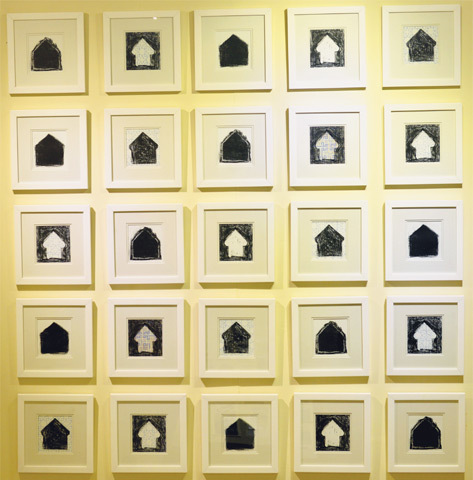 |
| Khula Dareecha, Dar Aaee Sab’a, Meher Afroz |
‘The blue door’ a mixed media print of Ikramullah, appeared to combine several aspects of the artist’s widely travelled world with a nostalgia that recalled memories of gardens enjoyed on perfect summer days. The diverse textures and patterns shown emerged from a wide range of techniques and media. The artist also contributed a densely worked etching with a romantic theme titled ‘A dream is born’.
Viewing the work of Hasan is invariably an exciting visual adventure. He is a young artist of considerable appreciative exposure with a talent matched only by his imagination. Here he combines his admiration for the wondrously graceful seraphs of the classic artist William-Adolph Bouguereau, with a tiny green sprig in the miniature tradition. Viewing his work, the words of Bridget Riley came to mind: “For me nature is not landscape, but the dynamism of visual forces …”
The unusual highlight of the exhibition was a stunning installation, by Afroz. Skillfully combining, five exquisite etchings and a series of paintings worked in acrylic, graphite and silver leaf, the wide range of techniques, media and textures bathed in light, created a joyous garden indeed. Well deserving of the artist’s recognition as the 2014 President’s Pride of Performance recipient.
Published in Dawn, Sunday Magazine, October 5th, 2014