24
24


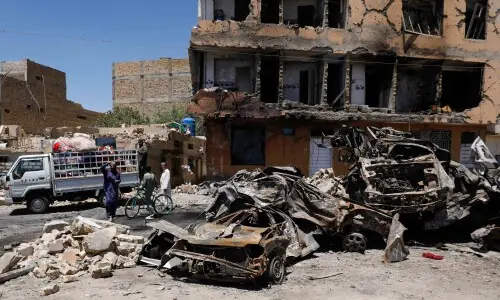
Karachi is the city of death for many; the poor die here, the hapless and the penniless, the diseased also perish and political activists are popped off regularly.
The bodies from these daily killings pile up at the city’s morgues; awaiting burial and if no one comes, they are wrapped in shrouds and buried by social workers. They are also forgotten.
In the midst of so much random killing; the killing for a cell phone, the killing for a parking spot, the killing for ransom and for enmity and for money, it is difficult to tell when a targeted killing has occurred.
Indeed there may be no better way to hide premeditated murder than to hide it within the ranks of random killing, of which Karachi, the city of death has a surfeit.
Editorial: More sectarian targets
The ruse has worked well, as lawyers, doctors, clerics, shopkeepers, students - all Shia, and all targeted by bullets intended for them - have fallen.
The city seems barely to have noticed.
According to a press conference held by the Majlis-e-Wahdatul Muslimeen in Karachi’s Soldier Bazaar Area, 160 Shia have been killed in the city this year, despite a military and police combined operation to crack down on the extremist groups that have made this their agenda.
They have included five lawyers, five doctors, five engineers, three professors and 21 traders.
The series of sectarian deaths come in spurts. This, most recent series began about a week ago, when on Saturday evening, Shia cleric Allama Ali Akbar Kumaili was shot dead on his way home. From the shower of bullets directed his way, two found their way to his chest and one to his abdomen. He died at the scene.
Then on Wednesday, Dr Maulana Masood Baig, also a cleric (whilst not Shia) was shot dead in North Nazimabad. He had been driving to pick his children up from school when he was met with a barrage of bullets. He too, died at the scene. A Ph.D scholar, his dissertation had been entitled “Islam’s Philosophy of Brotherhood and Tolerance”. In a Karachi deeply ensconced in hatred, it seems, the propagators of such learning are destined for death.
In the midst of these two more high profile killings, and before and after, others more ordinary met their deaths.
On the Friday before Allama Kumaili’s death, gunmen opened fire outside a shop in North Nazimabad and killed a shopkeeper. On the same day as Maulana Masood Baig’s death, Imran Ali who was sitting outside his television repair shop was also killed by unknown gunmen. According to a spokesperson from the Majlis-e-Wahdat ul Muslimeen he had been involved in organising mourning processions for the city’s Shia community.
The killings are not expected to stop.
There is neither enough outrage from those untouched among Karachi’s population, or any real political will, nor sufficient capacity among law enforcement to stop the war.
Also read: In Islamabad, more sectarian killings in past year than preceding decade
In the thin skinned layers of conflict that stretch over the city, isolating one set is not considered possible, police do not even attempt it, and Islamabad conveniently ignores it.
At the same time, sectarian killing, its perpetuation and primacy connects it to a larger global threat that is ransacking the Muslim world and filling its streets with dead bodies.
The recent ascendance of ISIS and their global, public and bloodthirsty rampage against the Shias in Iraq is undoubtedly whetting already seething sectarian tensions in Pakistan.
This particular strain of local killings in Karachi, lining up bodies in its morgues, connects then to a global blood lust, whose seeds are sown, are germinating and growing in Pakistan’s largest city, without anyone at all to stop them.
Correction: A previous version of the article incorrectly stated Ali Abbas Kumaili as riding in the car with his children. The error is regretted.