2
2


19 security personnel, civilians lay down their lives; 10 militants killed
• Attackers were ready for extended fight • CM upset over Nisar’s attitude
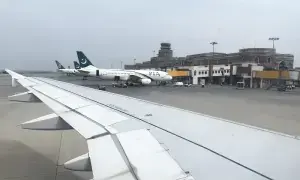
KARACHI: The militants, who kept security forces engaged for five hours in an attack on the Karachi airport late on Sunday night and resisted to the fullest of their potential till the wee hours of Monday, had a two-pronged strategy — to cut this city’s communications from the rest of the world for as long as possible and destroy the country’s aviation prowess, senior authorities and security officials said.
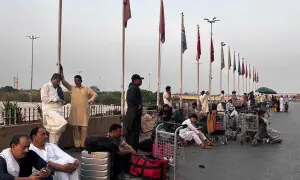
As the operation formally came to a close early on Monday morning, witnesses saw broken glasses, bonfires, spent cartridges and blood splattered across the cargo section and Isphahani Hangar — the area which saw the pitched battles.
The final count given by the authorities showed some 29 people dead, including 10 attackers who the Tehreek-i-Taliban Pakistan (TTP) owned as their comrades to take part in the assault that, it warned the authorities, was ‘just the beginning’.
The dead included 11 personnel of the Airport Security Force (ASF), one Rangers’ soldier, one policeman, three employees of the Pakistan International Airlines, two of the Civil Aviation Authority and one of a private airline. Some 26 others were injured.
Senior officials pointed to the bags full of dry fruits and food they found from the corpses of the attackers, which clearly showed their intentions to maintain the scene for much longer than they could during the fierce assault.
“They wanted to maintain the situation for a couple of days or so,” said a senior security official.
Interior Minister Chaudhry Nisar Ali Khan corroborated the statement, but did not hazard a guess about how long the attackers intended to prolong the standoff.
Talking to reporters at the airport after presiding over a meeting with security officials, he said: “The stocks of food and medicines show that the terrorists wanted to take hostage many people in a bid to prolong the situation as long as they could.”
The interior minister said the attackers had intentions of destroying our valuable assets, but failed because of our security forces’ brave reply.
A report about the attack submitted to the prime minister by the authorities authenticated the minister’s observation.
A spokesman for the prime minister’s secretariat said militants had “plans to destroy all aeroplanes which were parked near the Old Terminal and towards the Jinnah Terminal”.
“The terrorists had a plan to bring down our aviation industry,” said the spokesman unambiguously.
Sindh Chief Minister Qaim Ali Shah stayed at the airport till the end of the operation.
At a press conference in the afternoon, Mr Shah was not happy with Interior Minister Chaudhry Nisar for not talking to him over the matter.
“We had warned the federal government time and again that terrorists are coming to Karachi, but we remained unheard. Even since the attack began last night, the interior minister has not talked to me,” he added.
Major General Rizwan Akhtar, who heads the Pakistan Rangers, Sindh, told the media that the attackers appeared to be Uzbek.
“We killed seven and three blew themselves up.”
Inspector General of the Sindh Police, Iqbal Mehmood, also said the attackers had Central Asian features.
Chaudhry Nisar said since bodies of the seven militants were intact, their biometrics investigation had begun to determine their nationality. For the same purpose, fingerprints of three of them who blew themselves up had been documented. The origin of weapons recovered from the militants was also being investigated, he added.
A medico-legal officer at the Jinnah Postgraduate Medical Centre said all the bodies the hospital received were bullet-riddled save that of one officer who was killed in a bomb explosion.
Shujaat Azeem, the Prime Minister’s special assistant on aviation, said the attack affected 20 flights; one flight was diverted to Nawabshah, while three international flights landed in Lahore. He claimed that no plane was extensively damaged despite the violent exchange of gunfire and the torrent of grenades.
ISPR spokesman Asim Bajwa said the militants “were confined to two areas and eliminated”. He said weapons, live ammunition, including RPGs, were recovered from them.
The spokesman for the TTP, Shahidullah Shahid, in a statement to the media said the attack was aimed at avenging the killing of their leader Hakeemullah Mehsud, who died in a US drone strike in November last year.
Officials said the attackers were said to have forged identity cards so that they could pass themselves off as personnel of ASF.
Published in Dawn, June 10th, 2014