


We have all played board games and carrom is one of the most popular of them played in any household or gathering. The game, played with 19 coins or carrom men including the red queen and one striker to hit the coins with and push them in any of the four pockets is played on boards of all sizes. They all just have to be square in shape with four holes, or pockets as they call them, at each corner.
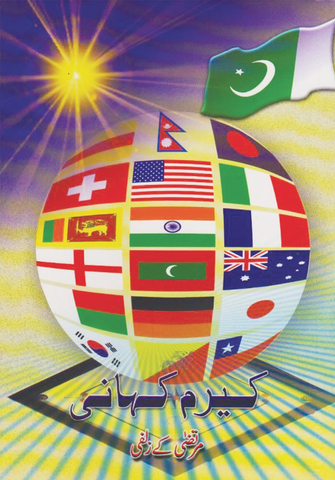 |
| Carrom Kahani by Murtaza K. Zulfee |
“There used to be a big carrom board in our school canteen and we would fight for our turn to play the game there. The canteen offered terrible food but it made good sales as the kids attracted to the game would also buy something or the other,” says Adil Akram, an amateur player.
“We would all chip in to buy boric powder for the board. Some kids also brought talcum powder to keep it slippery for the coins to move about with ease. I even bunked classes to play carrom. I was a great player and knew I could become world champion had there been any such championship,” the middle-aged gentleman laughs at the memory. “And now I hear there actually are carrom championships!”
What many may not know is that there is a Pakistan Carrom Federation (PCF) as well, which is doing a lot of work for the promotion of the game here. “Affiliated with the International Carrom Federation, the Pakistan chapter was established in 2004. The following year, Pakistan participated in the Saarc and the inaugural Asian Carrom Championship in Male, Maldives. Both events of three days duration each were held with a day’s gap in between,” says Murtaza Khan Zulfee, secretary general of the Pakistan Carrom Federation and one of the five vice presidents of the International Carrom Federation.
“Although we do get sponsors occasionally, the trips in the beginning and most of the time even now were all self-financed by the Pakistan Carrom Federation. Still the lack of funds hasn’t discouraged us from participating internationally,” he adds.
“Besides the Carrom World Cup, the Asian Carrom Championship and the Saarc Carrom Championship, there is the European Carrom Championship, the Swiss League, French Open and Malaysian Open, too. Countries such as India, Sri Lanka, Bangladesh, Maldives, Bhutan, Nepal, Iran, Afghanistan, UK, France, Germany, Holland, Switzerland, Czech Republic, Australia, US, Canada, Japan and North Korea are regular in many of these competitions. All in all there are 40 countries participating in the events and since 2005, Pakistan is one of them,” he points out.
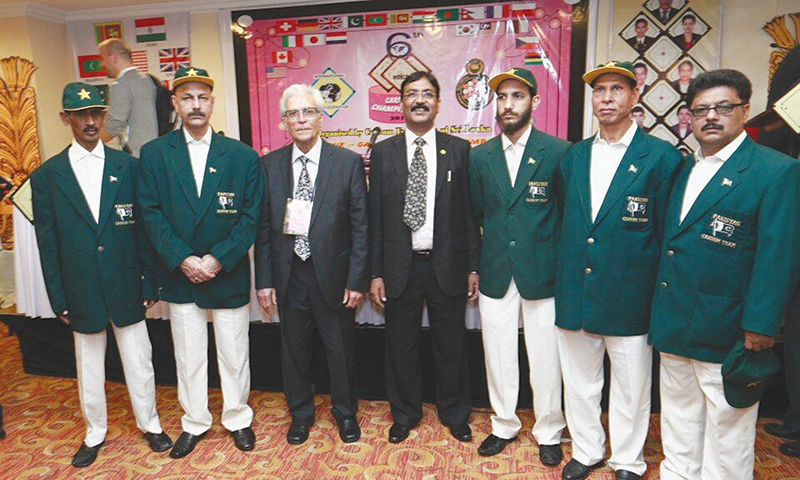 |
| (L-R) Pakistan contingent of captain Murtaza K. Zulfee, Ramzan Ali, Shafique Ahmed, Saad Bin Murtaza and M. Suleman with president International Carrom Federation Arif Naqvi and General Secretary S.K. Sharma in the middle |
The competitions include men’s singles, men’s doubles, team events, mixed doubles (one male player, one female player) and women’s events in the same categories.
On the topic of international competitions, Zulfee says that a country’s world ranking depends on the number of competitions it participates in. “The exposure, too, makes you better. Like India, right now is World No 1 and Sri Lanka World No 2. The two countries have been playing bilateral series since 1958. Pakistan is the new kid on the block, really, but we have always been noticed one way or the other in all our international appearances,” he says with pride.
The Pakistan carrom team beat the visiting Czech Republic team by 2-0 in the three test series played here in 2013 and before that in 2009, the green team beat Malaysia in Malaysia and the Nepal team in India in 2007.
“Initially, our team was not so great. To come up in the ranks we needed to know the international laws of the game and we weren’t even getting new good players as no one knew the rules. That posed a slight challenge as the book of rules and regulations was difficult to follow because it wasn’t written in Urdu for the general public to understand after all,” Zulfee points out.
“Therefore I translated the laws and published them in the form of books,” he says. “My book Carrom Kahani was really appreciated by the International Carrom Federation president, Mr Arif Naqvi. This was around the time of the Carrom World Cup in 2006 and Mr Naqvi, who is originally Indian but lives in Germany for the past 20 years now, liked it so much that he put it on exhibition there,” Zulfee smiles.
“In fact I always try to get Pakistan a mention one way or the other in all international carrom events. In 2008, during the 50th anniversary of the Carrom Federation of Sri Lanka, we got a special mention, a special award and a standing ovation after Pakistan was able to show up in the event despite me, the team captain, being injured. Twelve days before going I was in an accident in which I broke some seven bones in my nose. But I needed to be in Sri Lanka as, besides being the team captain, I also had to attend the annual meeting of international members as the secretary general of our federation. That year, we made news by my just being there with a bandaged nose,” he laughs.
This year, Pakistan will participate in the Carrom World Cup to be held in Maldives in September. This would be followed by the Saarc Carrom Championship but it is still not clear where the Saarc event will take place. Zulfee says, “India is keen on holding the championship but the Asian Carrom Confederation is concerned about visa issues. There are already few countries in Saarc with Iran and Afghanistan, too, not there and the president of the Asian Carrom Confederation Mr Langley Mathiasz is concerned that Pakistan may also have to forgo the event due to visa restrictions from India. They will award India the holding of event rights only if they can guarantee that the Pakistan team will be issued the visas in time.
“The other option for hosts is Pakistan itself but Mr Langley thinks that if security here is an issue with the other participating countries then Pakistan can always host the championship in Sri Lanka. They will provide us the space though funding and sponsors will be arranged by us. Still, all this is in the initial stages of discussion right now,” he says.
Carrom vs Dubbo
 |
| enter image description here |
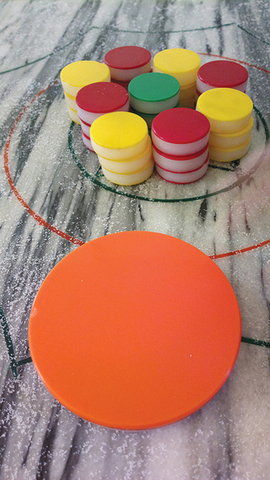
It might just be a difference of standing up and sitting down, but the deviation creates an altogether different game: carrom is played sitting down while Dubbo can be played standing up.
Though both games are played on square-shaped boards, the Dubbo board can be anything from 6x6ft to 12x12ft in size. The carrom board, however, is 73.50cm and at the most 74cm on all sides with the thickness of the board being 8mm.
In carrom, the stand of the board should be between 63cm to 70cm in height, while the stools the players sit on should be 40cm to 50cm in height, and no more.
Carrom rules also require an overhead lamp with a 60 to 100watts bulb to keep the board warm for the pieces or carrom men to move about smoothly with the help of boric powder. Dubbo, on the other hand, can be played in any kind of light. Dubbo also allows players to use chemicals besides boric powder, both for aiding the pieces to move and to increases the game's speed.
Also the carrom men in the game, if abiding by international rules, are made of wood and 3.02 to 3.18cm in diameter with the thickness being not more than 0.70 to 0.90cm. The striker, meanwhile, can be made of plastic or ivory and is 4.13cm maximum in diameter. The striker in Dubbo can be as big as 4 inches in diameter.
International carrom is played only with the index finger, middle finger or thumb, which one can use at one time or during one's turn but in Dubbo one can play with all fingers with no regulation on the number of fingers used in a turn. That, by the way, is considered foul in international carrom, with the bringing out of one of your potted carrom men as penalty. — S.H.
No long nails for Asma
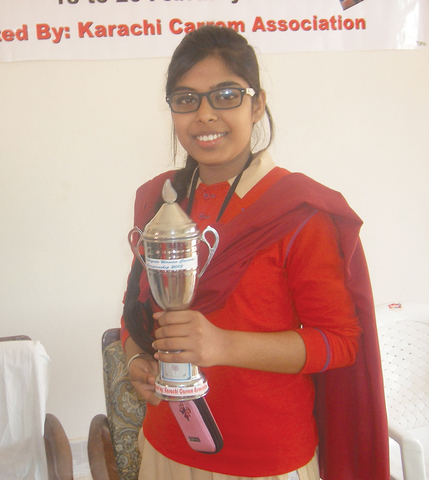 |
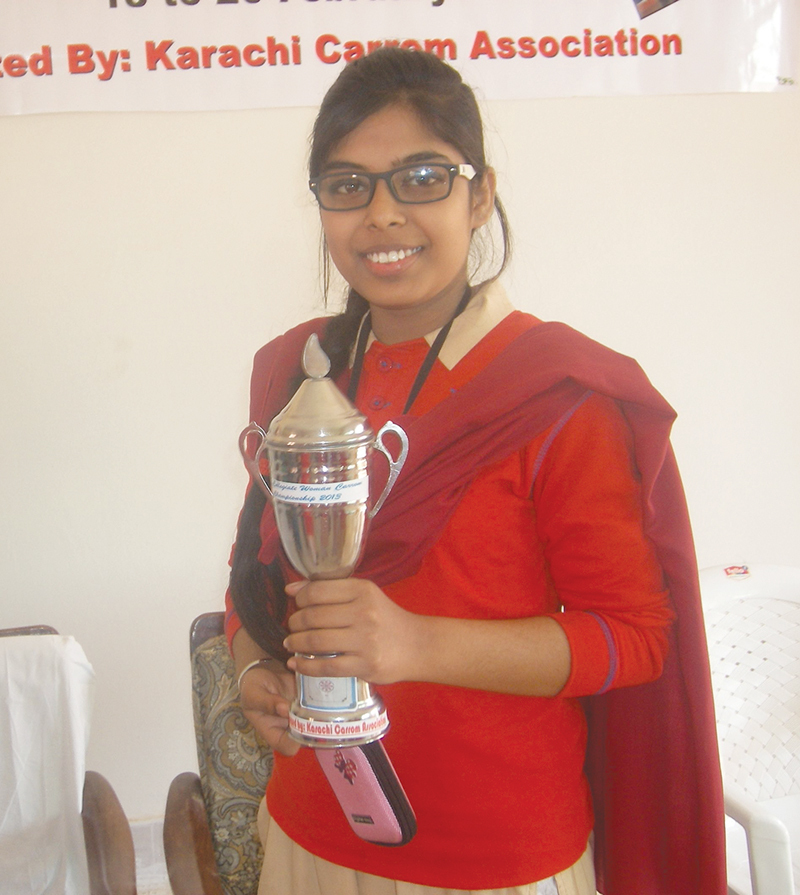
| Asma Nisar |
“Your finger nails must be clipped in order to prove your finger fitness for a game of carrom,” says Asma Nisar, member of Pakistan women’s carrom team.
A pre-medical student, Asma says that she used to enjoy the casual carrom games they played at home but “Playing by the rules is something different. Not following the rules and regulations of the game means disqualification,” she says.
“Like at home, the striker would be much bigger than the coins, pieces or carrom men, as they call them. But according to international rules the striker must be only slightly bigger than the carrom men,” she points out.
About how she became a professional player of the game, Asma says, “Our college, the Government College for Women Shahrah-i-Liaquat, received an invitation to send a team to play in a college championship organised by the Pakistan Carrom Federation. I got selected for the college team taking part in the event and one thing led to another.”
When asked if she has also taken part in international championships, Asma says that she would certainly like to but the women’s carrom team is still in its initial stage right now. “We haven’t as yet played abroad,” she explains. — S.H.
Published in Dawn, Sunday Magazine, May 18th, 2014