37
37


ISLAMABAD: In a bid to clear outstanding dues of billions of rupees, the capital’s electricity company disconnected power supply to most major government departments on Tuesday to demonstrate its commitment to cracking down on power thieves and defaulters.
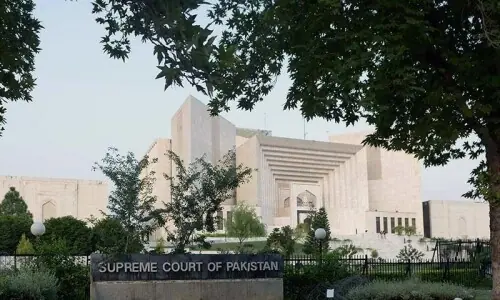
The Islamabad Electric Supply Company (Iesco) cut power to the Prime Minister’s Secretariat, President House, Supreme Court and Pakistan Secretariat, including the offices of the Ministry of Water and Power.
But the blackout was short lived. Power was restored to the Supreme Court within half an hour of the disconnection.
Basit Zaman, an Iesco spokesperson, told Dawn that power was restored upon receipt of payment of outstanding bills from the Pakistan Works Department (PWD).
The country’s leadership remained largely unaffected by the power cuts. Prime Minister Nawaz Sharif was already en route to the United Kingdom when his offices were cut off from the national grid. The president’s residence is equipped with standby generators that are switched on if the power supply is suspended.
The PWD is responsible for maintenance and utilities for the PM Secretariat and the offices of the chief justice and cabinet ministers. The Capital Development Authority has jurisdiction over President’s House, parliament and Pakistan Secretariat, the seat of the bureaucracy.
Zaman said his company kept getting calls from different government departments, promising to clear their dues as soon as possible and asking for power to be restored. “However, we had instructions not to restore power until we received cheques against the outstanding bills,” he said.
Govt commitment
Speaking to journalists ahead of the power cuts, Minister of State for Water and Power Abid Sher Ali said the government would not discriminate against anyone and was committed to action against electricity thieves and defaulters. He said the prime minister had been quite firm with the power sector team on Monday and reprimanded them for being lenient in recovering outstanding dues.
He said the Sindh government had publicly disowned about 5,000 public sector consumers who were either illegally tapping power lines or had not paid their bills.
Sher Ali said the total outstanding dues to power companies stood at Rs475 billion, with another Rs33bn added to the total in the current fiscal year.
According to the minister, Sindh owed power companies Rs56bn, Punjab Rs3.4bn and the Khyber Pakhtunkhwa and Balochistan governments owed Rs2.5bn each. In addition, nearly Rs70bn was yet to be recovered from tubewell-owners in Balochistan.
In parts of KP and Sindh, nearly 90 per cent of power connections were illegal and the government had identified areas with a high density of defaulters for 18-20 hours of loadshedding. Areas with the least outstanding dues should expect only up to 6-8 hours of loadshedding at the height of the power crisis, he said.