Protecting consumer rights
THE proof of the plan will be its implementation. Taken at face value, the Sindh Consumers’ Protection Ordinance promulgated by the governor on Friday is a step in the right direction, a law that has the potential to help redress the mounting grievances of citizens across the province. The positive role played by non-governmental organisations which have lobbied hard in recent years to make consumers’ rights an issue must be appreciated. As things stand in Sindh, people are held hostage to exploitative, negligent and whimsical business practices and have little recourse to legal remedies. Most suffer in silence, routinely paying hefty prices for poor-quality products and accepting after-sales guarantees of quality that belies the promises made at the time of purchase. With the creation of a Consumer Rights Protection Council and consumer tribunals, access to justice could be somewhat improved. The introduction of an element of accountability may, ultimately, lead to an improvement in standards.
For things to proceed according to plan, it is important that the ordinance is not allowed to lapse like the one promulgated by the Sindh governor in August 2004. In this connection, the provincial assembly must set aside partisan differences, debate the issue honestly and facilitate the enactment of the much-needed legislation that should benefit citizens across the board. In the law’s implementation and workings, the omissions and mistakes made elsewhere in the country must be avoided. Consumer protection laws — the Balochistan Consumer Protection Act 2003, the NWFP Consumer Protection (Amendment) Act 2005 and the Punjab Consumer Protection Act 2005 — already exist in all four provinces. In the federal capital, an act safeguarding the rights of consumers has been on the statute book since 1995. The problem, however, lies in the framing and implementation of rules and regulations that would make these laws functional. Legislation by itself serves little purpose when protection councils are yet to be activated and tribunals formed or fully staffed. Here, parallels can be drawn with the tribunals that were to be set up under the Pakistan Environmental Protection Act 1997 and which were to have sole jurisdiction over environment-related cases. A decade later, these tribunals are still not fully functional. Across the country, consumer protection legislation is similarly constrained. Like PEPA and its area of interest, Friday’s Sindh ordinance states that the tribunals will have sole jurisdiction over cases relating to consumer rights. Given the backlog of all kinds of cases pending before the lower judiciary and the high court, a one-window operation for hearing consumers’ grievances is an admirable idea. It must not be allowed to lose its efficacy in practice.
While the ordinance stipulates that a product’s maximum retail price must be clearly marked, it remains to be seen how the authorities will ensure that the rate is adhered to by the seller. This will be particularly problematic in the case of essential food items that are sold in loose rather than packaged form. Official rates for many such items as well as meat and poultry already exist but the law continues to be flouted at will. While it is conceivable that consumers may go to court over the supply of defective goods or outright fraud, overcharging is a different story altogether. Basically, it is therefore a question of developing a regulatory mechanism to watch over the prices and quality of goods and products and ensuring that no profiteering or malpractices are allowed to upset its working.
Winning the war on polio
THE tragic death of a doctor on Friday in a bomb explosion as he was on his way to the Bajaur Agency to counter claims that the polio vaccination was not an “infidel vaccination” is a shocking incident that should serve as a wake-up call for the authorities. Health officials have been struggling in the NWFP to counter propaganda by the clerics who use illegal FM stations to spread lies — like polio vaccine renders one sterile — but Friday’s incident shows how far extremists can go to “protect” their absurd beliefs and convictions. It is this obscurantist mindset that has deterred officials from eradicating polio in the province. Pakistan is one of four countries in the world where the disease is endemic. Last year saw 39 cases of polio reported from the NWFP, up by 11 recorded in 2005. According to the Guardian, 24,000 parents in the province refused to take the vaccine on religious grounds despite health officials showing fatwas signed by Qazi Hussain Ahmed and Maulana Fazlur Rahman endorsing the vaccine. This shows the kind of challenges the authorities are faced with in tribal areas where no amount of reason or logic can change opinion. That it has reached such dangerous proportions where a doctor can be so brutally killed for doing his job is frightening.
Part of the problem lies in the government’s ambivalent attitude towards the administration of the tribal areas and their integration into the national mainstream. Local Taliban have established their own form of governance. They have passed decrees like disallowing girls to go to school, punishing men for shaving their beards and on a more extreme levels, carrying out public executions of those they consider infidels or spies. All the while the government has turned a blind eye to this blatant disregard of the state laws and now finds itself in a bind. It can continue to turn a blind eye to these aberrations and excesses only at a great peril to peace and sanity or take the bull by the horn and confront these fanatic elements. One hopes it chooses the latter, especially since children’s lives and future are at risk unless firm steps are taken to rein in the bigots.
Time to review blasphemy law
CHAIRMAN of the All Pakistan Minorities Alliance is right in calling the blasphemy law “a naked sword hanging on the heads of non-Muslims”. Since it was promulgated in 1986, it has been used against Muslims, too. Last month, a 40-year-old Christian woman in Punjab was charged with blasphemy but her family claim that the charges are baseless, an act of vengeance by the accusers who are alleged to owe the victim some money for a job she did for them. The police have filed an FIR and the woman is under arrest but her family has gone into hiding, ostensibly in fear for their lives. This is nothing new. In 2005, a man was lynched by a mob in Nowshera on charges of blasphemy; he died well before a case could be registered, let alone investigated. There are numerous instances to show just how draconian the law is. It speaks volumes for the rampant fanaticism in our society when, in 2000, President Musharraf backtracked on making a promised procedural change in the blasphemy law. The amendment, when it finally came, calls for a case to be registered only with a district police officer. Despite this, charges of blasphemy are routinely made against minorities without any evidence. Public pressure must not sway the police into taking unauthorised actions.
This is a deplorable situation made worse by statements of state information minister who told minorities that there would be good news for them on Christmas. It has been over six weeks since then but there is no indication yet of any review of the unjust law. President Musharraf is in a position to repeal the blasphemy law. If he cannot, the government should at least make necessary amendments and remove all discriminatory and sweeping provisions of the law, as was done with the Hudood Ordinances.
Russia’s future course still uncertain
THINK of the new Russia as a highway: People used to drive on the left side of the road; now, officially, they are supposed to drive on the right, but the change has been uncomfortable (especially for the authorities). So the country straddles the middle -- which is understandable, but also dangerous.
That's a paradox of Vladimir Putin's Russia that I have encountered in nearly every conversation here this week. Russian officials insist they don't want to go back to communism, and why would they? Moscow glitters like a Christmas package, with more neon per square mile than any city I know. But behind Moscow's dazzling lights, the remnants of the old police state remain -- and many order-loving Russians seem glad of it.
The energy boom has helped Russians forget about the nagging problem of where they're heading politically. "There is a lack of clarity about our final destination," says one prominent Russian businessman. "Are we building China? The United States? Sweden? What is it? The situation now cannot continue. We are sitting between two chairs."
Russia is wary of full, American-style democracy, argues Konstantin Kosachyov, the chairman of the foreign affairs committee in the lower house of the Russian parliament. "To my mind, democracy is not a goal in itself, it is an instrument. It is the best instrument, but it should be used very cautiously. It's like the jackhammers that miners use. It increases productivity, but if you give this instrument to a child, it will destroy the child."
Kosachyov explains that Russians have bad memories of the wide-open democracy of the 1990s, and most Russians I spoke with confirmed that view. It was a crazy time, when people's savings were wiped out, gangsters battled in the streets, and the country was governed by what Russians saw as an alcoholic president and his thieving cronies. "Democracy came to us without us being ready to use it in a constructive way, and it destroyed us," says Kosachyov. "That's why Putin acts in a cautious way. He does not want to repeat the experience of the 1990s."
The Russian political puzzle now centres on the question of who will succeed Putin when his second term ends in 2008. The Russian president is very popular, and he would almost certainly be re-elected if he ran for a third term, but he insists he will abide by the new constitution's two-term limit. So who is the crown prince? Moscow was buzzing this week about whether Putin favoured First Deputy Prime Minister Dmitry Medvedev or Deputy Prime Minister and Defence Minister Sergei Ivanov. Medvedev appeared to be the front-runner -- until Putin announced late Thursday that he was promoting Ivanov to equal status as first deputy prime minister, with new economic responsibilities.
The succession circus, in truth, reinforces the awkwardness of Russia's not-quite-democratic system. Analysts count the minutes allocated to Medvedev and Ivanov on state-controlled television. It's like Kremlin-watching in the old days, when observers tried to handicap power struggles by noting where officials stood on the podium during parades in Red Square. The reality is that power resides with Putin and his small inner circle of presidential assistants.
I had a chance to peek into Putin's inner circle this week when I met with his chief economic adviser, Igor Shuvalov. His office is a Soviet-era palace that once housed the head of the Communist Party, but Shuvalov is very much of the new era: He's just 40, speaks English fluently and is as sharply dressed as any London investment banker.
A key to Russia's future, argues Shuvalov, is Putin's decision to seek membership in the World Trade Organisation. He says some Kremlin advisers opposed WTO accession, but Putin decided it was the best way to guarantee Russia's continued economic modernisation. When I ask about corruption in the new Russia, Shuvalov doesn't deny the problem. "We need to be persistent and patient," he says. "If we are persistent, then slowly it will change."
High oil prices have encouraged a consumer boom, but they are a mixed blessing. The giant state-controlled gas and oil companies, Gazprom and Rosneft, overwhelm the rest of the economy and dominate Russian politics -- with several of Putin's closest advisers holding energy directorships. Energy politics and democratic politics don't mix easily.
"Don't give up on us. Treat us as a normal democratic country," says Mikhail Kasyanov, who was prime minister during Putin's first three years but is now a critic of the government. Certainly, Western pressure can help preserve democracy here. But in the end, it's the Russians who will have to decide which side of the road they're driving on.—Dawn/Washington Post Service
Bush regains his footing
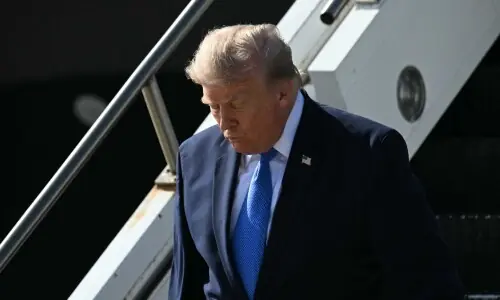
IT may seem perverse to suggest that, at the very moment the House of Representatives is repudiating his policy in Iraq, President Bush is poised for a political comeback. But don't be astonished if that is the case.
Like President Bill Clinton after the Democrats lost control of Congress in 1994, Bush has gone through a period of wrenching adjustment to his reduced status. But just as Clinton did in the winter of 1995, Bush now shows signs of renewed energy and is regaining the initiative on several fronts. More important, he is demonstrating political smarts that even his critics have to acknowledge.
His reaction to the planned House vote opposing the increase he ordered in US troops deployed to Iraq illustrates the point. When Bush faced reporters on Wednesday morning, he knew that virtually all those in the Democratic majority would be joined by a significant minority of Republicans in voting today to decry the "surge" strategy.
He did three things to diminish the impact of that impending defeat. First, he argued that the House was at odds with the Senate, which had within the past month unanimously confirmed Gen. David H. Petraeus as the new commander in Iraq -- the man Bush said was the author of the surge strategy and the man who could make it work. Bush has made Petraeus his blocking back in this debate -- replacing Vice-President Cheney, whose credibility is much lower.
Second, he minimised the stakes in the House debate by endorsing the good motives of his critics, rejecting the notion that their actions would damage U.S. troops' morale or embolden the enemy -- all by way of saying that the House vote was no big deal.
And third, by contrasting today's vote on a nonbinding resolution with the pending vote on funding the war in Iraq, he shifted the battleground to a fight he is likely to win -- and put the Democrats on the defensive. Much of their own core constituency wants them to go beyond nonbinding resolutions and use the power of the purse to force Bush to reduce the American commitment in Iraq.
But congressional Democrats are leery of seeming to withhold resources from the 150,000 troops who will be fighting in that country once the surge is complete; that is why they blocked Republicans from offering resolutions of their own in the House or Senate pledging to keep financing the war. Democrats did not want an up-or-down vote on that question, but Bush has placed it squarely before them.
In other respects, too, Bush has been impressive in recent days.
He has been far more accessible -- and responsive -- to the media and public, holding any number of one-on-one interviews, both on and off the record, leading up to Wednesday's televised news conference. And he has been more candid in his responses than in the past.
While forcefully making his points, he has depersonalised the differences with his critics and opponents. He has not only vouched for the good intentions of congressional Democrats, he has visited them on their home ground, given them opportunities to question him face to face, and repeatedly outlined areas -- aside from Iraq -- where he says they could work together on legislation: immigration, energy, education, health care, the budget.
With the public eager for some bipartisan progress on all these fronts, Bush is signalling that he, at least, is ready to try.
At his news conference, he also stepped away from personal confrontation with the rulers in Iran, making it clear that he does not necessarily hold its political leadership responsible for shipping arms to the insurgent Shiites fighting in Iraq. He insisted the U.S. military would do whatever is necessary to halt the shipments and protect the troops, but he said repeatedly that these defensive measures are not a prelude to aggressive action against Iran.
All this is to the good. But Bush, unlike Clinton, is in the middle of a bloody civil war, which can be ended only by the Iraqis themselves. All he claims to be able to do is to provide some breathing space for them by attempting to reduce the violence. As he said, "What really matters is what happens on the ground. I can talk all day long, but what really matters to the American people is to see progress."
And whether the American people will see it, no one knows. —Dawn/Washington Post Service
| © DAWN Group of Newspapers, 2007 |