US & South Asia
WITH President George Bush’s March visit to Pakistan and India confirmed, one hopes the US will make a determined effort to stimulate international interest in a resolution of the Kashmir conflict. The bilateral normalization process that has been going on satisfactorily is in danger of losing momentum unless there is a perceptible movement towards a solution of what indeed is the core issue in the Indo-Pakistan relationship. In fact, there are already signs that Islamabad has begun to feel frustrated over the lack of a meaningful Indian response to the many constructive proposals Pakistan has made for resolving the issue. The American president’s visit has aroused hopes because it will take place under completely different circumstances compared to President Bill Clinton’s visit to South Asia in March 2000. His visit came five months after the military coup toppling an elected government and putting the prime minister in prison. Above all, the world had not heard of a war on terror. Even though America was still hunting for Bin Laden, and Mr Clinton had signed an order for eliminating him, 9/11 was still 18 months away. Pakistan was then a totally isolated country languishing under a military ruler, with its economy virtually bankrupt, its foreign exchange reserves plunging to less than half a billion. No wonder, Mr Clinton all but bypassed Pakistan on his South Asian tour, visiting India for five days, Bangladesh for a day and Pakistan only for five hours.
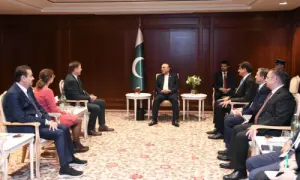
The Bush visit will be under entirely different circumstances. The terrorist attacks on New York and Washington and America’s subsequent war on terror, started with an attack on the Taliban-led Afghanistan, have made Pakistan a front-line ally. Pakistan now enjoys the status of a major non-Nato ally and the US has pledged three billion dollars in economic and military aid to Islamabad. During his meeting with Prime Minister Shaukat Aziz on Tuesday at the White House, President Bush said that US-Pakistan friendship was “vital” and the two countries had a strategic relationship. While this is a reiteration of an existing reality, one also has to take into account the new partnership the US is developing with India. The joint exercises which the two countries’ armed forces have held and the agreement — subject to congressional approval — on the transfer of American nuclear technology to India point to a common Indo-American perception of China. That China’s emergence as an economic superpower could also be a source of peace and stability in the region and the world seems not to have been given due attention in Washington and New Delhi, for both appear to consider China a threat. In formulating and evolving its foreign policy, Pakistan has to be mindful of this reality.
At present, Pakistan and America face a common threat from terrorism. The war on terror is Pakistan’s own war, given what terrorists of all sorts have done to our society. Al Qaeda terrorists are present in Waziristan, and they regard attacks on Pakistani military and civilian targets as their religious duty. While making every military and political attempt to eliminate this threat, Pakistan must guard its sovereignty jealously. Fighting terrorists, foreign or home-grown, is Pakistan’s responsibility. Foreign cooperation yes, but violation of our territory or air space must not be allowed. Incidents like the one in Bajaur on Jan 13 and similar other raids strain relations with the US and need a special mechanism among Pakistan, Afghan and US security forces for combating terrorism in border areas.
Promoting science
THE appeal to the media by physicist Dr Pervez Hoodbhoy to popularize science is timely. Speaking at a conference in Islamabad, he pointed out that the people in Pakistan were generally very superstitious because they did not have a clear understanding of scientific phenomena. It may be added here that a better knowledge and awareness of science also make a person more rational, something we badly need in our society. Dr Hoodbhoy is right when he says that the media has a role to play in promoting scientific thinking. This holds especially true of the electronic media, which has not always been serving the cause of science. While newspapers, television and radio could explain various events and happenings in a scientific manner, it is also important that science per se is promoted at every level.
There are two strategies to be adopted to strengthen the foundations of science in Pakistan. First, every primary school student should be given a grounding in physics, chemistry and biology before he reaches the secondary level. If taught in an interesting manner with reference to commonly observed or experienced phenomena, science subjects can be extremely interesting while arousing curiosity in the minds of young learners. Moreover, the study of science teaches people to reason and think logically — qualities we could benefit from. That is why every student should be given a grounding in science in the early stages of education, even if he does not go on to study the subject at the higher level. The second strategy would be to make science popular for the common man. This can be done by setting up science museums where interesting and educative exhibits can be put up for public viewing. Mercifully, some museums have been opened in Karachi — Mohatta Palace Museum, the Maritime Museum and the Air Force Museum — and they are known to attract big crowds, which testifies to the public interest in such exhibitions. Regrettably, science has been underplayed in this exercise. Not a single centre for science exhibits has been set up and those that existed have been closed down — for instance, the planetarium, aquarium and so on in Karachi. If attention is given to this aspect of social and cultural life, much can be achieved.
Poor maternal health
DESPITE the government’s claims that the safe motherhood initiative — a global effort to improve maternal health and reduce maternal deaths — is an integral part of its health policy, there are few indications that pregnant women are benefiting significantly from its implementation. Along with other South Asian nations, Pakistan is classified among those countries where the number of pregnancy- and delivery-related deaths is high: around 500 women die for every 100,000 live births. In fact, in the more remote areas of the country, where access to proper medical facilities is unavailable, the figure is even higher than the national average. The limited access to medical facilities and reliance on the services of untrained midwives (who are ill-equipped to handle emergencies and who practise questionable modes of delivery) are mainly responsible for this situation. However, the high number of maternal deaths is also linked to the overall marginalization of women and their subservient role in a patriarchal society where they are denied control over their own lives.
For any maternal health programme to succeed in Pakistan, it is important to allow women a role in decision-making — such as the number of children they want to have — and access to family planning programmes and contraception services. Moreover, it is also necessary to educate families on giving equal treatment to all children so that girls are given just as adequate a diet as their brothers. A large number of pregnant women are anaemic which can adversely affect the health of the unborn child. This owes primarily to the dietary neglect they have been subjected to during their childhood. Besides concentrating on the health infrastructure, these are the larger issues that the government should be looking at in its goal to improve maternal health.
Somalis take comfort in the past
 HOW many guns make a warlord? Twenty-five technicals, so about 250 armed men with Russian AK-47s and Belgian pistols make you a lord, and you can go up the hierarchy to viscount or marquis or earl or proper baron if you include a couple of anti-aircraft guns and artillery pieces.
But there are no kings in Somalia. A top of the line AK-47 costs between 400 and 500 dollars; many of the weapons are below the line. I picked up one, while we were lunching off chunks of dry roast camel in a dhaba, lent to me by a young man in a shy smile and a lungi. It was heavy, a little less than 10 kilograms. I gave it back after making appropriate noises, carefully avoiding even passing contact with the trigger. At a rough glance, my benefactor had about a million and a half Somali shillings worth of ammunition in his belts: a dollar fetches three bullets.
Three great symbols of modern civilization are available in Somalia: the AK-47, Coca Cola and the mobile phone. Three mobile phone companies, Nationlink, TelecomSomalia and Hormut, ensure proper competition. An international call costs only 30 American cents. They also double up as money-transfer operations and one of them (defunct after landing up in the suspect category) sent Washington into paroxysms after 9/11 with a word that previously did not exist in a western dictionary but was perfectly understood in much of Asia, hawala. Americans were in Somalia a decade before 9/11 but never picked up this word. Maybe, that is why they never stayed. You have to understand Somalia to stay in Somalia.
War is a great boon to technology. A cruise liner defended itself against heavily armed Somali pirate boats last year with the LRAD, Long Range Acoustic Device. It emits a sound from a long range that the human ear cannot tolerate and has proved a brilliant answer to pirate guns. So as long as pirates are human they can be driven. I am told that the device is being used in Iraq to disperse unwanted crowds. For more details on LRAD check Google.
Their present having been stolen, Somalis take comfort in the past. Ancient Egyptians imported cinnamon, frankincense, tortoise shells and “slaves of a superior sort” from Somalia and conceded that Somali civilization matched their own. If the Magi were kings from Africa, then it is at least plausible that the one carrying frankincense for the infant Jesus came from Somalia. Ibn Batuta, the 13th century Tunisian traveller who did not waste time on inconsequential places, found Maqdashaw a “town of enormous size” where “a single person ... eats as much as the whole company of us would eat ... and they are corpulent in the extreme”. The only parallel I can think of is a Kashmiri enjoying his wazwan in front of us mere mortals, but of course the Kashmiri is not corpulent. The waters of Chashm e Shahi keep him slim.
How many clans make a nation? The Arabs found 39 when Mogadishu became one of their principal trading colonies in the 10th century. This was the breakdown: Mukri (12), Djidati (12), Akati (6), Ismaili (6) and Afifi (3). The Mukri, who also had a dynastic ulema, were in the ascendant when Ibn Batuta visited the port. The nation state is a recent idea. Nomadic Somalis lived across a far wider region than their present borders, including Ethiopia and Kenya. European colonization came only towards the end of the 19th century.
The British came to the north because, as they put it, they wanted guaranteed meat supplies for their garrison in Aden. The Italians wanted the fruit groves of the south. The French were tempted, typically, by temptation and occupied Djibouti.
The clans did not wait to be conquered. They took the easy way out and sold their rights, most often for less than a hundred dollars. The treaties were remarkable for their three-point simplicity. Point 1: All rights are yours. Point 2: I get 70 or 100 dollars. Point 3: You have the last word in all disputes. Neighbours could hardly resist exploiting such weakness.
In 1891 Emperor Menelik II, founder of modern Ethiopia, wrote to European powers: “Ethiopia has been for 14 centuries a Christian island in a sea of pagans. If powers at a distance come forward to partition Africa between them, I do not intend to remain an indifferent spectator.” He did not.
He sent word to amir Abdullahi, ruler of the historic city of Harar and pivotal to Muslim east Africa, to accept his suzerainty. The Amir, heir to a dynasty of 72 generations, sent presents and a helpful suggestion, that Menelik should accept Islam. Menelik said he would conquer Harar and turn the principal mosque into a church. The Medihane Alam Church, in front of the Galma Amir Abdullahi, or the old palace, is evidence that he did.
The mosque was converted but not the people. While Ethiopia proudly and correctly claimed to have become Christian at the time of Constantinople, lands like Kenya changed only during the wave of missionary activity that accompanies colonization in the 19th century. As Jomo Kenyatta, first president of independent Kenya, famously said, “When the missionaries came to Africa, they had the Bible in their hands and we had the lands... We closed our eyes to pray and when we opened them, we had the Bible in our hands and they had the lands...”
Harar has the feel of a city that has travelled a long way through history but now has nowhere left to go. UNESCO has recognized Harar, about 450 kilometres east of Addis Ababa through land rich in the local addiction, chat (or khat), a mildly intoxicating but stimulating leaf that is chewed slowly, as a heritage city. There is some excitement among the educated elite that Unesco may do more for Harar than all the rulers since the defeat of Amir Abdullahi at the battle of Chelenko in 1887. There is hope but not too much trust. As a sociologist who did his post-graduate studies at the Tata Institute of Social Sciences in Mumbai some 20 years ago, told me over mercato in the lovely cafe in the courtyard of the city, “We have been living too long on a diet of pledges.”
Little was done for the people, who are of Somali origin, but bitter wars were fought over them. In the seventies, Siad Barre of Somalia invaded Ethiopia to take back the Ogaden region, where Harar is. Talk that Ogaden possessed huge reserves of oil and gas might have encouraged the invasion. Siad Barre’s tanks penetrated deep into the desert before they were defeated by Cuban soldiers who acted as mercenaries of the Soviet Union (Ethiopia had a Marxist-Leninist regime then, a fact that merely socialist Siad Barre forgot). Hararis remember the Cubans as a wild lot, shooting donkeys playfully even after being told how valuable these pack animals were. A few Cuban faces in a traditional and conservative society are more evidence that “liberators” make their own rules.
The elders, gradually losing their eminence as a new anger slowly seeps through the young, are resigned to stagnation, and the eyes flicker with old zeal only when they dream that Menelik’s church will once again become a mosque in their lifetime. The people, as elsewhere in Ethiopia, can be strikingly good-looking. The girls wear embroidered head scarves or, rarely, the hijab with jeans. The boys are in the ubiquitous football T-shirt. One bearded young man had EBAMA, San Jose, California, Badr 2004 written on his T-shirt. It stood for Ethiopian Bay Area Muslim Association. Had he lived in America, I asked. No, he said. Few leave Harar. Those who go send T-shirts along with cheques, but do not return.
The mansion in which the Lion of Judah, Haile Selassie, was born is in the old city, called Jubal, and was built by an Indian. You walk down a narrow stone alley full of shops and tailors with Singer sewing machines. Indians, particularly Bohras from Mumbai, dominated commerce during Muslim rule in Harar. Haile Selassie was born here because his father, Menelik’s brother, was made governor after the defeat of Amir Abdullahi. Unesco has allocated funds for the restoration of the mansion, but 10 families have made it their home and will not move. The most interesting occupant is a healer.
He sits, erect, on a mattress at the centre of one end of a spacious drawing room on the ground floor. His fame is recorded for posterity in a notebook where his literate patients describe their miraculous recovery, and attach passport-size photographs to add a face to their identity. He is 52 and learnt his skills from his father, whose picture is framed on the high wall behind him, above a carpet with a drawing of the holy mosque at Kaaba, and a much-extended string of prayer beads which he uses for dhikr, a Sufi form of devotion, at night.
A woman enters, kisses his extended hand twice while he continues talking to us, and joins another with a child in a corner. There is a telephone on a table, and two small tape-players, one broken. The telephone rings once during our visit, and is picked by an aide lounging on the side who, we realize later, also speaks English. A notice board indicates that the healer cures all the tough diseases, including gynaecological problems, but, alas, back pain is not on the list. He assures me that he can repair nerves that wrack your back as well, and there has been a cancer patient or two who has gone home happy. He explains that he uses herbs and plants, and not shaman-style magic.
Perhaps he tells villagers, who crowd around him in the mornings since they have to return by nightfall, something different; perhaps he is equally candid with them. He asks about herbal medicines in India and I include Tibet’s fame in my response. The notice outside affirms that the healer does not accept fees, but donations for the cause are not unwelcome. I do not use his expertise, but my donation is not unwelcome either.
The writer is editor-in-chief of Asian Age, New Delhi