Peace process grinds on
SOME recent developments have dealt a hefty blow to the ongoing Pakistan-India peace process. If the decision makers in Islamabad and New Delhi do not act quickly to restore the health of bilateral relations, the peace process will soon find itself going back to square one.
It is, however, gratifying that the latest round of foreign secretary-level talks, which marked the beginning of the third phase of the composite dialogue, has ended on a hopeful note is no mean achievement in the present vitiated environment. Pakistan’s foreign secretary, Riaz Muhammad Khan, said he was positive about the agenda he had come to discuss and found India “open and very sincere in wanting to discuss the final settlement of the Jammu and Kashmir issue.”
Yet, a realistic assessment of the situation shows that it is not just a perceptible drift that has taken hold of Pakistan-India bilateral ties; the two neighbours are also gradually returning to the favourite old game of trading charges and blaming each other for anything that goes wrong domestically. Added to this is the unfortunate fact that the long legacy of distrust between Islamabad and New Delhi continues unabated and the two establishments remain deeply suspicious of each other.
On the first day of the talks, Pakistan raised the issue of India’s commenting on the situation in Balochistan. The Indian side rejected as “unfounded” Pakistan’s allegation about New Delhi’s involvement in fomenting trouble in Balochistan. The two foreign secretaries addressed press conferences separately. When a question was asked on Balochistan, Pakistan Foreign Secretary Riaz Muhammad Khan’s response was precise, terse and unambiguously phrased. Terming India’s comments on the events in Balochistan “interference in Pakistan’s internal affairs”, Mr Khan said Islamabad “will resent, will reject and will always oppose any attempts to impose a Monroe Doctrine of hegemony on us. Let’s cooperate for a better future and have respect for each other’s sovereignty.”
It is distressing to see the progressive vitiation of bilateral relations since the historic meeting of April 18, 2005 in New Delhi between President Pervez Musharraf and Prime Minister Manmohan Singh. The joint statement, issued after their discussions, declared the peace process as “irreversible”. It also declared that neither side would allow acts of terrorism to disrupt the relationship. It spoke of continuing the discussion on the issue of Jammu and Kashmir “in a sincere and purposeful and forward looking manner for a final settlement.” And lastly, it emphasized the need to find “expeditiously” a solution to both the Siachen and Sir Creek issues.
It was unfortunate that solemn commitments contained in the joint statement were not implemented. For instance, the commitment about the Indian and Pakistani consulates in Karachi and Mumbai, which according to the April 18 joint statement, were to be opened “before the end of the current year” remained unimplemented.
Similarly, lack of progress on Siachen and Sir Creek, despite directions from the Pakistan president and the Indian prime minister to institute mechanisms to find expeditious solutions to these issues, has damaged the credibility of the entire peace process. The Indian prime minister, during his visit to the glacial battlefield last June spoke of turning the area into “a mountain of peace”, yet there has been no forward movement at the official level, because the Indian army has been dragging its feet.
The real problem is that Pakistan and India remain suspicious of each other and neither is willing to trust the other. The trust deficit has led public perception in India to link Pakistan to any bomb blast that takes place in any part of the country. The three bomb blasts in Delhi during Ramazan and on Diwali eve, killing 67 people, were attributed to Pakistani terrorist groups. The Indian establishment should have kept in mind that some of the terrorist groups, suspected of the bomb blasts in India, were also found responsible for assassination attempts on President Pervez Musharraf himself in December 2003.
At the recently-held foreign secretary-level talks, while Kashmir was on top of the agenda for Pakistan, for India it was the issue of cross border terrorism. At the end of the talks, Indian Foreign Secretary Shyam Saran criticized Islamabad for not doing enough to stem the flow of “militants” into India-held Kashmir. “While some steps have been taken... all steps (have) not been taken,” said Mr Saran.
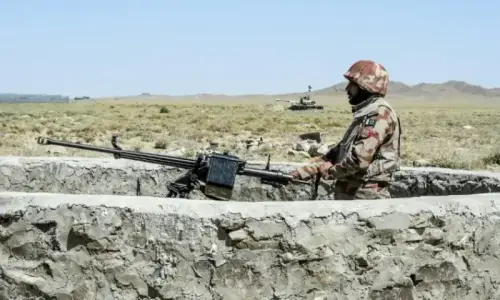
The most serious setback to the peace process occurred recently when New Delhi decided to embark on a verbal offensive against Islamabad over the Balochistan issue, saying it had been “watching with concern the spiralling violence in Balochistan and the heavy military action, including the use of helicopter gunships and jet fighters by the government of Pakistan to quell it.” This unwarranted interference in the internal affairs of Pakistan evoked a strong response from Pakistan.
A few days later, President Musharraf in a CNN-IBN interview said that there were lots of “indications” of New Delhi’s financial and material support to militants in Balochistan. It is significant that India’s ministry of external affairs, after the resignation of Mr Natwar Singh, is under the direct charge of Prime Minister Manmohan Singh, and it is obvious where the approval for the Balochistan statement came from.
The Balochistan statement is all the more unfortunate because India does not share territorial borders with Balochistan nor has anyone said “extremists” from the province pose any threat to Indian interests. Also, Balochistan is not a part of Pakistan-administered Kashmir over which India can claim to be locked in a dispute with Pakistan. New Delhi’s comment on Balochistan is like Pakistan commenting on Naxalism in Andhra Pradesh or the law and order situation in Assam or northeastern India. The timing of the Balochistan comment could not have been worse because it was made three weeks before the third round of composite dialogue between the two countries was to begin with the foreign secretary-level talks in New Delhi on January 17-18.
What could be the motive behind India’s provocative statement on Balochistan? Was it in retaliation to the alleged use by Pakistani intelligence agencies of some terrorist outfits against Indian interests? Some perceptive observers of South Asian affairs think that Indian’s verbal offensive against Pakistan should be viewed in a larger context. It needs to be recognized that the US has become an important player in South Asia after the September 11, 2001, terrorist strikes.
In view of the importance of the United States to both Pakistan and India, it is possible that New Delhi and Islamabad have upped the ante before President George W. Bush’s visit to both countries some time in February-March this year. If New Delhi wants to emphasize that Pakistan continues to support terrorist actions on its territory and the need for Mr Bush to restrain Pakistan, Islamabad may wish to stress its frustration over the lack of progress on Kashmir and the need for Mr Bush to push India.
India’s response to President Pervez Musharraf’s CNN-IBN interview was quick and sharp. In an apparent snub to Pakistan, the external affairs ministry’s spokesman asserted that demilitarization or redeployment of security forces in Jammu and Kashmir was the sovereign decision of New Delhi and could not be dictated by any foreign government. Discouraging any creative thinking on the Kashmir issue, the spokesman rejected the Pakistan president’s proposal on self-governance in Jammu and Kashmir saying the “state already enjoyed autonomy”.
The sharp and negative Indian reaction to President Pervez Musharraf’s proposals appear to be due to the fact that they were aired through the media. According to New Delhi, President Pervez Musharraf keeps “shooting off” vague new ideas on Kashmir through the media, which should be first discussed bilaterally to get a proper response. But India’s contention has been rebutted by the president himself, who said that all the proposals he was projecting had been either conveyed to New Delhi earlier or discussed with its leadership.
According to some Indian analysts the Pakistani president, by airing his proposals through the media, is resorting to “punching bag diplomacy”. To quote an Indian analyst and commentator Bharat Bhushan, President Pervez Musharraf “undermines his credibility by being too voluble and facile in projecting his ideas through the media.”
The Pakistani proposals on self-governance and demilitarization, based on President Pervez Musharraf’s ideas, came up for discussion at the foreign secretary-level talks in New Delhi. Pakistan’s foreign secretary told reporters that Islamabad had asked New Delhi to allow “self-governance” in Kashmir and urged a cut-back of troops in the heavily militarized region. “There is a commitment by both sides to reach a final settlement” (on Kashmir) and “in the search for it, various ideas, any ideas need to be discussed,” he said. He added that the time was ripe to take up the Kashmir issue for serious discussion.
It may be observed that Pakistan’s proposal on self-governance marks a significant political shift. Since the Kashmir dispute began about six decades ago, Pakistan’s stand has been that the dispute is not about territory but about “self-determination”. The new emphasis on “self-governance” as opposed to “self-determination” could help reduce the political distance that needs to be bridged with India in order to move forward on the Kashmir dispute.
As a result of unfriendly developments in the past few months, India-Pakistan relation have reached a critical juncture. Despite some progress at the recently concluded foreign secretary-level talks and the fact that the CBMs continue to be in place, a question mark hangs over the future of the peace process. As the history of almost six decades of India-Pakistan relations attest it is easy to destroy the momentum of goodwill and amity and very difficult to recreate it.
Therefore, any complacency on either side may derail the whole peace process and nullify the efforts made so far to remove the hurdles in the way of normalization of relations. The time has come when India and Pakistan have to find some way of managing the complex linkage between New Delhi’s concern on cross-border infiltration and Islamabad’s solicitude for India’s political gesture on Kashmir.
The writer is a former ambassador.
Court & parliament at loggerheads
IT is ironical that the biggest challenge to the Indian constitution has come in January, the month in which the country introduced it, as far back as 1950, to become a republic. Unfortunately, the challenge is developing into some sort of a confrontation between the legislature (parliament) and the judiciary (the Supreme Court).
Both are creatures of the constitution which has delineated their respective territory. Yet, both appear to be transcending the limits and going relentlessly towards a point where they can burn their fingers, one probably more than the other.
It all began with the expulsion of 11 Lok Sabha members from parliament because they had accepted money for raising questions in the house. Through a sting operation, a TV network had shown them taking the bribe. The Lok Sabha speaker, Somnath Chatterjee, constituted an all-party inquiry committee which recommended their expulsion. The speaker implemented the decision to public applause. For the first time, the prestige of parliament went up in the eyes of people.
The members, however, knocked at the court’s door. The conflict with parliament began when the Supreme Court referred the matter to a constitution bench to examine whether parliament had the powers to expel its members. The Supreme Court took care not to disturb the speaker’s sensitivity by observing that it was not concerned about “the merit of the case.” Nor did the court give a stay which would have resulted in restoring the members’ right to sit in the Lok Sabha.
Still, the speaker took umbrage at the Supreme Court’s admission of the members’ petition. The speaker has said that his stand “remains the same.” That is, “I cannot help anyone from going to court. But, according to me, the courts have no jurisdiction at all in the matter. Any order is not binding on me.”
I appreciate the speaker’s touchiness. Indeed, parliament, elected by people, is supreme. But a judicial review is the basic structure of the constitution. The case of the expelled members does not relate to the question of who has the last word — whether parliament or the Supreme Court. The point at issue is whether the Supreme Court is correct in examining the extent to which parliament can go in punishing a member.
It is apparent that the Supreme Court has been quite circumspect in its brief order: “The notices to the respondents are to assist the court in adjudication of the matter.” The words used are “to assist.” There is not even a whiff of suggestion that the speaker has been put in the dock. The order merely seeks his help to interpret the constitutional provision on the disqualification of a member. The Supreme Court is at pains to explain that “we are not on the merits of the case, we are only on the constitutional provision whether Article 105, setting out the privileges of members of parliament, encompassed the power (in parliament) to expel a member.”
Article 105, which defines the powers and privileges of the members, does not say much. Nothing has been “defined.” Until it takes place, parliament follows the House of Commons in the UK. This is not a compliment to the Indian parliament which has not codified its privileges and powers for more than five decades. It is obvious that it does not want to do so because the undefined territory is any day better and larger than the defined one.
But the big difference between the UK and India is that the former does not have a written constitution while the latter has one. One depends on vague precedents and the other on cold provisions. Chatterjee’s stand, however democratic and laudable, cannot be above the constitution which is supreme. The question is not about the expelled members but that of the constitution’s interpretation. This is the court’s job. As far back as 1803, the US Supreme Court upheld in the Malburry vs Madison case that a judicial review is in order even after what the US Congress had decided.
In India itself, there is one judgment by the Madhya Pradesh high court which is in favour of the speaker’s stand and another by the Punjab and Haryana high court that is against it. In 1957, a UP journalist was punished by the Allahabad high court and all the 29 judges on the bench endorsed it. The right to appeal was also extinguished. However, the Supreme Court said that it was the final authority and let the journalist free.
In the days of Jawaharlal Nehru, there was a similar case in the Lok Sabha. A member was caught taking bribe for asking questions in the house. Before the resolution to expel him was adopted, he resigned. At that time, the question had taken the shape of morality, whether such a thing behoved a member of parliament. This was probably because the ethos of the independence struggle denoting high moral standards had not dimmed then.
This time the constitutional aspect has come to the fore. No one has mentioned the word, “moral”. I do not know what shape the crisis will take. But the Supreme Court has to carry out its job, however controversial and onerous. This is an issue which is bound to be raised in the years to come. It is better to get it out of the way now. In no way should the prestige of the Supreme Court be lessened.
The manner in which the government has handled the Bofors scandal simmering for the last 20 years, does not indicate that New Delhi is conscious of the scant respect it has shown to the Supreme Court. It has ordered not to defreeze the Rs 20 crore accounts of Ottavio Quattrocchi in London banks. Defence Minister Pranab Mukherjee argues on behalf of the government that India has no jurisdiction over foreign banks. This remark is meant to scoff at the Supreme Court. Of course, everyone knows what Mukherjee has said. The question that arises is why the government sent the additional solicitor general to defreeze the account when the case against Quattrocchi was pending before the Delhi high court.
More than that, when the Supreme Court directed the CBI on January 16 to ensure that Quattrocchi did not withdraw the money, the latter send the order four days later. The British authorities went on saying that they were awaiting the government of India’s fresh request to “refreeze” the bank accounts. No authorization was given to the Crown Prosecution Service to approach the British courts. Who is to blame?
Surprisingly, Quattrocchi withdrew money on January 11 and it turns out that New Delhi knew about it. Why did the CBI not tell the court about it? It’s more than a coincidence that a television network broke the story that very evening. Whoever gave it information made sure that Quattrocchi had withdrawn the “kickbacks.” Any bets who could have done it?
The writer is a leading columnist based in New Delhi.
US missile attack
IT is hard to say how many people would have mourned Ayman al-Zawahiri if he had indeed been killed last week by the US missiles that hit a Pashtun area near Pakistan’s border with Afghanistan.
That was apparently the intention of CIA officers when they dispatched a remotely piloted Predator aircraft to execute the deadly hi-tech mission. Eliminating Zawahiri would have been a significant coup for the US in its “war on terror”. The Egyptian-born paediatrician is increasingly seen as the brains of Al Qaeda amid doubts as to whether Osama bin Laden is still alive. That Zawahiri, like Bin Laden, has a $25m bounty on his head attests to his status as a “high-value target”.
The incident shows, not for the first time since 9/11, that intelligence is a dangerously imprecise business. Zawahiri was believed to be coming to dinner in a mud-brick house in Damadola village. Yet at least 17 dead, including women and children, were found in the rubble. Pakistani sources claimed that several of the victims were “militants” and US officials spoke of taking DNA samples to ascertain the identity of the dead, but an Arab TV channel reported that Zawahiri is alive and well.
The death toll is a grim reminder of the fact that, legal and moral considerations aside, operations of this kind — like the “targeted assassinations” carried out by Israel against its Palestinian enemies — are rarely cost-free. The “collateral damage” of killing innocent people risks recruiting others to the jihadi cause, not least in the teeming madressahs that are so often identified as breeding grounds for extremism.
There is also the danger of destabilising the regime of General Pervez Musharraf, who used to have a cosy relationship with the Taliban next door but who has reaped huge rewards from backing the US as a “frontline” ally — including F16 fighters and indulgence of his acquisition of nuclear weapons and of the smuggling network run by AQ Khan.
The president warns his countrymen against harbouring “foreign militants”, but Islamist parties, which form the main parliamentary opposition and govern two provinces on the Afghan border, accuse him of being too willing to accommodate the US.
— The Guardian, London
The Chad experiment
FIVE years ago, the World Bank lent money and credibility to a risky experiment. Despite the depressing record of oil projects in poor countries — they tend to fuel corruption rather than boost development — the bank provided $190 million to kick-start the oil industry in one of the world’s most impoverished dictatorships, the landlocked African state of Chad.
As a condition of its lending, the bank insisted that oil revenue be used for poverty reduction, and at first it mostly was. But now Chad’s government wants to relax the restrictions on how it spends its petrodollars. Unless Chad backs down, it will become harder for the World Bank to justify future oil projects in poor countries. Western oil companies that invest in such places will face more criticism, too.
— The Washington Post