0
0

Making the same mistake?
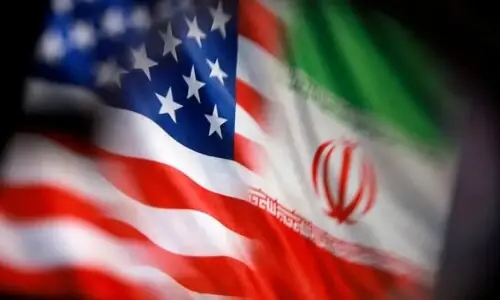
WITH the adoption of the US-led European resolution by the UN nuclear watchdog, the stage is now set for a confrontationist move against Iran. The proposal approved recently by the International Atomic Energy Agency (IAEA) at Vienna provided for referring Iran over its nuclear programme to the UN Security Council, at an unspecified date, for failing to convince the agency that its nuclear programme was entirely peaceful. The timing of this referral will be decided by a future IAEA meeting, presumably the one that will be held in November.
The IAEA’s 35-nation board adopted the resolution by 22-1 vote, the only negative vote was cast by Venezuela. There were 12 abstentions, including Russia, China, Pakistan, Algeria, Brazil, Mexico, Nigeria, South Africa, Sri Lanka, Tunisia, Vietnam and Yemen.
The most conspicuous name missing on the above list was that of India which, abandoning the independence of its foreign policy, voted against Iran and supported the resolution to strengthen its “strategic partnership” with the United States. According to the CPI (M), an important constituent of the coalition supporting the Manmohan Singh government, India’s voting for the resolution has done immense damage to India’s standing among non-aligned and developing countries. In the words of the former foreign Minister Yashwant Sinha, India’s vote has made it “a client state of America”.
Pakistan’s decision to resist US and European pressure and abstain on the resolution came as a pleasant surprise to all those who have been advocating that Islamabad should always accord top priority to its national interest and zealously guard its strategic autonomy. There have been few glorious moments in the annals of Pakistan’s foreign policy as Islamabad has rarely been immune from outside pressure. It was certainly a golden moment when the Pakistan policy-makers showed the courage and good sense to decide not to be an accessory to the targeting of Iran. The coming days will vindicate the wisdom, far-sightedness and long-term benefits of this decision.
Even those who are sceptical of Iran’s nuclear motives admit that a referral to the Security Council might not be helpful. If pushed, Iran could end cooperation with the IAEA. Tehran can also disrupt oil supplies through the Gulf. The irony is that it has never felt so secure internationally as it does today. America’s problems in Iraq have worsened. Iran has succeeded in soliciting diplomatic support from powerful neighbours.
Russia is building a one billion dollar nuclear reactor in Bushehr in Iran and has much to gain from Iran’s plans to develop atomic energy. China, which wants to benefit from Iran’s vast energy resources for its booming economy, also abstained on the IAEA resolution. Both are permanent members of the Security Council and are not likely to support economic sanctions against Iran. It may be recalled that when the case of North Korea, which had committed more flagrant breaches of the non-proliferation conditions than Iran and had even withdrawn from the NPT, was reported to the UN Security Council, China, with its veto as a permanent member, blocked further discussion.
Even if the Iranian case is referred to the Security Council and neither Russia nor China exercises its veto against it, the economic sanctions are not likely to succeed at a time when oil prices are rising, and any oil embargo or disruptions in Iran’s supply of petrol to the outside world could be fraught with dire consequences.
So far Iran has done without US investment and trade for years which leaves only its biggest trading partner, the European Union, having economic relations with it. Under the present circumstances, the sanctions are not likely to work in the case of oil producing countries at a time of soaring oil prices. However, one consequence of Security Council’s sanctions will be that the Iranian gas project across Pakistan would become almost impossible to implement.
What the US and its European allies tend to overlook is that Iran’s nuclear programme is more about nationalism and pride than weapons and energy. One hopes America would not commit the same mistake as was committed by the British in 1951 when they imprudently turned a question of oil royalties into a groundswell of Iranian nationalism.
Tehran has made several positive proposals aimed at reassuring the international community that its civilian facilities will not be misused for military purposes. But Washington does not seem to be interested in any such proposal as it has decided that it will not allow Iran to enrich uranium. Another part of its agenda appears to be to strangulate Iran’s oil and gas sector, and bring about a “regime change” in that country.
The Iranian people have learned the hard way not to trust foreigners for supplies of essential resources and that is why they are not prepared to accept the offer by other countries to supply enriched uranium. For instance in 1975, Iran purchased 10 per cent of France’s Eurodifuranium enrichment plant for one billion dollars yet in spite of its having a shareholder’s stake in the plant, Tehran has not received any uranium from it to date. Similarly, a German company under pressure from the US backed away from its contract with Iran to build the Bushehr nuclear power plant. During the Iran-Iraq war, the US not only cut off Iran’s supply of parts for the US-made war planes but also did not hesitate to share sensitive aerial reconnaissance on troop movement with Iraq. Given the history of broken promises, Iran is justified in its desire to be self-reliant in nuclear fuel.
There is an uncanny resemblance between the policy being followed towards Iran at present and the events preceding the Iraq war. According to the IAEA, while Tehran concealed for 18 years its nuclear activities, the agency has found no evidence of a nuclear weapons programme in Iran. Any evidence of weapons of mass destruction(WMD) was also not found in Iraq.
As in the case of Saddam’s Iraq, the Bush administration is presenting an alloyed picture of a nuclear-armed Iran and saying that this is something that Washington will not tolerate. As in the case of Iraq, Iranian exiles are providing the press and the government with the so called “evidence” concerning Iran’s nuclear weapons activities.
Secretary of State Condoleezza Rice has warned that Iran will not be allowed to use the cover of civilian nuclear power to acquire nuclear weapons, adding, however, that an attack on Iran is “not on the agenda at this point”. The US should pause and recall what went wrong with the assessment of Iraq’s WMD programme. If it makes the same mistakes in Iran, the consequences will be even more disastrous than the ones that have resulted from the Iraq war.
It is time the US and its allies accepted the fact that the past cannot be undone. The nuclear knowledge and technology that Iran has already learnt during the past 18 years cannot be eliminated. Therefore, it makes no sense to talk about eliminating Iran’s nuclear capabilities, short of war and occupation.
The hope is that the US is wiser after the Iraq misadventure to acknowledge that it is not all-powerful and has to coordinate its policy with those of other big powers to achieve its ends. Also, it has to realize that creative and soft diplomacy can be far more effective than threats or military action. Talk of ‘regime change’ and use of force will only strengthen the resolve of the Iranian people who are profoundly nationalistic and proud of their history as one of the world’s oldest nations.
The best argument for a change in the US approach to Iran is the total failure of the strategy followed so far. The economic sanctions and demonizing and shunning of Iran since the Islamic revolution have failed to produce the desired result. The regime in Tehran is more powerful and firmly entrenched today than it was sometime back. Whether Washington likes it or not, it has no alternative to building its own direct relationship with Tehran. The covert and indirect approaches the US has relied on so far have only succeeded in diluting American influence and keeping Washington more ignorant about Iranian affairs than it can afford to be.
The writer is a former ambassador.
Nature is the enemy
TWO things, after half a lifetime of trying to understand America, come suddenly together. One is the curious, seemingly mindless obsession with regulation that infects the land of the free. (A few weeks ago they detained a babe in arms at airport departure because his name was on their terrorist-suspect list.) The other is a perennial sense of looming disaster. But let’s come to Katrina and Rita in a second. Meanwhile, other signs point the way.
For years — a silly little holiday hobby — we’ve gone round the United States taking pictures of the municipal notices they put up. “Have fun and enjoy Santa Monica beach,” for instance. “No fires or fireworks; dogs not permitted at any time; ball playing in designated areas only; must obey lifeguards’ direction; no dressing or undressing; no tents or enclosures permitted; no sleeping midnight to 5am; must place rubbish in trash can; no alcoholic beverages; no glass containers; no percussion instruments” — with the relevant city ordinance numbers tabulated down the side. (No percussion instruments, rule 4204C.)
So “fun” is a carefully limited concept. And that, in part, is because inanimate objects can wreak havoc. “Caution: nails, splinters, uneven deck, gaps between planks, bare feet and high-heel shoes are dangerous.”
In Oregon, a few weeks ago, you saw full Hollywood horror lurking on the horizon. “If you feel an earthquake — Protect yourself until the earthquake is over — Move quickly inland to high ground — Do not pack or delay — A tsunami may be coming in a few minutes ... “ Play it safe? Only, perhaps, by staying at home.
Can such notices of imminent extinction be taken seriously, though — especially when, as on Venice Beach, they’re close to an athletic centre where “The ethics of paddle tennis and good sportsmanship shall prevail” by similarly gruff decree? Not really. Too much bureaucracy douses any sense of fear. A warning ritually repeated is no warning at all. You forget what this big country is like.
Now it’s time to remember as Rita piles more debris along the Gulf and pushes New Orleans back into Katrina’s ooze. In Hertford, Hereford and Hampshire, hurricanes hardly happen. But along America’s south and east coasts, they have their regular lashing season of destruction. To the west, tsunamis may come, and come again, hours later. Blizzards spread from the north. Tornados from nowhere beat through Oklahoma. The San Andreas fault shifts sullenly, waiting for its moment. Mount St Helens never sleeps.
Nature, in short, is a hostile force and repeated enemy. Most of Europe’s disasters are man-made: mountain tunnels imploding, planes crashing, wars, hatreds. Most of America’s, by contrast, are natural nightmares. And there’s one gap in understanding.
Did New Orleans react so sluggishly to Katrina because it was warned and warned again, warned into apathy? Perhaps, a little. Was Rita quite the monster a once-bitten met office warned against? Perhaps, not quite. But the struggle for perspective is constant. We can sit on more tranquil sidelines and cry “global warming”. Yet America’s next disaster may burst from beneath the earth or sea and have nothing to do with Kyoto.
Did the BBC “gloat” over Katrina? Not that I saw. But that tired, glib line about “the world’s only superpower” assumes that any power on earth can somehow staunch natural disasters. Not so. We are humbled time and again, from Sri Lanka to San Francisco. Our defences come down. Mortality engulfs the Big Easy as swiftly as Thailand. Stand on the slopes of Mount St Helens and, 25 years on, the dead forests of blasted trees bear witness to our impotence. Millions flee.
And there, perhaps, the noticeboards of life and death come together, not just as bureaucracy striving for order, but as something Old Testament apocalyptic. The ten commandments of Santa Monica beach, with one commandment added for luck. Never forget plagues, pestilences and our terrible vulnerability. Be humble (and observe the due ethics of paddle tennis). —Dawn/Guardian Service
Diplomacy at gunpoint
WHEN interests come into conflict with policies, the latter suffer. Something like that happened to India at Vienna where it voted against Iran at the International Atomic Energy Agency (IAEA) to ensure the supply of civil nuclear reactors and their technology from America and Europe.
New Delhi said goodbye to its traditional non-alignment. Tehran did not lose a minute to express its “unhappiness” over India’s voting. It was protesting against the violation of its own interests. However, Iran preferred to stop at that and did not go beyond to cancel the proposed gas deal that was the verbal warning of Iran’s ambassador at Vienna.
Whatever the explanation, New Delhi acted under pressure. It had in mind America’s legislation to accommodate India. The US Congress had made it clear before the voting at the IAEA that its response would be dependent on how New Delhi voted. It was diplomacy at gunpoint. In similar circumstances, Prime Minister Jawaharlal Nehru would have acted differently.
Although India was weak, he challenged the UK and France when they tried to capture the Suez. He saw to their withdrawal. But Prime Minister Manmohan Singh is no Nehru and Foreign Minister Natwar Singh is only a babe in the woods of diplomacy. They had no gumption to stand up to almighty America.
I suspect that Manmohan Singh assured India’s vote when he met President Bush at New York at the latter’s initiative. It is clear from Bush’s observation that the “prime minister is a good person. We can do business with him.” Natwar Singh met US Secretary of State Condoleezza Rice only to confirm India’s decision. Even before Manmohan Singh and Natwar Singh left New Delhi, the government seemed to have decided to side with America in the face of outbursts like the one made by Republican Congressman Tom Lunton that nuclear power reactors would be available to India on the condition of “reciprocity” to isolate Iran.
That Tehran would have given New Delhi more gas to produce energy to make up for the loss of civil nuclear reactors goes without saying. But India did not want to displease America. However, it came as a relief when the IAEA’s resolution did not suggest that Iran would be straightaway hauled up before the UN Security Council. This gave New Delhi some leeway. It could officially say that it had taken a “midway” stand to push diplomacy and dialogue as the way to find an amicable solution. New Delhi also said that it supported the European Union’s resolution which gave time to Tehran to establish beyond doubt that its nuclear programme was only for peaceful purposes. Still, at the back of India’s mind was, as Manmohan Singh said, that it did not want another nuclear state in its neighbourhood.
The fact that the matter has not yet been referred to the Security Council indicates that some way would be found to allay the fears of Iran on an American attack. Europe has ruled out a war. India too would put its foot down if ever the situation came to such a pass. Probably, America’s unilateral war against Iraq, even when weapons of mass destruction were not found, has made the world wary. It would exhaust all peaceful avenues before punishing Iran. It should feel doubly assured because New Delhi would support it if Tehran has nothing to hide in the field of nuclear proliferation.
Tehran should realize that New Delhi has stood by Iran through thick and thin for decades. Maybe, it appreciates this because Iran’s embassy at New Delhi has officially stated that the friendship does not diminish by one act, however dislikable. Iran has assured India that the gas deal held good, the supply of which is to begin in 2009. It goes without saying that New Delhi will go on trying to ensure that Iran is not a target of America which has as its age-old policy to draw it out for war.
True, Tehran is “very disturbed” over India’s voting. It said that it could not imagine that a founder of the non-aligned movement could vote against another member nation. With the collapse of the Soviet Union, the world has become unipolar where the neo-conservatives of America lay the law. They are power crazy and brook no dissent. India has to tread the path cautiously. I recall former Pakistan foreign minister Abdul Sattar telling me that Islamabad had no alternative except to support Washington in the war against Kabul because after the 9/11 incidents America made clear to Pakistan that the carpet-bombing would begin from its soil if it refused to support Washington. Islamabad changed overnight.
Some may say that the values were sacrificed but many will agree that Pakistan had to save itself from destruction. I do not want to labour on the point that India and Iran share a culture which goes dates back thousands of years and that their relationship is age old. These things will remain whatever the voting at Vienna or Iran’s reaction. Saadi’s Persian poetry will not become something foreign to Indians, nor will our music, dance and architecture be lost on the Iranians. These ties of emotions will never weaken. The current period is testing, indeed.
Even otherwise, tit for tat is not a mature reaction. It is definitely not in order for New Delhi which has a long record of its unstinted support to Tehran despite all the pressure. A principle cannot be stoutly defended by the language of ‘no’ or by condemning those who do not accept it. This is an old approach of the bigoted aspects of some countries. It is not the approach of feeling that perhaps others might also have some share of the truth.
I find this approach wholly unscientific, unreasonable and uncivilized, whether it is applied in the realm of religion or economic theory or anything else. I am glad that Iran did not act hastily. It should wait for the next step and see how the IAEA resolution takes shape.
India’s problem is that it is trying to ride two horses at the same time. It wants to project the image of being non-aligned while recognizing the advantage of siding with America. Even non-alignment has a question mark against it. Non-alignment can mean values but self-interest spells disaster for ideals. India has no heart for the sacrifices such a course demands.
The voting at Vienna was a challenge. That India did not come out well was because it could not afford to annoy America although it knew that New Delhi would hurt Tehran in the process. The belated reaction of Iran to underline the friendship between the two countries indicates that Tehran is conscious of New Delhi’s predicament. One expects that from friends.
The writer is a leading columnist based at New Delhi.
| © DAWN Group of Newspapers, 2005 |