0
0

Key to economic progress
THE Quaid had the vision to realize that education held the key to progress and development. Sadly, fifty-five years later, the human development report by UNDP for 2002 suggests that the adult literacy rate in Pakistan is 43.2 per cent. Official statistics put the figure of literacy above 50 per cent but that is on the basis of ability to sign one’s name. Pakistan remains 16th among the least developed countries in terms of literacy.
Though literacy is only one indicator of backwardness, it has been established that education holds the key to solving a host of other problems, including poverty, disease, crime and social instability. Even the problem of rapid increase in population that is at the root of many economic and social problems, becomes amenable to solution with the spread of education. With government resources falling considerably short of requirements, the private sector has been called upon to play an increasingly important role in providing educational facilities.
Among the many organizations that have come into being in this field, one of the most innovative and dynamic is the Tameer- i-Millat Foundation, which is chaired by Dr Zaheer Ahmad, founder of the Shifa International Hospital in Islamabad. Starting with a small school in 1987 in the town of Khewra, the foundation is now running 280 informal schools, 22 formal schools, 30 adult literacy centres and a School of Excellence for gifted children, all over the country, from Skardu to Karachi.
It has also established a teachers’ development institute, as well as four vocational training centres for women.The total strength of students already exceeds 16,000, though the key contribution the non-profit foundation makes is through the network of informal community schools in remote localities with an average enrolment of 30 children.
The Foundation launched a major initiative on September 7 last year, when it brought together intellectuals, thinkers, businessmen technocrats and educationists to launch the Educate Pakistan Forum. The project is a nationwide enterprise to achieve both vertical and horizontal expansion of education. The objectives are to achieve a significant improvement in the literacy rate by 2010, improving the quality of education through teacher development programmes, and creating a tolerant civil structure, eliminating gender disparities, and neutralizing ethnic and sectarian differences by developing special curricula. The project seeks to mobilize the community and introducing sustainable capacity-building programmes. The main constituents of the project are an Educate Pakistan Campaign, as well as a forum, a fund and a website.
A notable feature of the foundation’s activities, is that the objectives are being pursued in partnership with existing organizations, both private and governmental. The foundation’s partners include the ministry of education, several reputable foundations in the US, UK and educational trusts in various cities in Pakistan. The foundation is conscious of the need to integrate the on-going activities in the field, and to utilize available resources in an optimum manner.
What is important is to secure general acceptance that education for all Pakistanis is a priority objective for which everyone must make a contribution. Thus, even if half the people at home and overseas participate in this fund-raising, the objective can be achieved by raising the amounts to be contributed, with those who are well off paying two or three times their share. In this way the overall resources generated could prove adequate for the goal of achieving universal education.
Many countries in our own neighbourhood have managed to overcome illiteracy by means of crash programmes. In the case of China, Marshal Chen Yi, who liberated the central part of China from Kuomintang control, was put in charge of the literacy campaign that was launched in the aftermath of the revolution. He achieved the target of increasing the literacy rate dramatically through an operation on military lines. Iran, another neighbour, also adopted a similar strategy, creating a countrywide force of educated persons who went from village to village, spreading literacy. The campaign there also achieved the objective of virtually eliminating illiteracy.
It is necessary to point out that the task of spreading education does not involve financial resources alone. The fact remains that various governments in Pakistan did launch literacy campaigns and laid down targets to be achieved in spreading literacy. As in other fields of development, the desired results proved elusive on account of wastage of resources through inefficiency and corruption. The experience of the past half century is that the impact of inadequate funding was only one element in the failure to achieve educational goals. Others were poor utilization of available resources, and a lack of motivation and commitment among those responsible for implementing the plans.
The mobilization of financial resources for overcoming illiteracy is only going to be one goal, though it is the most important one. Two other inputs are going to be equally important. One is the degree of commitment and dedication to the goal of imparting quality education. Unfortunately, there is too much stress on imparting practical skills, and too little on educating the minds so that learning goes beyond technical competence and creates a better, more enlightened human being. To achieve this, courses on literature, humanities and fine arts are being made a compulsory component of the curriculum for business administration or engineering in many countries.
Creating balance and a sense of proportion is one dimension of proper education; the other is that it must help shape the personality and character of the younger generation. A person therefore should be enabled to develop all three dimensions involved in education. First is that the student achieves a comprehension of the place of his specialty, whether it is in science or humanities. Second is that the value system he or she acquires results in a more humane, tolerant and positive personality, conscious of obligations and rights. Last, but no less important, is the acquisition of technical competence in chosen fields, be it medicine, engineering or computers.
Apart from having faculties in the specialized disciplines, all universities must have departments of social sciences and have courses in religion and literature. They should not only have well-equipped laboratories, but also must maintain good libraries. There needs to be interaction between the teachers and the taught that goes beyond the classroom, and enables contacts that will influence the character and personality of the students.
Who pays for health & education?
THE slide in the quality of social services in Pakistan has prompted some serious thinking in concerned circles on who should pay for the education and health care of the people. Now that the idealism of the left is no longer fashionable and market-mania (to borrow the Nobel Prize winning economist Amartya Sen’s term) has swept aside all rational considerations, it requires some courage to suggest that the state must be responsible for educating its citizens and attending to their basic health needs.
Many people in a position of authority in Pakistan now unabashedly declare that the government cannot undertake this burden since it does not have the resources to finance a welfare state. Even if we set aside humanitarian and religious considerations, simple economic compulsions should make us think otherwise. Amartya Sen, who links freedom and development together, describes education and health as ‘enabling factors’ since they promote freedom by offering more choices to the people and empowering them to resist oppression.
Hence a society which is truly concerned about its own economic development must feel concerned about the education and health of all its citizens. If it is accepted that economic development is not possible without a modicum of social development, then how can a state leave its citizens to fend for themselves in obtaining education and health care, especially when a very large number of them live below the poverty line? Logically, social sector spending should be viewed as an investment in economic progress.
These are not happy times to promote the concept of a social welfare state which is under attack even in the affluent West from the radical right and the capitalists. Many of the social democracies, such as Sweden, Britain, Canada and Germany, have scaled down the benefits which they liberally offered to their citizens at one time. In spite of the cuts, schooling continues to be free — hence also compulsory — in all the countries mentioned above. At the most, parents have to spend a relatively nominal amount on books and stationery for their children.
Hospital care is also provided free of charge to people needing it in these countries. Patients may be required to pay for their medicines as in Canada and Britain but there too the charges are waived for children and the elderly.
Those who have argued against the state providing social services in Pakistan have pointed out that the developed states of the West introduced their social security net only after they had reached a respectable level of economic development and could effect a redistribution of wealth without impeding economic growth. The champions of the marketplace in Pakistan have also pointed to the existence of a private sector in education and health in all these countries mentioned above.
But such comparisons are misleading, given the contrast in their conditions. The aid-giving agencies which have been insisting on the withdrawal of subsidies for various services are trapping us permanently in a bog of poverty and underdevelopment. Since the process of structural readjustment was undertaken, the country has been retrogressing in the social sector.
Poverty has been on the rise. The number of illiterates has increased and the standards of education in public sector institutions have fallen. The morbidity rate has also gone up, as a number of diseases have been visibly on the increase. In these circumstances when the ‘enabling factors’ are on the decline can economic growth ever take place?
It is a pity that the crunch has come at a time when many other factors have added up to create a crisis in the social sector. The high birth rate has left the country with a massive population of 150 million of whom 46 millions subsist on less than one dollar a day.
Apart from the population size, which is a testimony to the failure of our family planning programme, there are other factors which have cumulatively created the present crisis. They are the aging of the population, the increase in the incidence of many diseases, the change in people’s lifestyles, the state’s failure to attend to public hygiene and sanitation, environmental pollution and other ecological factors. All these have added to the burden of disease in the country.
The education sector has been affected by the population growth and the increasing demand for education brought about by the rise in public awareness about the advantages of a good education. The information and communication explosion has also created higher expectations among the people who had previously remained reconciled to their state of deprivation.
Thus, new demands have been created which are not being met. The government has responded to this situation by adopting a strategy which is directed towards: 1) recovering users’ charges from consumers in the health and education sectors; 2) promoting the public-private partnership approach in which the government has inducted the private sector in the health and education fields; 3) slowing down the expansion of primary education and basic health facilities in the public sector.
It is plain that this strategy has failed to produce positive results as the appalling state of the education and health sectors testifies. It has led to a marked decline in the services of public sector institutions while tilting the balance towards the private sector, which has made health care and education prohibitively expensive. More and more people who do not have the means are being forced to send their children to private schools and take their ailing relatives to private hospitals. When private sector institutions are allowed to operate on a laissez faire basis, they cannot be forced to reduce their charges.
The wiser approach would be to regulate the working of these institutions in such a way that they complement the social welfare role of the state. But before it proceeds to enlist the cooperation of the private sector, the government must put its own house in order. Official sources have revealed that the public sector often fails to utilize all the funds available for education and health. This is to be attributed to bad management, corruption, embezzlement and wastage. Given the exemplary services provided by some public sector institutions headed by devoted and motivated people, one feels that the situation is not beyond rectification.
The next step would be to mobilize additional funds. There are two sources which could be tapped. One, the government should cut down its defence spending — especially on its nuclear programme which is a white elephant for a country with people as uneducated and in such poor health as Pakistan — and divert these funds to the social sector. Two, resources can be raised from public donors and philanthropists as many institutions are already doing successfully.
It might appear paradoxical that a society notorious for tax evasion should donate so generously to charitable causes. But the fact is that institutions with a reputation for delivering — the Edhi Foundation, for instance — do mobilize voluntary donations without much difficulty. The key precondition is that the people should be convinced that their money is being put to good use and is not being swindled — as is the general impression about the taxes collected by the government.
Once the government has established its credibility, the private sector should be inducted into the programme to provide social protection to the people. This can be in the form of trust hospitals and schools which could be encouraged by the government and provided subsidies and grants to enable them to keep their charges low and affordable. But that should not mean that their standards should be poor.
True, they may not be able to match the high standards of private sector schools and hospitals. But they should at least provide reasonably good services. It may be pointed out that in Germany and Britain the ratio of children in state-funded and private schools is 99:01 and 93:07 respectively, when in Pakistan it is 85:15. Although it is widely admitted that private institutions have a higher standard state-funded schools and hospitals in Britain and Germany do fulfil the minimum needs of the people. Why can’t ours?
The slogan is a slow gun: OF MICE AND MEN
READING the slogans of the Punjab Forest Department one comes across on the G.T. Road, in preparation possibly for the coming spring tree plantation drive (or were they remnants of the last autumn drive?), one may be excused for the impression that permits for entry into the Lord’s paradise are also issued by that department.
Otherwise it would not be saying Zameen pe darakht lagao; jannat men ghar banao. That is, plant a tree on this earth and you are building a house in heaven. Or again, Darakht ka saya; jannat men hamsaya, meaning the shade of the tree (you plant) will be your neighbour in heaven. People who have spent long years doing pious deeds so that they can go to paradise could have saved themselves the bother by just planting a tree.
Apparently the department is engaged in some other vital national jobs also, and maybe it becomes the harbinger of true democracy in the country, succeeding where both the PPP and the PML(N), and, according to many, the military regime, have failed. For witness another slogan that says, Awaaz yehi jamhoori hai; shajarkari zuroori hai. To translate: this is the demand of true democracy that the plantation of trees is essential.
I suppose that is why successive presidents and prime ministers keep on planting saplings whenever the Forest people request them to give a fillip to their tree plantation drives twice a year. Maybe they find it easier than actually labouring for democracy. The governors and chief ministers have always followed suit, and so have many other VIPs, including the COAS, for how can you have democracy without his blessings? To strengthen democracy every little sapling counts, if the intention is honest.
Whatever else we may do, or not do, we should never give up our slogans. It is the only thing we are really good at, believing that they are more effective than hard work in building up Pakistan. Our experience at the business has been further honed ever since the art of writing jingles for television became a paying proposition. It is compulsory that a jingle should be in rhyme, whether the slogan extols the qualities of a silly oil filter or seriously advocates the blessings of daily prayer.
Queen Victoria was not credited with a sense of humour by even her most ardent admirers, but one of her remarks has become as famous as herself. This was, “We are not amused.” This came from her at the end of an hour-long session with Edward Lear, recognised in England as the father of the limerick. Since the Queen was constantly hearing praise of his verses he was invited to recite some of his limericks before her. The reaction of Her Majesty, made known in his presence, was that she was not amused. Had Queen Victoria been the Pakistani head of state, she would have loved Mr Lear’s nonsense rhymes and adopted some of them as national slogans.
As it is, to rhyme is to conform, and we as a nation are inveterate conformists. Our governments hate dissent of any kind and want us always to conform. Our political parties dislike people who disagree with them. Our leaders want only yes-men around them. General Zia (and, one is at pains to observe, General Pervez Musharraf too) moved heaven and earth, and ballot boxes, to ensure that every Pakistani said yes to the call for a referendum.
This is not all. In the matter of faith, some of our religious leaders would rather kill than tolerate the slightest deviation from their interpretation of religion. In fact every institution that matters in Pakistan wants the people to conform, to have things its own way. So, what better than for everybody to rhyme with everybody else and thereby attain supreme conformity? The whole nation marching in verbal step, as it were.
You will say I am playing with words. So I am, I suppose. But then, what are slogans at all — only false and hollow words strung together in rhyme. We live on slogans from morning till night. Whenever we want something done at the national level we devise a slogan and bombard the people with it instead of setting examples. We even fought two wars with the slogan “Crush India!” In 1965 and 1971 every car running away from Lahore with its occupants to get as far away from the front as possible, carried this sticker.
Once newspapers used to be advised by the Ministry of Information to print “suitable slogans” on the front page — extolling patriotism and Islamic brotherhood and warning against the evils of sectarianism and corruption. Our radio and TV remind us every hour of the need to adopt admirable qualities and shun despicable practices. We seem to believe that we can change the very psyche of the people with slogans, and the more trite they are the better. Our national motto may well be “We can kill anything with a slogan.” It is a slow gun but a sure gun, guaranteed to destroy all that is healthy, sensible and rational.
Slogans have always been with us. Only they are sparingly used. The only ones that I remember from my schooldays were “God is love” and “Honesty is the best policy.” These were invariably employed to decorate classrooms when the government’s inspector of schools came on his annual visit. As we grew up came “Inquilab zindabad,” and then our hearts throbbed with shouts of “Pakistan zindabad.” However this became so commonplace that long ago when a cousin introduced himself to a foreigner in England the man exclaimed, “Ah, so you come from Pakistan zindabad!”
After that we were deluged by slogans, and its getting worse day by day. The epitome of our genius in publicity is comprised of slogans. The nation has now come to believe that whether it can do without anything else or not it simply cannot do without slogans. In a way the people are right. Slogans typify our penchant for hypocrisy which is now more important for us than any other trait.
Some years ago I saw in Lahore a slogan on a metal board, rather askew, outside the American Centre. It said Naap tol poora do. I am sure no offence was meant to the Americans asking them to dole out an honest measure. This was a relic of the campaign in the eighties in which Lahore’s main roads were peppered with similar themes. Another one exhorted the people to pay zakaat. The masterpiece was one that said in Urdu “Don’t take bribe.” That must surely have finished corruption. How did it manage to come back?
Iraq: will they fight back?
“If they come, we are ready,” Saddam Hussein told his most recent biographer, Con Coughlin, last September. “We will fight them on the streets, from the rooftops, house to house. We will never surrender.”
To anybody who recalls Saddam’s hollow threats about the coming ‘Mother of Battles’ during the Gulf War in 1991, it sounds like empty bravado, but what if the Iraqis (or at least a lot of them) really fight this time?
In theory, the US attack on Iraq could begin only days after the United Nations arms inspectors present their first ‘status report’ to the Security Council on 27 January, but in practice Washington will probably go through the motions of conferring with its allies. It is most unlikely that the Bush administration can be diverted from its resolve to eliminate the Iraqi leader regardless of the inspectors’ findings.
It is almost universally believed in Washington that Saddam Hussein’s regime will collapse in a matter of days after a US attack. The advocates of war with Iraq have to believe that, for this is the same capital where the prevailing doctrine on foreign military adventures as recently as two years ago was the ‘Mogadishu line’.
After the Somalia fiasco saw 19 American soldiers killed in one day in Mogadishu in 1993, Washington’s military and foreign policy elite was convinced throughout the later 1990s that American public opinion would revolt against any future US military intervention abroad that cost more than twenty American military deaths unless vital national interests were at stake. And while the shock of the terrorist attacks on America in September, 2001 may have shifted the Mogadishu line a bit, most observers think it is still there.
Every opinion poll tells the same story: most Americans back their president in an attack on Iraq — but they do not believe that Bush has made his case in trying to connect the Iraqi regime with Al Qaeda or the 9/11 attacks, and back Bush anyway because they do not expect large casualties in an attack on Iraq. Surely all those high-tech weapons will deliver a cheap and easy American victory, especially against the same Iraqi army whose resistance collapsed so quickly eleven years ago.
This may prove to be the case, but there is another bit of evidence from the events of eleven years ago that should give Americans pause. Most of the Shia and Kurdish conscripts who made up the bulk of the Iraqi army in Kuwait surrendered quickly or fled, but after the ceasefire, when both the Shia south and the Kurdish north of Iraq erupted in massive revolts, the Sunni Arabs of the central region around Baghdad, about one-fifth of the total population, closed ranks around Saddam Hussein and fought to defend his regime. That is the only reason he survived in 1991.
It’s not that the Sunni Arabs of Iraq love Saddam. They simply know that he is the current embodiment of their community’s control of Iraq, a near-monopoly that has endured ever since the Iraqi state was carved out of the Ottoman empire after the First World War, and that if he goes down, so do they. Sunni Arabic-speakers are only one-fifth of the population of Iraq; if they lose control over the army and the state administration as a result of Saddam’s fall, they will never get it back.— Copyright
Zimbabwe under spin attack: WORLD VIEW
IT may be a trifle impolitic to broach the subject of cricket while the memory of the second Test in South Africa is still so fresh.
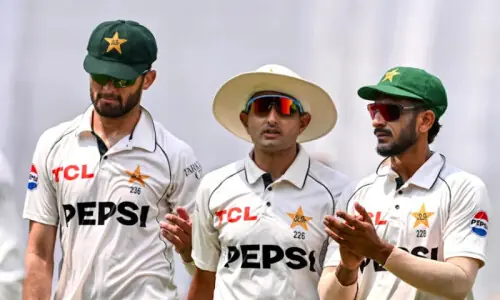
The hosts are, no doubt, a strong side; that is no excuse for the Pakistani tourists to have offered a degree of resistance that would have embarrassed even a bunch of teenage amateurs. Presumably, as far as management and coaching posts are concerned, the revolving-door strategy, which has thus far rarely produced anything but dire results, will remain in effect.
But, no matter how many heads roll between now and the start of the World Cup next month, it will be a miracle if the national XI are able to give even a semi-respectable account of themselves. Seldom before have their performances been so consistently abysmal. The dire state of Pakistani cricket is not, however, the theme of this column — although South Africa does offer a valuable jumping-off point.
For, barely a decade after its re-entry into the realm of international cricket, South Africa is the chief host of this year’s World Cup. But it is not the only one. Six of the matches are to be played in Harare and Bulawayo, in neighbouring Zimbabwe. And that has given rise to a dilemma.
Politicians in England and Australia have lately been berating their respective cricket boards for signing up to such an arrangement and suggesting that, even at this late hour, they should refuse to allow their teams to play in Zimbabwe. New Zealand has lent its support to the drive, but does not figure too prominently in the equation because its national side is not scheduled to take part in any of the games on Zimbabwean soil.
The cricketers and boards concerned have mixed feelings on the matter, but are almost unanimous in demanding that since a political decision is required, it should be taken at the government level. The England and Wales Cricket Board (ECB) is particularly peeved by the fact that Tony Blair’s government offered no advice on the issue until there was an outcry in the press. Its chief concern, apparently, is that the ECB will face a hefty fine for any forfeited matches, not to mention the prospect of loss of revenue in the event of Zimbabwe consequently cancelling a tour of England scheduled for May.
The ECB’s chief executive Tim May is expected to meet government ministers on January 9 and the likelihood is that the ECB’s final decision will depend on whether the government is willing to more or less indemnify the board against financial losses, rather than on any political argument.
The Australian government, meanwhile, is lobbying hard in an effort to persuade the International Cricket Council (ICC) to shift the Harare and Bulawayo matches to South Africa. In the event of the ICC bowing to the pressure, it is not entirely inconceivable that Zimbabwe will react to the humiliation by pulling out of the World Cup; in that event, if another nation cannot be persuaded to step into the breach at the last minute, it will become necessary to rearrange the list of fixtures.
It is probable that all of this angst could have been avoided had England and Australia intimated to the ICC their reluctance to play in Zimbabwe well before the World Cup arrangements were finalized. After all, Zimbabwe’s status as a co-host is not a surprise that the ICC has sprung on the international cricketing community. Nor has the nature of Robert Mugabe’s administration — or, for that matter, the overall situation in Zimbabwe — taken a dramatic turn for the worse in the past couple of weeks. However strong the case for a boycott may be, one is compelled to wonder why it has taken the shape of a concerted spin attack on the eve of the tournament.
Nary an eyebrow has been raised about one outstanding aspect of the attack: that it is purely white. Not only do cricketing nations such as India, Pakistan, Sri Lanka and the West Indies apparently have next to no reservations about playing in Zimbabwe, but, in British and Australian eyes, they are not really expected to. This attitude could be interpreted as a tacit admission that the proclivities of the Harare administration do not universally arouse a great deal of angst, largely because it hardly enjoys a monopoly on poor economic management and human rights records.
Alternatively, the stance could arise from an assumption of western moral superiority. This is the likelier explanation, of course — and it is one that other members of the ICC should find particularly insulting, not least because it derives from a degree of hypocrisy built into western radars in the context of rights’ violations. For example, when the US declared last August that it was attracted to the idea of regime change in Harare, Walter Kansteiner, the assistant secretary of state for African affairs, noted: “We do not see President Mugabe as the democratically legitimate leader of the country. The political status quo is unacceptable because the elections were fraudulent.” He appeared to be oblivious to the irony that his own president could be indicted in precisely the same words.
This is not to claim, however, that all the charges laid against Mugabe are unreasonable or inaccurate. There are solid grounds for the suspicion that the elections last March were less than free and fair. Similarly, the manner in which vast estates have been wrested from white farmers and handed over to government supporters is singularly unfortunate and a violation of Zimbabwean laws. Although a strong case could be made for the redistribution of land, the reckoning with Zimbabwe’s colonial and racist past clearly ought not to have been so crudely mishandled. There can also be no acceptable excuse for widespread restrictions on the freedom of expression and assembly, nor for resort to violence against opponents of the regime.
The egocentric and increasingly erratic Mugabe has, thus, provided much fodder to his foes, and the argument that staging part of the World Cup in Zimbabwe would offer succour to an unpleasant administration does carry much weight. On the other hand, it could also be argued that the international focus on Harare on account of the tournament could conceivably put a damper, at least temporarily, on some of the regime’s more deplorable excesses, while a boycott would be construed as a provocation.
It is intriguing, but not entirely surprising, that some of the most vociferous opposition to the idea of the English team playing in Zimbabwe has come from political and journalistic sources that a couple of decades ago were equally vehement in their defence of sporting contacts with all-white South African teams. There is an underlying nostalgia in their outbursts for the colonial past, specifically for Rhodesia under Ian Smith. Many of them would be inclined to agree (albeit for all the wrong reasons) with the contention that the question of engagement with a nation that practised apartheid was substantially different from the current Zimbabwe dilemma.
Many among England’s cricketing types were never entirely convinced about the propriety of ostracizing South Africa. A decision on excluding segregated teams from international competition was enforced only in 1970. Two years before that, the MCC was perfectly willing to kowtow to apartheid by excluding outstanding all-rounder Basil d’Oliviera from a touring team simply because he was not white enough. “The MCC,” the commentator John Arlott wrote at the time, “have never made a sadder, more dramatic, or potentially more damaging decision.” Two years later, ahead of a scheduled South African tour of England, Arlott excused himself from commentating duties at the BBC.
By then South Africa had already been barred by the ICC. The record shows, however, that England withdrew its invitation for the tour only after African, Asian and West Indian nations threatened to boycott the Commonwealth Games in Edinburgh. Subsequently, unofficial “rebel” tours of South Africa were undertaken, often by senior cricketers; during the Thatcher years in particular, such tours became an almost regular fixture.
The year was 1990. The fixtures offered a focus for anti-apartheid activists. Then, with little warning, president F.W. de Klerk announced the release of Nelson Mandela. Cricketing supremo Bacher bowed to pressure from the African National Congress and sent Gatting’s team packing two weeks early. Thirteen years on, some of the cricketers involved are still smarting from the blow. Last week it emerged that they are planning to settle scores with the South African board, because they had to pay British income tax on their earnings even though their lucrative contracts specified otherwise.
Mandela’s release and the subsequent demise of apartheid suggest that the cultural and political blackballing of South Africa, in combination with economic sanctions, ultimately paid off. There has been no suggestion that a boycott of Zimbabwe would pay comparable dividends. Politics cannot be dissociated from sport, but interaction between the two ought to be constructive and judicious. (The circumstances whereby regular encounters between Indian and Pakistani cricketers have become virtually impossible do not, for example, fall in that category.) These criteria are not entirely satisfied by the calls for a boycott. It does not make particularly good sense to disrupt World Cup arrangements in pursuit of what sometimes looks more like a vendetta than a morally principled stand.
E-mail: mahirali@journalist.com