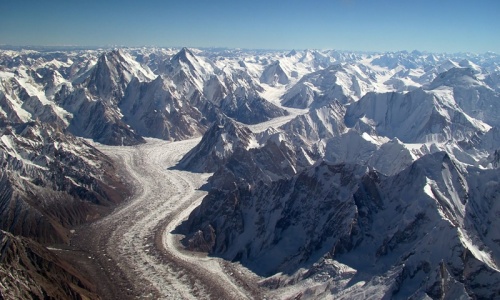
ISLAMABAD: Glaciers in Pakistan are continuously melting because of rising temperature, and by the year 2035, the country will no longer have water reserves in the shape of glaciers.
This was stated by Federal Minister for Science and Technology Zahid Hamid while addressing the inaugural ceremony of the International Conference on Plants, People and Climate 2013 on Tuesday.
The three-day conference has been organised by the Pakistan Council for Science and Technology in collaboration with five other departments of the National University of Science and Technology (Nust).
The minister said in the past 100 years, the average temperature of the world had increased by one degree centigrade.
“Pakistan is contributing roughly 0.34 per cent of green house gases which are responsible for global warming. However, it is the eight most vulnerable country facing climate changes,” the minister said.
He added that siltation of dams was continuously increasing while forest cover was decreasing. “In 2010, floods forced 20 million people to abandon their houses,” he said.
“If global warming continues in the next few years, we will face more natural disasters,” the minister said.
Similarly, Secretary Climate Change Division Raja Hasan Abbas said during the past few years, almost 1,700 people had died in the country because of the floods. In addition, the country faced a loss of $15 billion, he added.
“23 per cent people in Pakistan are at a risk of floods. The glaciers will melt in the next two to three decades and after that, we will face an acute water shortage due to which the risk of food scarcity will increase,” he said.
“A climate change policy had been approved in 2012 and we are trying our best to implement it,” he added.
The secretary of the Ministry for Science and Technology, Kamran Ali Qureshi, said water was important for life and there was a dire need for research to face the effects of climate changes. He added that not only was water being contaminated but plants were also being affected.
“We have to save our water resources because there will be no life without them,” he said.
Pro-Rector Nust Dr Asif Raza said scholars and researchers from all over the world, including United States, China, Switzerland, Nepal and Malaysia, would be participating in the conference.
“Nust has provided a platform for such conferences. The floods of 2010 adversely affected the country and I am hoping that researchers will recommend the solution to global warming,” he said.
Mohammad Ammar, a student of civil engineering at Nust Institute of Civil Engineering (NICE), while talking to Dawn, said environment issues had become very important especially in Pakistan.
“Murree has been greatly affected by construction work. If I got a chance, I would change Murree back to the same city it was around two decades ago,” he said.
“It is embarrassing that every year a fires is observed on the Margalla Hills to cover illegal wood cutting. The government should take steps to resolve such issues,” he added.