0
0

The slogan “Jinnah’s Pakistan” was raised at the launch of the Jinnah Anthology 2nd Edition at the Pakistan High Commission in London in July 2009. It was picked up by the media and news items appeared stating that “the demand of the present time is ‘Jinnah’s Pakistan’ and this view has emerged not only in the civil society media but also at the government level, and this is Pakistan’s hope for change as countries which forget the vision of their founding fathers end up as failed States”.
Mr Ashfak Bokhari while reviewing the Jinnah Anthology 2nd Edition stated, “There has never been so great a need to revisit Mohammad Ali Jinnah’s legacy as now, under the changed circumstances, to renew our resolve to adhere to his ideals, his principles and his vision of Pakistan. Nor has there been so much urgency to disseminate and popularize the political philosophy of Mr. Jinnah – the Quaid-i-Azam to most of us – which has now largely been either ignored by the political community or hijacked by obscurantist and even distorted by Islamists to suit their designs. Given the atmosphere charged with narrow minded approach in the country, not many would be willing to endorse Mr Jinnah’s secular polity and accept that he created Pakistan not to establish a theocratic Islamic State, but a democratic and secular State. Equally disagreeable for many is the fact that he struggled for a separate homeland where Muslims would be able to live in accordance with their social customs and religious traditions – but the polity would be non-religious in which there would be no discrimination between a Muslim and a Hindu. In fact, the Quaid now seems to be an outsider in Pakistan. He seldom figures in public debate and political discourse on issues of vital importance to the future of the country, although his father-figure image remains intact and he is accorded the respect he deserves but as a ritual only. His advocacy of democracy and rule of law is acceptable, but not his firm belief in secularism. The conservative political community, which has grown in size, tends to ignore his ideas about polity. However, there are still many in the community of liberals, progressives and the educated segments who are vocal in asserting the primacy of Mr. Jinnah’s vision in tackling political and constitutional matters and seek to re-establish ‘Jinnah’s Pakistan’”.
Mr Iftikhar Murshed in his article which appeared in the media in January 2011 stated “Jinnah was wrong when, in a rare outburst of emotion, he triumphantly stated before students at Aligarh in 1938 that the Muslim League had liberated them from the clutches of the mullahs. He was similarly mistaken nine years later when he declared at the Constituent Assembly on Aug 11, 1947, that the citizens of Pakistan were free to subscribe to any faith they wished, as religion had nothing to do with affairs of State. He could not have foreseen that the political pygmies who would succeed him would not be able to withstand the relentless onslaught of the religious right. Within six months of his death, the Constituent Assembly adopted the Objectives Resolution, thereby administering a crippling blow to his concept of Pakistan as a modern and progressive State. In one sweep non-Muslims became second-class citizens of a country they loved and did not forsake at the time of Pakistan. The worst was still to come”.
The idea of ‘Jinnah’s Pakistan’ picked up steam when authors and columnists started expressing their views. “How to revive Jinnah’s Pakistan” an article by Izzud-din Pal, appeared in the Press; “Return to Jinnah’s Pakistan”. “Bring back Jinnah’s Pakistan” was a further demand by late Ardeshir Cowasjee. All this went on between 2009 and 2011 but politicians were silent until election year 2012 when several political leaders spoke of ‘Jinnah’s Pakistan’ and promised to adhere to Jinnah’s principles, ideals and vision. Needless to state that nothing materialized from such political statements.
For the past 10–15 years this nation and its people have seen and read how political leaders referred to Jinnah and made commitments to introduce and adhere to Jinnah’s principles, ideals and vision. But all this ultimately turned out to be lip-service in the same way as politicians love to be photographed under the life-size portrait of Jinnah and even take their oath of office with Jinnah towering above them in the background.
Pakistan and Jinnah meant different things to different people. For a large number of people Pakistan was formed in the name of Islam and Muslims of the subcontinent would be free to freely practice and propagate their faith and religious beliefs. To others it meant freedom from domination by the British and Indian majority population. Politicians, historians, scholars and leaders in different spheres of life still talk about the ideology of Pakistan. Opinions differ but 65 years after the creation of Pakistan we are still debating this issue.
The question whether Quaid-i-Azam Mohammad Ali Jinnah wanted Pakistan to be a secular or an Islamic State has been agitating the minds of a large number of people, particularly in South Asia as a result of the recent surge in Islamic activism all over the world. Records of the Pakistan movement do not contain any reference to any speech or statement in which Jinnah used the term ‘secular’ in relation to Pakistan.
When Jinnah spoke of the Muslims of the subcontinent as constituting a nation, he declared that by all canons of international law the Muslims constitute a nation, but also added that the Muslims could never cut away from their Hindu and Christian brethren. The reason was to make the Hindu and Christian brethren understand that the Muslims of India were entitled to their proper place in the Indian sun. Jinnah’s reference to development of the Muslims was cumulative and included cultural, economic, political, social and spiritual aspects which he sought to safeguard and protect for the Muslim minority in a manner that was fair and just to all concerned and was not limited only to religious worship, belief and practice.
Thus Jinnah’s personal outlook of life and on life was evidently secular in nature. He very firmly believed and advised Muslims to follow the teachings of the Quran and that the Prophet was his ideal, but he did not want interference by the State in the religious beliefs and affairs of the people which he considered to be personal in nature. He made this position clear time and again in his public speeches and statements. In a speech in January 1948 he stated, “Islamic principles today are as applicable to life as they were 1,300 years ago. Islam and its idealism have taught democracy. Islam has taught equality, justice and fair play for everybody. What reason is there for anyone to fear democracy, equality, freedom and the highest standard of integrity on the basis of fair play and justice for everybody?”
Jinnah obviously saw no serious conflict between the essential principles of Islam and secular principles as generally understood in the sense that the State would not interfere with the religious performance, worship and practices of citizens and would not legislate and make any law compelling a religious belief or prohibiting any other religious belief, faith, expression or worship.
When Lord Mountbatten referred to Emperor Akbar as a secular monarch whose example could be followed, Jinnah publicly retorted that Pakistan had a more permanent and better ideal to follow in the form of Prophet Muhammad (PBUH). Although Jinnah did not reveal why he referred to Prophet Muhammad (PBUH) at this stage he may have had the Medina Constitution in mind.
Rajmohan Gandhi, the grandson of Mahatma Gandhi and the author of the celebrated book Understanding the Muslim Mind, has dealt with eight leading Muslim personalities in his book including Mohammad Ali Jinnah. He refers to Jinnah’s famous speech of 11 August, 1947 in the Pakistan Constituent Assembly which he describes as a remarkable utterance.
This speech is often quoted, repeatedly interpreted, and often misinterpreted by speakers and writers. Some of them are of the view that Jinnah had bid farewell to his two-nation theory. However, others have observed that the preservation of national unity, which had been Mohandas Karamchand Gandhi’s primary goal, before partition, became a major objective for Jinnah after partition. But what is extremely significant is the reference to an interview by M.S.M. Sharma, a Karachi-based Hindu journalist who did not leave Pakistan until a year after its creation and who recorded a conversation with Jinnah in the following words, “The long and short of his lecture to me was just this. Now that he had got Pakistan, he had no longer any grudge against the Hindus. In fact he was anxious to revert to his old and familiar role of ‘Ambassador of Hindu—Muslim unity’. ‘Now, my dear fellow,’ he roared, ‘I am going to constitute myself as the Protector-General of the Hindu-minority in Pakistan’. “
Jinnah never used the word secular in relation to Pakistan but he did say Pakistan would be a Muslim State and the Constitution would embody the essential principles of Islam. He said that Pakistanis would not emulate the secular leader Akbar as they had a more permanent role model in the Holy Prophet and that Pakistan would not be a theocratic State. But he emphasised that the Holy Quran which enshrined the principles of honesty, integrity, justice, fair play, rule of law, tolerance, equality, was as applicable today as it was 1400 years ago and that the Quran was a complete code of life for Muslims. His personal religious beliefs are irrelevant but he evidently saw no conflict between Islamic and secular principles as he firmly believed and propagated that religion was personal to human beings and was not the business of the State and, therefore, the State should not legislate on religion. Each citizen was free to practice his religious beliefs and would be entitled to equal treatment and protection of law.
On the occasion of the historic Pakistan Resolution in 1940, Jinnah declared that the Muslims of India were a nation according to any definition of nation and they must have their homeland, their territory and their state, and wished his people to develop to the fullest their spiritual, cultural, economic, social and political life in a way that they thought best and in consonance with their own ideals and according to the genius of our people. In a reply to the charge by Gandhi that by a change of faith the children of India who were originally Hindus could not denote a separate nation, Jinnah insisted that the Muslims and Hindus were two major nations by any definition or test of a nation. Jinnah convincingly maintained that the Muslims were a nation with their own distinctive culture and civilisation, language and literature, art and architecture, names and nomenclature, sense of value and proportion, legal laws and moral codes, history and tradition, aptitudes and ambition, in short, the Muslims had their own distinctive outlook on life and of life and by all canons of international law, the Muslims were a nation, Jinnah maintained.
The two nation theory was criticised by several people in retrospect, particularly after the separation of East Pakistan from Pakistan. The large number of Muslims left behind in India and the even greater number of Muslims presently in India gave rise to further criticism, but the emergence of Bangladesh has proved Jinnah to be right because the Bengali Muslims also constitute a nation.
Jinnah’s speech to the Constituent Assembly of Pakistan has been interpreted to mean that Jinnah took a turn towards secularism after Pakistan had been achieved and he wanted to establish a tolerant society with no compulsion on religion and no interference by the State in religious matters, which was personal to each individual and so everyone in Pakistan was free to practice their religious faith and beliefs. Jinnah then went on in 1948 to reiterate that while the future constitution of Pakistan would be democratic, it would embody the essential principles of Islam and later in the same year explained that no one should fear Islamic principles which were applicable today as they were 1300 years ago. He was reiterating the principles of honesty, integrity, justice, fair play, tolerance, equality and adherence to the rule of law.
Jinnah’s Pakistan partly disappeared in 1971 when Bangladesh came into being. Jinnah’s Pakistan in the strict technical sense of his principles, ideals and vision were resisted or deviated by successive governments and political leaders after 1948. They used Jinnah to their advantage whenever it was considered necessary or expedient so as to get acceptability and credibility. It has become politically fashionable for political leaders of different standing and political stature to reiterate adherence to Jinnah’s principles and to state that they want to have Jinnah’s Pakistan. To them I would put the pen portrait of Jinnah by Sarojini Naidu to check if they pass the test. “The casual pen might surely find it easier to describe his limitations rather than to define his virtues.True criterion of Jinnah’s greatness lies not in the range and variety of his knowledge and experience, but in the faultless perception and flawless refinement of his subtle mind and spirit; not in the diversity of aims and challenge of towering personality, but rather in a lofty singleness and sincerity of purpose and the lasting charm of a character animated by a brave conception of duty and an austere and lovely code of private honour and public integrity.”
Practically speaking it is impossible to revert to “Jinnah’s Pakistan” but we can subscribe to his ideals, principles and vision though we have not over the past 65 years produced one leader in the role model of Jinnah, whereas the need of the time is for leaders with a brave concept of duty and an austere code of private honour and public integrity. But then Jinnah also said that Pakistan and its constitution will be what the people want it to be. The people of Pakistan are the ultimate sovereign while governments are only representatives of the people. The ultimate sovereign must assert itself and decide what type of Pakistan they want. It does not have to be Jinnah’s, Iqbal’s or any brand of Pakistan.
In the ultimate analysis, even if Pakistan is presently not what it was in 1947 and even if the Baloch insurgents or freedom fighters have destroyed the Jinnah Residency as a token of their aspiration to reject Jinnah and Pakistan or for that matter “Jinnah’s Pakistan”, it does not matter because Pakistan which according to Jinnah was a moral and intellectual achievement is here to stay. It will be “Our Pakistan - Hamara Pakistan” because the idea of Pakistan which was created by the power of speech, power of the pen and power of vote will never die.
“Pakistan Zindabad.”
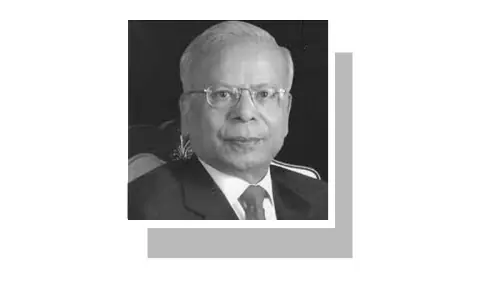
The author is grand-nephew of Quaid-i-Azam Mohammad Ali Jinnah, President of The Jinnah Society, Managing Trustee of The Jinnah Foundation, Executive Trustee of Quaid-i-Azam Aligarh Education Trust and former Deputy Attorney General of Pakistan.