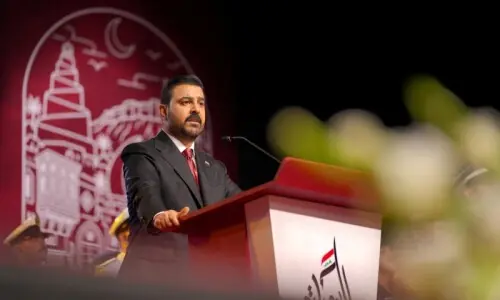
ISLAMABAD: Ruling party candidate Mamnoon Hussain was elected as the 12th President of Pakistan on Tuesday, replacing Asif Ali Zardari whose five-year term expires in September.
Chief Election Commissioner Fakhruddin G Ebrahim said Hussain received a total of 432 votes from the two houses of Parliament and the four provincial assemblies.
Hussain, a 73-year-old textile businessman from Karachi, will be sworn in on Sept 9 at the presidency due to be vacated by incumbent Asif Ali Zardari.
Hussain, who will be president for five years, resigned his membership of the Pakistan Muslim League- Nawaz (PML-N) soon after the election results were announced, in what is seen as a symbolic move to establish himself as a non-partisan president.
Hussain has been an active member of the PML-N since the 1960s. He was governor of Sindh from June to October 1999 when Sharif's government was overthrown by the then army chief General Pervez Musharraf.
The new president was elected by an electoral college made up of members of the Senate, National Assembly and the assemblies of the four provinces. Voting was held with secret ballots at two polling booths from 10am to 3pm.
According to the official results announced by Ebrahim, 432 votes were cast in favour of Hussain. Mamnoon required 263 votes to win, a target comfortably achieved with the 277 votes cast in the National Assembly and Senate.
A total of 77 votes were polled in favour of Justice Retd Wajihuddin Ahmed, the competing candidate backed by the Pakistan Tehrik-i-Insaf (PTI), while nine votes were declared invalid, said the chief election commissioner.
27 electoral votes were cast in the Sindh Assembly, out of which 25 were polled to Mamnoon Hussain while two went to Wajihuddin.
Hussain secured 55 votes out of 56 votes cast in the Balochistan Assembly, while Wajihuddin could get only one vote.
57 electoral votes were cast at the Khyber Pakhtunkhwa Assembly, where Wajihuddin took the lead by bagging 36 votes against Mamnoon Hussain, who got 21.
Out of total 58 electoral votes validly cast at the Punjab Assembly, Mamnoon Hussain received 54 and Wajihuddin 4.
Earlier, Chief Election Commissioner Justice (retd) Fakhruddin G. Ebrahim visited the National Assembly while polling was underway. The voters had been requested to leave their cellphones, cameras etc outside the polling booths for the duration of the election.
Strict security arrangements were in place at the National Assembly, the four provincial assemblies and the Senate for the occasion.
PML-N candidate Mamnoon Hussain also arrived at the National Assembly premises while lawmakers were casting their votes.
The main opposition party in the National Assembly, the Pakistan Peoples Party, had withdrawn its candidate and announced a boycott of the election over reservations on the decision of the Supreme Court of Pakistan to reschedule the poll.
The Awami National Party (ANP), Pakistan Muslim League - Quaid (PML-Q), Balochistan National Party - Awami (BNP-A) and the Awami Muslim League (AML) also boycotted the election.