Hilda Saeed recalls the early days of WAF.
It was a routine meeting of the Shirkat Gah Women’s Resource Centre. In those days we had no office; we just met in each other’s homes. But the talk wasn’t routine, and the mood was tense — we were all deeply perturbed with the news: an inhuman punishment was to be meted out next day to a young couple accused of adultery: a hundred lashes for the woman, who was pregnant, and stoning to death for her husband, Fahmida’s father had lodged a case of kidnapping against Allah Baksh; in court, the couple was accused of adultery, because their marriage was considered invalid under the recently constituted Hudood Laws.The news came as a bombshell. Military dictator Ziaul Haq had come on the scene in 1977, and by 1979, his process of Islamisation had begun. Although the public was aware of these changes, they had not yet affected middle class urban life substantially. Even educated professional women had failed to realise the full impact of the laws passed in 1979, under which the young couple was now being sentenced.
The Shirkat Gah women felt ill-equipped and uncertain as to how to deal with the crisis, but anger won out. An urgent meeting was called of all women’s groups in Karachi; the room was a large one, and crowded. We decided that no matter which organisation we worked with professionally, we would get together to form a pressure group — and the Women’s Action Forum was born. Its mandate: to ensure justice and equality for women. The Fahmida Allah Baksh case was taken to completion by WAF, till honourable acquittal was obtained for the couple.
That was the first of many, many cases. As we gained knowledge and some ability to highlight the overwhelming issues that affected women, our confidence grew, that yes, we too could achieve something....
By this time, our friends and colleagues had opened chapters in Lahore and Islamabad. All became vociferous in denouncing injustice, and struggling for equality for women.
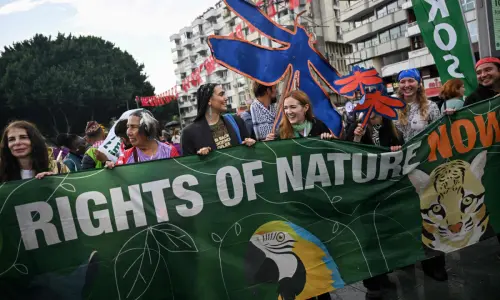
We used whatever means we could to highlight injustices. The media has been our strong support. We held meetings at the Press Club, demonstrated outside, began and ended our marches there, on many occasions, and we have been fortunate to have good press coverage.
Many of us began writing in those years: news offices became our regular haunts; I remember the team at the daily The Star — Asif Noorani, Kaleem Omar, Feica and Vai Ell (we’d pester them to do cartoons for our articles!) Zohra Yusuf (now chair, HRCP) and Saneeya Hussein provided us endless encouragement and support, and our views began gradually appearing in the press.
Those who worked in the social development sector applied their increasing knowledge about women’s issues, linking it to human rights. Those years were wonderfully enriching ones, with that shared struggle, in some cases despite family opposition. Many of us were newly married, or with little children in tow — but nothing deterred us, we would take our children to meetings and demonstrations, we were determined to achieve justice for the countless women who were abused and denied their rights.
The ups and downs were many. Our friends demonstrating in Lahore were beaten up on Feb 12, 1983 — a day that we now celebrate as Pakistan Women’s Day.
The women’s struggle has been shared and joined by human rights activists, marginalised groups, ‘minorities’ — or rather, non-Muslim Pakistani citizens — workers and peasants. All this has helped and enriched us as we continue our struggle for a socially and economically just society, where each person’s human rights are recognised.