THE International Union for Conservation of Nature had recommended 22 years ago that 27maf water must flow downstream of Kotri annually and at least 6,000 cusecs all the time. These figures were probably recommended in 1991, in response to the Water Accord 1991. The old IUCN figures would no longer be valid now because during these years a number of factors have come up, which impact the environmental flows, requiring a substantial upward increase in the IUCN figures.
Climate change will have a profound impact on water accessibility, people’s vulnerability to water-induced hazards, and socioeconomics in areas downstream of Kotri. Together with the river communities’ efforts to improve their adaptation strategies, the water requirements would be relatively more currently than what it was estimated over two decades back, due to increasing temperature.
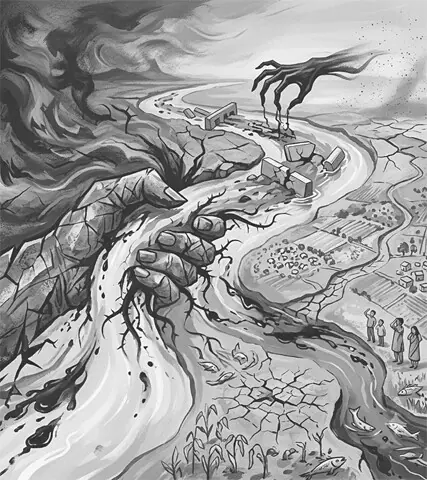
Indus river water pollution is on the increase. As reported in this paper (Jan 7), the participants of Sindh Abadgar Board meeting have urged the government to ensure scientific treatment of wastewater being released into Sindh’s waterways by establishments in Khyber Pukhtunkhwa, Punjab and Balochistan. Also, in Sindh raw industrial and municipal wastewater is discharged into the Indus. Increased water pollution would require more water to flush out toxic constituents from downstream areas. The last two decades have witnessed changes in the use of landscape. Rural areas are being turned into peri-urban areas. This means increased water requirements. This also applies to river communities, downstream of Kotri Barrage. Likewise, the increasing population of river communities requires more freshwater to sustain the human demand and ecological requirements of the river.
Environmental degradation caused by sea intrusion has affected the entire Sindh coastline spread over the two districts of Thatta and Badin. Higher temperatures, due to climate change, are expected to further raise sea level by expanding sea water.
The density of seawater (1.5 grams/cubic centimeter -- g/cc) is more than that of freshwater (1.0 g/cc). Freshwater will, therefore, float on top of the seawater. What this means in the context of lower Sindh is that if there is no freshwater, the seawater will intrude inland. Freshwater tends to exert pressure at the top, forcing seawater beneath out of the area. Increased freshwater would now be required to reverse the process of sea intrusion.
The Sindh planning and developing department should conduct a study to determine the volumetric requirements of the environmental flows (e-flows) downstream of Kotri Barrage. IUCN appears to be an appropriate forum for this study. Many methods have been developed to determine e-flows. However, it is rare just to recommend an annual flow volume. Environmental engineers are now interested in monthly and daily flow volumes and patterns of flow over the seasons. Studies are also required on the biological and civil engineering control of sea intrusion.
F. H. MUGHAL Karachi