BAGHDAD: Iraq on Thursday opened the last day of a landmark sale of energy exploration blocks by awarding two contracts, already better than a poor start that dampened its hopes of cementing its role as key global supplier.
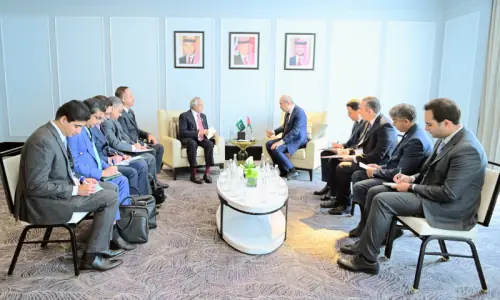
The finale of the two-day sale, the first to invite international oil companies to explore Iraqi territory for energy deposits since the 2003 US-led invasion, opened with the oil ministry handing deals in central and south Iraq to Pakistan Petroleum and Russia's Lukoil respectively.
In all, six more blocks were to be offered on Thursday—five thought to hold gas and one believed to hold oil—including two that were initially offered the previous day.
The bid round, the fourth public auction of Iraqi energy contracts since mid-2009, comes amid progress in ramping up oil exports, which account for the vast majority of government income, and as Baghdad eyes higher gas production to increase woefully inadequate power supplies.
But whereas previous auctions offered contracts to foreign energy firms to raise output at existing oil and gas fields, Iraq has this time showcased areas earmarked for exploration.
Thursday opened with a winning bid from Pakistan Petroleum for a 6,000 square kilometre exploration block which is thought to contain gas covering Diyala and Wasit provinces in central Iraq, with the company agreeing to $5.38 per barrel of oil-equivalent eventually extracted.
And shortly afterwards, a partnership between Russian energy giant Lukoil and Japan's Inpex won a contract for a plot covering Muthanna and Dhi Qar provinces in the south, believed to hold oil, with an offer of $5.99 per barrel of oil.
Of the three oil and three gas blocks offered on Wednesday, though, just two received bids, only one—Block 9, an area near Iraq's border with Iran that is thought to contain oil—was accepted by Baghdad.
A consortium led by Kuwait Energy that also includes Turkey's TPAO and Dubai-based Dragon Oil won the 900 square kilometre block in the southern province of Basra, for a service fee of $6.24 per barrel of oil.
Another exploration block in south Iraq thought to contain oil received a single bid, but it did not meet the oil ministry's asking price and so was not awarded.
“I think it was expected, and it's certainly a disappointment for the oil ministry, but it should give them a reason to rethink the terms that they offered, and the model,” Ruba Husari, an analyst and editor of the www.iraqoilforum.com website, said of the first day of the auction.
“Exploration is too risky, and no one was going to bid big money on something that is not even guaranteed to secure the rate of return.”
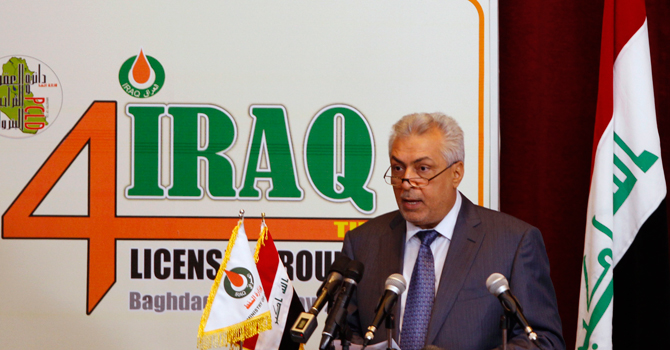
Asked on Wednesday what caused the lack of interest from the companies, Amidi said: “Our estimations do not allow us to (offer remuneration) that we believe could harm the national interest. The estimations of the two sides are not in agreement, resulting in a lack of interest from the companies,” he said.
As in previous auctions, Iraq required foreign firms that agree to explore the blocks to work under fixed-price service contracts, rather than production-sharing agreements that are common elsewhere and more popular with major energy firms.
Baghdad is also now mandating that firms that win contracts agree not to sign deals with the autonomous Kurdish region in northern Iraq, or any other sub-national authority, without the central government's approval.
Kurdistan has signed dozens of contracts with foreign energy firms, but Baghdad regards them as illegal because they were not approved by the federal oil ministry.
Iraq is looking to ramp up its exports from its current level of around 2.5 million barrels per day.