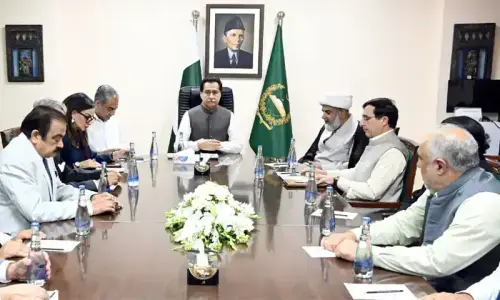
KARACHI, March 20: The central aspect of EU intervention is the distinction they make between the need for civilian operations as opposed to military ones, most of the EU operations were civilian, said Pierre Mayadou, deputy head of the EU delegation in Pakistan, at a talk held by the Area Study Centre for Europe (ASCE) at Karachi University on Tuesday.
Speaking on the topic ‘EU’s emerging role on the security and defence fronts’, he said that the EU approach to security is based on establishing the rule of law under civilian capacity-building programmes.
Mr Mayadou, who has been deputy head for nine months now and formerly worked with the French Ministry of Defence, had the challenging task of condensing the topic of the evolution, relevance and intricacies of EU defence strategy in one brief session.
“When and how to intervene is stated in Article 43 of the Treaty of the EU,” he said. “All 27 member states need to agree to the intervention as well as commit state assets. The Political and Security Committee (PSC) exercises strategic direction and political control. There is no suo moto — unlike the Supreme Court of Pakistan,” he added.
An example of a military operation given by Mr Mayadou was that of Operation Atalanta against piracy off the coast of Somalia which began in 2008 — an operation endorsed internationally and in the interest of many, including Pakistani sailors.
The EU has since 2003 initiated over 23 crisis management operations under the European Security and Defence Policy — with the signing of the Lisbon Treaty in 2007 it is now known as the Common Security and Defense Policy (CSDP) — but these are mainly in the Balkans and Africa. Mr Mayadou said that the reason for this is the geographical proximity in the case of the Balkans, and historical ties in the case of Africa.
In his introductory statement, ASCE Director Dr Moonis Ahmar said that Europe had lived through more than 400 years of war — it was a continent with a history of armed conflicts, notably the world wars — but since 1945 has been prosperous and peaceful.
The role of NATO was highlighted as being not only historically important, but also still relevant even under the CSDP. Mr Mayadou reiterated the famous adage “Keep the US in, the Germans down and the Soviets out.”
However the deputy head mentioned how the Balkan crisis had caused the EU to review its approach to security. “EU institutions did not have the capacity to play a role in the crisis,” he said. “This was a wake-up call.”
The Lisbon Treaty signed in 2007 endorses the so-called “Petersberg tasks” — a list of military and security priorities in the CSDP — which includes tasks such as joint disarmament operations as well as peacekeeping.
Regarding Pakistan, Mr Mayadou said that the country views the EU through its traditional optic of trade and development.
“The EU is Pakistan’s foremost trading partner, and has been active in supporting democracy in regard to electoral process as well as human rights,” he said.
“Recently there has also been progress in research and technology exchanges but there are no EU defence projects in Pakistan.”