DESPITE New Delhi’s tough-looking posture regarding its activities in India-held Kashmir, it is quite apparent that international reactions to the Modi government’s brutal tactics in the region are beginning to hurt.
For one, it is clear that India’s ill-advised move of annexing occupied Kashmir by changing its constitutional status has not altered the status quo internationally; much of the world still considers Kashmir a disputed territory, exposing India’s fiction that the troubles in IHK are an ‘internal matter’.
The other day, US Assistant Secretary of State Alice Wells reiterated Washington’s position in a briefing giving to a Congressional panel, saying that the US considers the LoC “a de facto line separating two parts of Kashmir”.
Elsewhere, Malaysian Prime Minister Mahathir Mohamad has stood by his criticism of India’s tactics in IHK at the UN General Assembly in September. The veteran leader’s forthright comments have drawn the ire of Indian trade bodies, with one concern calling for a ban on the import of Malaysian palm oil.
Moreover, Turkish President Recep Erdogan’s raising of the Kashmir issue — also at the UNGA — has reportedly made Narendra Modi postpone a forthcoming visit to Ankara.
The fact is that due to India’s size and economic potential, it has bullied smaller and less powerful states into toeing its line. However, now that stronger states are challenging its actions and calling out the atrocious human rights situation in IHK, New Delhi is showing visible discomfort.
Indeed, all the spin in the world cannot change the situation on the ground in occupied Kashmir.
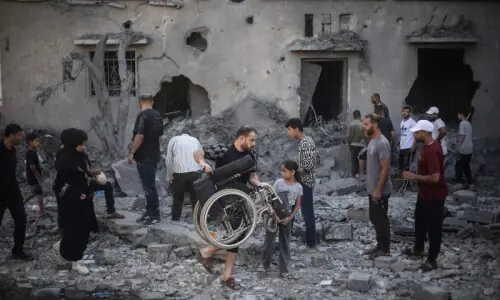
The region’s people have been suffering under a suffocating lockdown for over two months, and people of conscience around the world are expressing their disapproval of these brutish actions. Even the Indian drama of carrying out strikes against ‘terror launch pads’ on this side of the LoC has been exposed, as envoys from various states were given a tour of the affected areas on Tuesday, clearly showing that the victims of India’s ceasefire violations were innocent civilians.
Indeed, it is to the government’s credit that human rights violations in occupied Kashmir are now being discussed at world forums.
Pakistan’s diplomats have apprised key world capitals of the situation in the occupied region, and the result is that states and individuals are speaking out against the violence in IHK and calling for justice for Kashmiris.
From hereon, the Indian state can do one of two things. Either it can continue to sulk and break off or downgrade ties with all those that criticise its horrible behaviour in IHK. (This may not be a workable policy, especially if more and more states start calling for justice to be done in Kashmir.) Or New Delhi can adopt the path of dialogue and statesmanship, end the siege of Kashmir, and work with Pakistan and the Kashmiris for a long-term solution.
Published in Dawn, October 24th, 2019