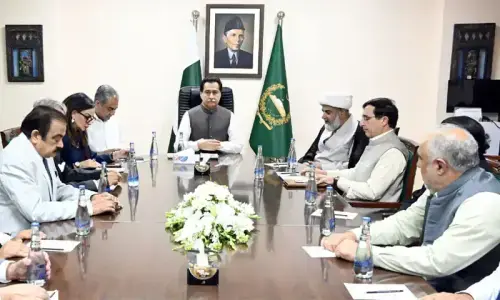
KARACHI: The much-awaited draft Geographical Indication (GI) Bill 2016 was presented by the Intellectual Property Organisation (IPO) on Wednesday before relevant stakeholders including lawyers, businessmen and bureaucrats.
The meeting observed that Pakistan’s GI protection law has been long overdue and IPO should expedite the process of making the draft into a law. The panellists highlighted issues confronting trade without GI protection and certification.
The participants observed that the GI protection draft was impressive but not as exhaustive as the law in developed countries.
However, some panellists strongly advised that Pakistan must protect its GI logo and maintain its reputation by working hard on research and development.
Being one of the marketing tools and a tag for getting higher price, efforts must be made to maintain the benchmark and keep up the reputation of its characteristics and features, they added.
It was also advised that the responsibility for certification of GI should not be entrusted to any trade body as it would result in conflict of interest and a committee be formed to decide which authority or government body should be entrusted this task.
The case for Basmati
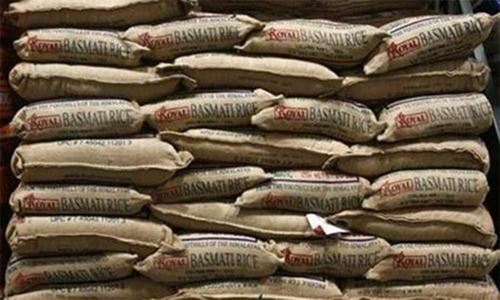
The meeting was informed that the Rice Exporters Association of Pakistan (Reap) had been at the forefront for demanding protection for Pakistan’s Basmati rice.
Way back in 1994-95, Reap took up the issue with the government after the European Union threw out Pakistani Basmati from GI certification following strong lobbying by India.
As a result, the Indian Basmati rice started fetching 150 to 200 euros per tonne while Pakistani Basmati rice having no GI certification was quoted at 50 euro per tonne, a speaker said.
Pakistanis put up a strong argument with EU as to how it was possible that a farmer only 40km away from an Indian rice grower could get a lower price for the same produce. Finally India agreed to enter into talks on GI for Basmati rice in Geneva, he added.
It was also observed that while Pakistan could have signed the GATT in 1948, it did so in 1995. The speakers questioned as to why there was a long delay in protecting Pakistan’s GI interests which are directly related to trade interest and our heritage.
It was stated that WTO is of a view that every member country – including Pakistan – has to protect its GI interests so that their indigenous products could fetch better price in the world.
The meeting noted that if India today has around 200 products protected under GI, Pakistan could at least have around 100 goods which could fall under the category of GI which ensures value-addition which also helps to get better price in world market.
Besides Basmati rice, Pakistan could have GI logos for mangoes, Sindhi Ajrak, Multani halwa and so many other indigenous commodities.
Prominent among those who spoke were Director IPO Meesaq Arif, TDAP Director General Dr M. Usman, IPO expert Dr Owais Hassan, Sheikh Zahid Khwaja of REAP, Feroz Ahmed of SMEDA, PIPRA Chairman and Registrar of Trademark.
Published in Dawn, August 18th, 2016