KARACHI: The feminisation of poverty is a contested concept primarily because to truly understand it, one must openly acknowledge the rampant gender bias within Pakistani society.
This was the major thrust on Saturday at the launch of the annual diary of Uks Research Centre, a resource-based publication centre dedicated to the cause of gender equality and women’s development.
According to the director of Uks, there is a general lack of comprehension about the concept among media personnel, the bureaucracy, the military and the rest of civil society. As a result, policies and legislation thus far have done little to encourage a gender-balanced society. “It is only when the powers that be realise how detrimental their present gender biased policies are to the well-being of all Pakistanis, and to the nation and country as a whole, that things may change for the better.”
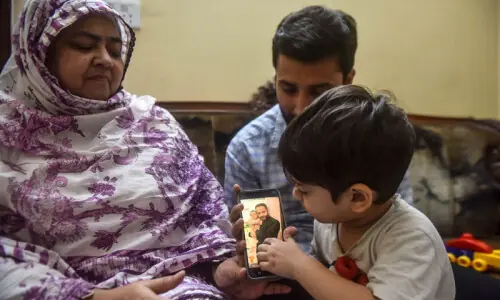
And things do look very dire. Image after image and news after news focuses on highlighting the pitiable state women are at most times reduced to, and how efforts being made to mitigate the impact are few and far between.
The diary compiles different articles, advertisements, opinion pieces, cartoons and images published in Urdu and English newspapers, where women functioning in different capacities are highlighted. The one refrain present within all these representations is how women are affected by poverty more so than men.
Ghazi Salahuddin spoke about the empowerment and emancipation of women in Pakistan which is present in individual cases, however, the overall condition is very serious. “If you read or hear stories about people in disasters or facing deprivation, we see the most severely affected among them are women.”
Reporting on such issues raises concerns, according to Mr Salahuddin. “We have reached a stage where media is not part of the solution but is becoming a part of the problem, especially the electronic media. This is because they cater to the lowest common denominator and then further bring it down. This is proved by how society has taken a turn for the worst in the decade or so of the rise of the electronic media.”
Representative of the National Organisation for Working Communities Farhat Parveen brought forth to the discussion the disadvantaged position of working women. “In Pakistan only 0.5 per cent workers are unionised and the law in place for unionisation is very regressive,” she said, and connecting this to the overall increase in poverty in the country.
“We have seen an overall increase in employment of women workers in different industrial and manufacturing sectors, including the services industry. However, this in no way suggests that there has been a marked improvement in their status,” she said, adding that women mostly were given jobs which were paid less, or having very poor and hostile working conditions.
The concept of home-based workers, a growing trend among women nowadays, was also discussed.
Many proponents believe it is a better option that women are stepping out and in a way it empowers them. Ms Parveen disagrees and insists that it is just a means to get the work done on a must cheaper rate.
Zubeida Mustafa was also present and took influences from her decades-long career and called out the problem as being more deep-rooted than originally believed, as the general attitude of society towards women is biased.
“This can be seen in how we treat boys and girls. A mother will feed her son more than her daughter, rush him to the hospital if he falls ill, yet will wait out in case her daughter falls ill. This issue therefore manifests itself into a bigger issue.”
Mrs Mustafa ended her talk on a very apt observation about how Pakistan was headed into murky waters. “I always was of the opinion that education would fix all our issues, however, now it is being used to forward the agenda of different stakeholders,” she said.
A global war must be waged against poverty and as the state is not doing enough to achieve this, individual-based efforts, all present at the launch, agreed was the need of the hour.
Published in Dawn, January 24th, 2016