59
59


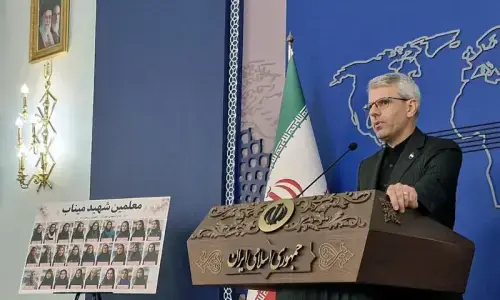
WASHINGTON: The US nuclear deal with India has affected the strategic stability that existed in South Asia before the deal, says Foreign Secretary Aizaz Ahmad Chaudhry.
The foreign secretary, who will lead the Pakistani team at the US-Pakistan talks on security, strategic stability and non-proliferation which begin in Washington on Tuesday, said that maintaining this strategic balance was necessary for peace in South Asia.
Also read: ‘US-India nuclear deal will disturb regional balance’
“This will be our main line in these talks,” he told a news briefing at the Pakistan Embassy on Monday.
“The perception of the threat form India was the only rationale for Pakistan’s nuclear programme,” said Mr Chaudhry. “This is a weapon of deterrence, not for actual use.”
The secretary, however, noted that the US-India nuclear deal, signed in 2006, had “affected strategic stability which existed before that.”
Mr Chaudhry pointed out that in a joint statement issued after the nuclear confidence-building talks in January 2004, both India and Pakistan had recongised this as “a factor of strategic stability” in the region.
“Any discriminatory treatment is not good for strategic stability and this has been our consistent line: create a level playing field.”
The secretary explained that in the last decade, Pakistan had gained international recognition as a responsible nuclear state.
“We have come a long way in establishing strong export controls against any proliferation of nuclear materials,” he said. “And our export control lists have been harmonised with the multilateral export regime.”
Mr Chaudhry said that nuclear safety was another strong area where Pakistan had made a considerable progress.
“We have more than four decades of experience in power generation and our nuclear facilities have been completely safe,” he said, adding that there was now an international recognition of Pakistan’s strong credentials.
Tuesday’s talks will cover “a whole range of issues”
relating to strategic stability in South Asia, including non-proliferation, civil nuclear cooperation, and other areas of nuclear safety, security and strategic stability, he said.
Rose Eilene Gottemoeller, the Under Secretary of State for Arms Control and International Security, will lead the US team in the talks.
Published in Dawn, June 2nd, 2015
On a mobile phone? Get the Dawn Mobile App: Apple Store | Google Play