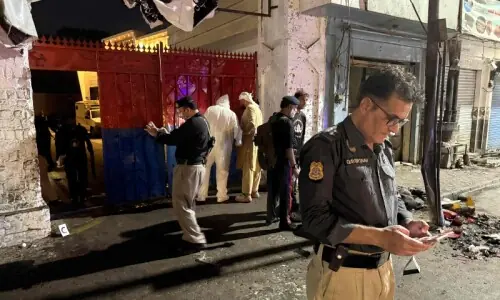
TWO days on, the country is still reeling in the aftermath of Sunday night’s assault on Karachi airport. Just as nerves were beginning to stop jangling, as bodies were being lowered into the ground and the costs started being counted, came a second, though less deadly, attack on the Airport Security Force’s Camp # 2, adjacent to the same airport. The attackers in the second incident managed to flee, unlike the ones in the earlier attack who were killed. This, if the state is to be believed, constitutes a great victory — these particular militants’ ability to wreak further havoc has been cut short. The government’s attempt to put a positive spin on the incident notwithstanding, nothing could be further from the truth.
The fact that must be faced is that what happened at the airport on Sunday night constituted a massive failure of the state, an indictment of the country’s security strategy. First, and most obviously, there is little to celebrate in eliminating men who had never expected to walk away alive. Second, more damningly, we had forewarnings. Similar assaults on similarly sensitive installations have taken place before, from the siege laid to the GHQ in Rawalpindi in 2009, to the attack on the PNS Mehran base in Karachi in 2012, to the PAF Minhas airbase at Kamra a year later. In any country where efforts to counter the situation are genuine, these incidents would have been more than enough to prompt a full rethink of the national security strategy in the face of the internal and escalating nature of the threat. Given the scale of the militants’ assault on Pakistan’s state and society over the past decade, our security and intelligence personnel should have been amongst the world’s best-trained, most well prepared and highly efficient. Instead, once again, we find the security and intelligence machinery helpless in the face of an implacable enemy, demonstrating a preposterous level of ineptitude — just as we saw in the context of a range of assaults such as the D.I. Khan jailbreak last year.
Do we need further evidence that an overhaul of the country’s security systems and personnel is urgently needed? Must more dead bodies pile up before we see anyone being galvanised into determined action? There are hard questions, and Pakistanis — as well as the rest of the world that is increasingly becoming convinced that this is a battle the state is not up to fighting — need answers. For instance, it is indeed remarkable that the militants somehow managed to slip into a secure airport area a large number of weapons that would have been impossible for the 10 attackers to carry. But all the federal interior minister — whose job it is to ensure that this sort of thing does not happen — could do was to express his shock and amazement in parliament. Clearly, if Pakistan is going to succeed, far more seriousness of purpose is needed.
Published in Dawn, June 11th, 2014