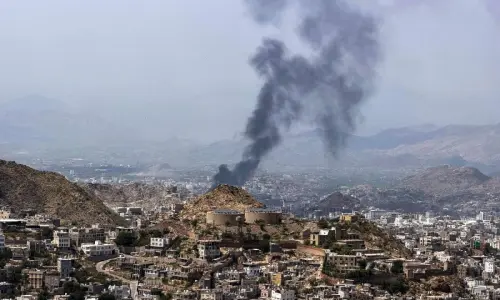
DESPITE the ‘operation’ against criminals and violent elements in Karachi, major bloodshed returned to the city on Tuesday as at least 15 people were killed in different parts of the metropolis. On the surface it seemed the violence had heavy sectarian overtones. A Shia scholar and political leader was gunned down along with his bodyguard while later in the day three members of the Tableeghi Jamaat, including two Moroccans, were shot outside a city mosque. However, care must be taken not to jump to conclusions. After all, the lines have become so blurred in Karachi that it isn’t immediately clear if killings are sectarian, ethnic or political in nature, or if criminal gangs are involved. Sometimes it can be a combination of factors. What is clear, though, is that in terms of law and order Karachi is a total mess. As Tuesday’s violence showed, this city of millions can be paralysed within a few hours.
When it comes to analysing the violence, the authorities resort too often to oversimplification by blaming killings on ethnic or sectarian factors. Nearly every other murder is termed a ‘targeted killing’. If sectarian gangs are operating in the city carrying out attacks on rivals in retribution, or if ethnically motivated killers are at work, there must be proof to back up these claims. The suspects must be identified and prosecuted using credible evidence-gathering and investigation techniques. Simply lumping all killings under the ethnic or sectarian tag amounts to brushing them under the carpet. And if a ‘third force’ is at work — as police officials have said — trying to spark communal discord, who constitutes this force? Who is involved in planning and financing the violence? And more importantly, what is the state doing about it?
While the efforts of the police and Rangers over the last couple of months did bring down the level of violence in Karachi, the relief was only temporary. The problem is that the Sindh government is looking at the symptoms, not the cause of the violence, with the approach being one of fire-fighting, not proactive investigation and law enforcement. The police needs to name names to unveil who is involved in Karachi’s bloodshed while the administration must follow up by investigating these crimes, prosecuting the suspects and breaking the networks involved in destabilising the metropolis. If such bouts of deadly violence continue unabated, it can only bode ill for communal harmony in the city and country.