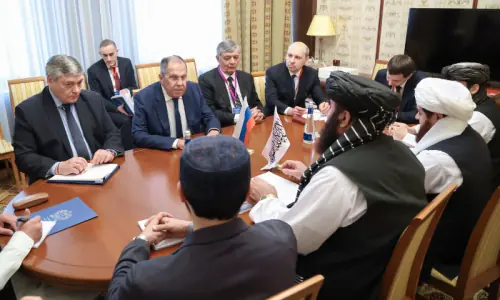
ISLAMABAD, Oct 28: The first Pak-Afghan mini-Jirga formally decided to hold talks with militants in their respective areas of control if the Taliban agreed to adhere to the countries’ constitutions. However, the jirga dropped the condition that militants should first renounce violence.
Both Kabul and Islamabad had earlier insisted that talks with the Taliban would be possible only if the militants laid down arms and renounced violence. But, the declaration adopted at the end of the mini-jirga only talked about “urgent and imperative need of dialogue and negotiations with opposition groups in both countries with a view to finding a peaceful settlement of the ongoing conflict, upholding the supremacy of constitutions of both countries”.
Analysts described it as a significant step forward and said it might create room for negotiating teams to start dialogue for ending militancy.
However, the move is likely to draw severe criticism from the West which insistsd on the condition of renunciation of violence by militants before holding talks with them. US Assistant Secretary of State Richard Boucher said during his recent visit to Islamabad that there was no option but to fight the militants because they had not shown sincerity in renouncing violence — an essential pre-requisite for peace talks. “Upholding supremacy of constitution of both countries is non-negotiable,” said chairman of the Afghan component of the Jirga Mr Abdullah Abdullah at a press conference at the end of the talks.
NWFP Governor Owais Ghani, who led the Pakistan side, told journalists that the doors for negotiations were wider open now. “We’ll talk to everyone.”
“Every option would be explored because we want to create an atmosphere to take forward this initiative of the jirga. We will take it forward at any cost,” Mr Ghani said
The purpose of relaxing the conditions for talks appeared to be opening up channels of communications with the warring groups.
The Taliban would be approached by a committee comprising ‘influential people’ and its contact groups to be set up by chairmen of Pakistan and Afghan components of the mini-Jirga.
Although Governor Ghani refused to explain what the joint declaration meant by ‘influentials’ for contacting the Taliban, a reference in the declaration to strengthen the role of Ulema in the process indicated that religious groups and leading religious figures would play an important role in the process.
Names of people involved in the dialogue, Mr Ghani said, would be kept secret.
Islamic customs, traditions and prevalent practices (revaj) would be used to pursue dialogue to promote peace and reconciliation in both countries.
The contacts would take place over the next two or three months and a report in this regard would be presented at the next mini-Jirga to be held in January in Kabul.
About chances of success, Governor Ghani said they would initiate talks with “good intentions, God’s blessings, and support of tribes. We will attempt to gain the confidence of the warring groups”.
Referring to the 14-month delay in convening of the mini-Jirga because of a Pak-Afghan tiff, Mr Abdullah said: “The two countries have missed some opportunities for peace.” He praised the unanimous resolution passed by Pakistan’s parliament last week and said the new situation offered ‘new opportunity’ for securing peace.
Referring to tribal lashkars being raised in Pakistan’s tribal regions, the joint declaration said there was a consensus in the Jirga for supporting local populations for reviving and strengthening local structures and enabling them to deal with terrorists and restoring peace in their domains.
The declaration denounced militancy and terrorism as a common threat to both countries and called upon both governments to deny sanctuaries to terrorists.
It stressed the need for closer ties between the two countries and said their destinies were closely interlinked and a coordinated response to terrorism was required for creating peaceful and stable environment in the region, which was necessary for the prosperity and development of the people of two countries.
A separate committee was constituted for implementing peace jirga decisions for promoting cooperation between the two countries.