0
0

Pricey electricity
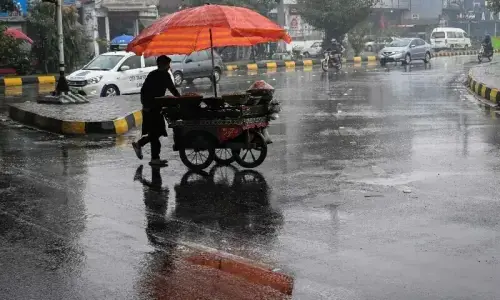
ELECTRICITY has become more expensive. The ministry of water and power has issued a notification to retrospectively increase the electricity tariff by an average of 31 per cent for all consumers of the eight distribution companies of the Pakistan Electric Power Company. This means that domestic, agricultural, commercial and industrial consumers — in short, everybody — in Lahore, Gujranwala, Faisalabad, Islamabad, Multan, Peshawar, Hyderabad and Quetta will receive substantially higher electricity bills. The tariff increase, although necessary, has been met with dismay across the board. The All Pakistan Organisation of Small Traders and Cottage Industries has demanded the withdrawal of the notification, claiming that over 4,000 businesses have already closed down.
Electricity pricing is a complex issue but several simple observations can be made. First, why did the government need to issue the notification so surreptitiously late into the night? Governance by stealth appears still to be the modus operandi in Islamabad. There is simply no excuse for news reports having to rely on ‘sources’ to inform the public of a matter as basic and important as their electricity bill. Even until Wednesday evening, officials at the ministry of water and power were unavailable to advise the public on what to expect in their bills next month. Then there is the issue of the methodology used to calculate the new price of electricity. The prevailing method is for the distribution companies (DISCOs) to petition Nepra, the national electricity regulator, for a tariff increase. Nepra considers the DISCO’s petition and then issues a recommendation to the government. The ministry of water and power can accept, decline or modify Nepra’s recommendation before issuing a final notification. In the current cycle, individual DISCOs petitioned Nepra in May and June requesting an increase of between 10 and 20 per cent in tariffs. However, Nepra advised the government at the end of August to raise tariffs of the DISCOs by up to 76 per cent, with different rates of increase for individual DISCOs. Those recommendations have now been converted by the ministry of water and power into a uniform tariff increase across the DISCOs for different categories of consumers. The only thing that is clear in this whole process is that the public has been kept in the dark about the government’s thinking and plans for future tariff increases.
Finally, there is the issue of winners and losers in the tariff stakes. So-called ‘lifeline’ consumers have been given a reprieve by increasing the base from which the increases are applicable to 100 units from 50 units. However, consumers using 700 units and above will effectively be billed 50 per cent more. Depending on consumption, the middle-class is set to take an enormous hit of either 26 or 50 per cent.
Coping with trauma
A REPORT about the plight of the family of a young man, who died in the recent twin suicide blasts at the Pakistan Ordnance Factories, has highlighted the emotional and psychological fallout that such traumatic events can have on affected families. The victim’s mother, who also has four daughters, was so traumatised by the loss of her only son that she had to be hospitalised. It is not only the family members of those who have died but also the survivors of suicide attacks who may suffer from severe emotional reaction to such horrendous events — a condition which is clinically termed as post-traumatic stress disorder (PTSD).
Although the term PTSD was originally coined in 1980 with reference to the readjustment difficulties experienced by Vietnam veterans on their return to the US, it has since then been increasingly extrapolated to civilian populations who are traumatised by shocking events. We as a society have been pretty resilient and resourceful, and have shown a remarkable ability to rebound and cope with one traumatic incident after the other, whether it is a suicide blast, a natural disaster, a major accident or war. Nevertheless, there has been growing awareness that the increasing number of people affected in one way or another by such mass-based distressful events, as well as by other more individual-based traumatic experiences like torture, assault, domestic violence etc., need help in dealing with and recovering from their emotional shock and returning to their daily life and routine.
In this respect, the First International Conference on Psychotrauma held recently at the Jinnah Convention Centre in Islamabad represents an important step in building our capacity for preventing and mitigating stress caused by traumatic events. Organised by the National University of Science and Technology’s Centre for Trauma Research and Psychosocial Interventions, the conference discussed ways to deal with the growing phenomenon of pyschotrauma in our society. As many countries have already done, we too need to establish more specialised psychotrauma centres, not only for psychological therapy and counselling but also to provide education and training in emergency mental health services to all emergency service professionals including psychologists, psychiatrists, social workers and counsellors. As was aptly pointed out at the conference, while it may be impossible to prevent natural disasters and difficult to stem acts of violence in society, the psychological and social effects of these on our people can be minimised by building our capacity to put up a fight against them.
A rare honour
SPECIAL athlete Haider Ali’s silver medal in the long jump final of the Beijing Paralympic Games on Tuesday has done Pakistan proud. In his first Paralympic Games, 23-year-old Haider, who has cerebral palsy, took the lead over favourites China and Poland, and ended up sharing the world record with Farhat Chida, the gold medallist from Tunisia. Coincidently, this was also Pakistan’s first-ever medal at the Special Olympics since the country’s debut in the competition in 1992 at Barcelona. This achievement will go a long way in propping up Pakistan’s fast-eroding sporting image in a year marred by shameful debacles in cricket, hockey, squash and, of course, the recently-concluded Olympic Games in Beijing from where the 37-member Pakistani contingent returned empty-handed. Indeed, Haider’s feat is a rare honour especially in view of the severe embarrassment endured by the national hockey team that finished eighth — an all-time low for a once winning team — at the Games. What is equally shameful is that none among the shooting, swimming or athletic contestants made any kind of attempt to reach the medal podium. In such a bleak scenario, Haider’s effort, fortitude and sense of sporting spirit at the Paralympic Games, despite his handicap, is deserving of unqualified praise and not one bit blighted by fellow athlete Naveed Butt’s doping saga the same day.
Haider’s achievement makes it all the more difficult for our so-called sporting superstars to save themselves from the wave of national antipathy that has arisen in the wake of their abject performance at the Olympic Games. It is not as if the athletes and sports administrators woke up to the Olympic challenge one fine morning. They had four years to prepare for the Beijing Games and yet turned in an abysmal performance when they got there. This is hardly surprising when the quick-fix solution to sporting woes and the lethargy of years comprised energy-sapping camps — instead of efforts to put together winning combinations, work out strategies, eliminate deficiencies and throw up new ideas on the tactical side. It is no shock then if they returned from the Olympics with nothing to show for their efforts.
OTHER VOICES - Middle East Press
Yet another try at peacemaking
Arab News
THE Israeli response to the Syrian peace proposal will have to wait. No reply will be [given] until the results of elections in Israel and the US are in. But President Bashar Assad’s assurance that when there is a peace accord there will be reciprocal recognition should make Israel’s eventual response a positive one. The logical next step would be for Syria and Israel to engage in face-to-face negotiations.…[E]ven though the Syrian proposal has not been made public, it revolves mainly around the Golan Heights captured by Israel in 1967…
…Israel has demanded that Damascus end its support for the groups in battle with Israel, namely Hezbollah in Lebanon and the Palestinian Hamas. There is nothing surprising in this. This is the usual Israeli tactic to avoid making any commitments … to Arabs. With an injured innocence, Israel can say it can’t make any concessions as long as Damascus associates with or helps its enemies. Again it will be Israel or its friends who will decide whether the association has ended or not.
In 2003 President Bush announced that Syria just had to wait until all pending issues in the Middle East were settled before the US turned to the Syrian-Israeli track. Ariel Sharon helped convince President George W. Bush to keep the Syrians on the backburner for years.… [R]eal peace can only be achieved with full and active Syrian participation and cooperation. — (Sept 8)
Don’t push Pakistan around
Khaleej Times
WITH the third possible unilateral US strike inside Pakistan in as many days, the outrage in Pakistan is only understandable.
There can be no denying that Islamabad has been at the forefront of the so-called war on terror ever since General Musharraf effected the u-turn on the Taliban and hopped on to Bush’s ‘with us or against us’ bandwagon in the aftermath of 9/11.
Those accusing Pakistan of not doing ‘enough’ betray a gross misunderstanding of ground realities. Pakistan’s border with Afghanistan remains one of the most difficult to monitor anywhere in the world. For the US to strike from the outside not only adds to domestic resentment that has festered over long years of war, but also severely compromises the Pak military’s operations....
It is not surprising that a number of very strong trends have emerged inside Pakistan. One, the tribals that sided with the insurgents have grown in number and strength, using the hate-America card chiefly because of such outside strikes that ridicule locals on the ground as well as the government in Islamabad. Two, the more moderate group too now advocates ditching the US alliance as it has brought unprecedented losses for their country. Three, with a democratic government in Islamabad that is struggling practically on all fronts, America is making it increasingly difficult for Pakistan to remain part of the US coalition.… — (Sept 6)
Democracy’s best revenge
AFTER the Oct 6 burlesque enacted in Pakistan last year in which a military dictator unconstitutionally proclaimed himself re-elected we finally had on Sept 6 this year a real presidential election in which the PPP’s co-chairman, Asif Ali Zardari, was constitutionally elected as the first democratically-chosen president of Pakistan in a decade. This was the best revenge that democracy could have taken on dictatorship.
Gen Musharraf was ‘re-elected’ for five years by his handmade ‘Queue-lined’ assemblies despite serious questions over his eligibility in the circumvention of Articles 41 and 63 of the constitution. Asif Zardari has been elected president in a constitutionally legal election for five years, but in his case too, there were questions over his eligibility raised both within and outside the country. The only difference was that in the case of Musharraf, the latter’s illegality under Article 41was real, whereas in Zardari’s case, questions related only to alleged perceptions of his past.
Democracy is not about perceptions or reputation. Democracy is about people who are the final arbiters, no matter how poor a reputation a politician might have. They choose their leaders. History then gives its verdict on whether or not they made the right choice. In Gen Musharraf’s case, the new democratically elected assemblies have spoken loudly and clearly against him. History didn’t let him complete his five years. It was quick in giving its verdict. He was forced to quit. He stands discredited and doomed to ignominy.
Zardari has a chance to prove that perceptions regarding his reputation are ill-founded. History is already registering its accounts and will soon start judging him. It is between history and Zardari now. What about the people? They would like to believe that real democracy has finally returned to their country. And in politics, as in every other aspect of life, what people know and understand or what they believe largely depends on what they see, hear and feel and how they think and act.
But in looking at the unfolding events in our country and the acts of our newly elected rulers, we see what is not, and see not what is because we have chosen to be prisoners of an exploitative system based on elitist, feudal and tribal structures. There are no angels in politics. Even in the world’s major democracies, heads of state and government and eminent politicians have been implicated in assorted scandals. Big names come to mind in no time. Hypocrisy and vacillation are the hallmarks of success in politics.
If Plato was sometimes cynical about politics, he had reason to be. As he wrote in his Apology, “a man who really fights for what is right must lead a private, not a public life, if he hopes to survive, even for a short time.” Politics knows no morality, no ethics. Plato was raised by a distinguished Athenian family for a political career but was disillusioned with politicians. He saw his city-state being torn apart by a power conflict among the politicians themselves.
Disheartened by the oligarchs’ attempt to discredit Socrates, his teacher and friend, Plato refused their offer of a political niche although some of the oligarchs were his close relatives and friends. He was even more profoundly disillusioned by the democrats who, when restored to power, condemned and executed Socrates. So he fled both country and politics for a self-imposed exile with Euclid in Megura.
For Plato, the prisoners are we who are “dwelling in the cave of concrete experience until the philosopher-king brings enlightenment to our shadowy reality”. He acknowledged that the philosopher would be reluctant to descend to the shadowy world of reality once he glimpsed the sun but he still remained uniquely qualified for leadership because in his view, his eyes would be on the principle of good, not on political ambition and personal power.
Plato devoted almost all his thinking to reuniting the public and the private, the political and personal realms of existence, so that the “virtues of the individual soul” would lead to the virtues of the national soul. Soul-tending, he called it, and it is what we in Pakistan today need more than ever before. Zulfikar Ali Bhutto had inherited a physically truncated country. Asif Ali Zardari’s challenge is much bigger and perhaps more tortuous. He inherits a Bhuttoless truncated party and an emotionally disintegrated country. Both need soul-tending.
We as a nation have suffered the politics of power and blood for too long. It has been a constant struggle and a long tragedy of errors since the very beginning. The script is the same. Only the faces have been changing. We have seen prime ministers assassinated, removed in military take-overs, executed through judicial murder and in some cases even exiled. Benazir Bhutto gave her life for democracy and fell tragically at the altar of our politics of power and blood.
Pakistan has been the scene of pitiable tragedy for too long now. We have had coups, both military and civilian, and in every instance, there has been someone from the judiciary to provide ‘legal’ cover to the illegality. The present set-up is no different. It is rooted in the Nov 3 illegality.
Benazir Bhutto must be turning restlessly in her grave over what her party is doing to the pledges she had made to the nation during the last days of her life. She had pledged a genuine democracy rooted in the will of the people and had promised to reinstate the real judges. She had told the chief justice that he would soon be back in his chamber. She must be witnessing with horror and anguish that her own commitment to the chief justice and the one to the people’s Feb 18 verdict remain unfulfilled.
We may not have a philosopher-king but we now do have a democratically elected president who has the authority to do justice that his party’s immortal leader and his own better half had pledged. The nation awaits soul-tending from him. Plato’s central question in his Republic was ‘what is justice?’. Mr President, let us hear from you: ‘Iftikhar Mohammad Chaudhry is justice’. This would complete democracy’s revenge. Let history judge you differently from the baseless perceptions of your past. Prove your detractors wrong. You have a chance to be a different ruler in Pakistan and make history.
The writer is a former foreign secretary.
White women’s choice
WHITE women voters are deserting the Democratic presidential candidate Barack Obama because of the sudden emergence on the Republican ticket of Sarah Palin, according to a poll on Tuesday.
An ABC/Washington Post survey recorded that an eight-point lead Obama held over his Republican rival John McCain before the arrival of Palin had turned into a 12 per cent lead for McCain.
The trend is in line with other polls since Palin, McCain’s vice-presidential running mate, ignited the Republican convention with a speech last week espousing social conservative values and presenting herself as a small-town mother taking on the cosmopolitan media.
McCain, who was behind Obama in most polls before last month’s Democratic and Republican conventions, has taken a three per cent lead in a tracking poll by the RealClearPolitics website.
Although the momentum has shifted to McCain and Palin, the election will be decided by independents and moderates, where Obama’s domestic and foreign programme should have the greater appeal.
However, the loss of support among white women could be fatal for his chances of winning the presidency if it was to be sustained. Obama had upset this constituency before the conventions, with many Democratic women unhappy that he had dumped their champion, Hillary Clinton, out of the nomination race.
McCain received another boost when Rupert Murdoch’s New York Post backed him in a front-page editorial. Earlier this year, Murdoch, who has extensive media outlets across the US, had hinted of support for Obama.
Palin campaigned with McCain again on Tuesday, before taking off on her own for what is likely to be a tumultuous return to her home state, Alaska. She is not only bringing in the crowds but also the funding. McCain said a single fundraising event in Chicago had brought in $4m.
The Democrats were initially uncertain about how to respond to Palin, but Obama, in recognition of her impact, now devotes almost as much time to attacking her as he does McCain. At a rally on Monday, he ran through her CV: “Mother, governor, moose shooter. That’s cool,” he said. But he went on to say that voters had to look beyond and study her record as a Republican to see that she would amount to a continuation of the policies pursued by President George Bush over the past eight years.
Obama’s campaign manager, David Plouffe, acknowledged she had energised the Republican base but said the crux question was whether she would succeed in reaching out to independents in the run-up to the election on November 4.
— The Guardian, London