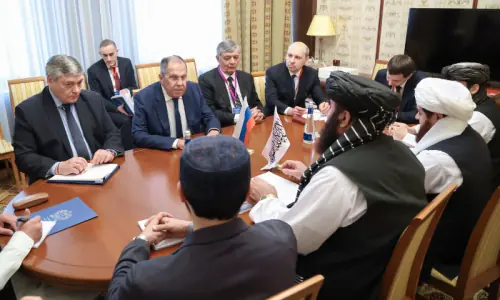
ISLAMABAD, May 12: An international seminar on “Afghanistan: Unabated Turmoil” held here by the Institute of Regional Studies (IRS) on Monday produced the turbulence that the title suggested.
It started with IRS president Maj-Gen (retired) Jamshed Ayaz announcing that the crisis in the ruling coalition had prevented Foreign Minister Shah Mahmood Qureshi and Information Minister Sherry Rehman from keeping their speaking assignment at the seminar.
Their absence, however, did not prevent other speakers from engaging in a lively discussion and sharp exchanges on what ails Afghanistan and why.
American scholar Dr Barnett R. Rubin, the star speaker, set the pace by observing that Pakistanis had “many misconceptions about Afghanistan” and that “we produce knowledge which suits our policy”.
Dr Rubin was responding to Lt-Gen (retired) Kamal Mateenuddin’s remark that Pushtun-Tajik divide in Afghanistan was a factor in the continuing instability in the bordering country.
Gen Mateen was also critical of the “do more” demands made on Pakistan when it had met “all the commitments” it had made in fighting the US declared ‘war on terror’, except the one to stop cross-border movement of militants. “Pakistan cannot do it alone. Nato will have to do much more,” he said.
Dr Rubin also provoked many by asking Pakistan to state its “strategic interest in Afghanistan” which, he said, President Hamid Karzai considered to be “the main driver of instability in Afghanistan”.
“Afghanistan’s economic, political and military weakness means that stability requires international guarantees,” he said, urging countries having a stake in Afghanistan “to merge their national security with global security”.
Dr Rubin was accused of “glossing over India’s involvement” for including India among the countries which should help turn Afghanistan from being a destabiliser to “central stabiliser”.
Col Saffet Akkaya of Turkey, who spoke on the role of the US and Nato forces in Afghanistan, said in reply to a question that the stay of the international forces in Afghanistan “directly depends on US interests in the region”.
Dr Roney W. Jones who followed Dr Rubin was billed to speak on the position and importance of Afghanistan to the future peace and stability of South Asia but devoted himself to speaking on “neutralisation of extremism and insurgency in Afghanistan and the borderlands” which he defined as Pakistan.
“Pushtun problem is more a Pakistan problem as twice as many Pushtuns live in Pakistan than in Afghanistan,” he said, alluding to the view in Islamabad that marginalisation of Pushtuns was a factor in the continuing insurgency in Afghanistan.
Dr Jones attributed the rise of Islamic radicalism in Fata to Salafi school of thought and was astounded that Sufi Mohammad of “the extremist Tehrik-i-Nifaz-i-Shariat-i-Mohammadi” had been released. He suggested that secular forces, like the Awami National Party, should be encouraged to check Islamist extremism and to integrate the trial areas like settled areas were integrated.
It was not in the interest of Pakistan to be perceived as “bastion of terror” or to isolate itself, said Dr Jones who runs a consultancy firm in US.
Such advices provoked former ISI chief Lt-Gen (retired) Asad Durrani to retort that “it is our business, not US”.
“US scholars are sometimes a bigger threat. We are quite happy these people are around, resisting in Afghanistan, Iraq and Fata,” he said to loud cheers from the audience.