Homecoming — and exit
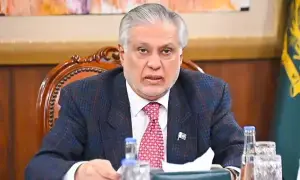
THE action-packed drama surrounding Nawaz Sharif’s return to Pakistan ended on Monday afternoon after the former prime minister was forced to go on his second exile to Saudi Arabia in a manner that was questionable. Obviously, deception and an utter disregard for written agreements are the hallmark of the style of politics of our leaders, whether they are in uniform or without it. If the Sharifs violated the agreement and the pledges they had made to the Saudis and the Hariris way back in 2000, the government behaved no differently at the Islamabad airport on Monday when it finally achieved what it wanted. Shown a warrant of arrest, the former prime minister was escorted out of the arrival lounge, hoping to be sent to prison; instead, he was put on a Jeddah-bound aircraft. The political and legal implications of the episode will stay with us for quite some time. It is now for the Supreme Court to decide whether the government violated its judgment that said that every Pakistani had “an inalienable right” to return home and remain here. The military government appears not to have abided by the spirit of the SC decision.
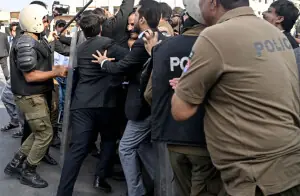
Monday’s events, including the use of force against PML-N leaders and workers, seem to be part of the chain of events occurring in rapid succession, as if with an inexorable force, to rock Pakistan. At stake is not just the survival of a military regime that has been shaken to the core but the very fate of the ongoing movement for freedom and democracy. The people want democracy — as it is understood the world over — and the government has pledged to hold a fair and free election. But the way things are moving, one cannot but develop serious doubts even about the near future. After all who will fail to note the lack of an election schedule even now, the continued uncertainty about Gen Pervez Musharraf’s re-election as a president in uniform or otherwise, the periodic talk of emergency by the ruling party’s president, the unabashed involvement of foreign powers in Pakistan’s domestic affairs and the pre-election search for a ‘moderate’ regime with US State Department officials parked in Islamabad at this critical juncture. Over and above this is the menacing rise in suicide bombings by the religious militants.
The heavens would not have fallen if Nawaz Sharif had been allowed to return and taken to court for his alleged malfeasance. His return would have served to strengthen the political process, encouraged other personalities in exile to return and paved the way for what could possibly become one of the most hotly contested general elections. This opportunity has been lost. The country faces grave economic and security problems: inflation is squeezing the people dry, and acts of terrorism have added to the public’s sense of insecurity. Only a government truly deriving its mandate from the people can meet these challenges. That looks a mirage because of the shenanigans on the part of all those in whose hand lies the fate of Pakistan. Essentially, it is lust for power, family fame and fortune and self-aggrandisement that appear to be guiding our leaders’ actions and policies. All this because we have failed to evolve and hone a political system to run a country founded by a constitutionalist like Jinnah. By a strange coincidence we are lamenting the absence of democracy and constitutionalism in Pakistan on the 59th anniversary of the Quaid’s death.
Honour among capitalists
WORDS are the linchpin of both fact and fiction. Unless worth can be assigned to the purely symbolic, the Apec deal on climate change is unlikely to herald a new dawn in conservation. On face value, it would seem significant that some of the world’s biggest polluters like Australia, China, Japan, Russia and the US have taken note of anything other than profit maximisation, leave aside issues espoused by the socially conscious. On Saturday, the Apec summit in Sydney saw Pacific rim leaders forge a deal on climate change which included a commitment to cut ‘energy intensity’, or the amount of power needed to produce a dollar of GDP, by 25 per cent
by 2030. Some are quick to point out that such a consensus among economic heavyweights, however perfunctory, bodes well for the evolution of a new, post-Kyoto blueprint for tackling environmental degradation. Apec also pledged to increase forest cover in the region by at least 20 million hectares by 2020, and acknowledged that richer countries ought to bear the majority of the costs involved in finding a solution to global warming.All very well on paper but nothing more than that. The fact remains that the agreement is non-binding — dependent as it is on honour among capitalists — and does not set limits on greenhouse-gas emissions, the primary cause of global warming and climate change. Moreover, the 25 per cent reduction in ‘energy intensity’ is largely meaningless in a world where technological advances are making production processes more energy-efficient in any case. Most economies, according to at least one expert, are meeting this standard as a matter of course without even setting a target. As Greenpeace energy campaigner Catherine Fitzpatrick said, “If the Apec statement is the platform for future action on climate change, then the world is in trouble.” Even that may be an understatement. Now that climate change is an irrefutable scientific fact, governmental lip service is perhaps unavoidable. As was the case in the West with racism and affirmative action a couple of decades ago, making the right noises about the environment is now part of a politician’s job. Sincerity doesn’t come into it.
Little hope for child labourers
A SPEAKER at a recent workshop in Peshawar put the figure for child labourers in the country at 3.3 million. However, it should be noted that this statistic, contained in a government study conducted more than 10 years ago, is now obsolete. Currently, the figure, as estimated by human rights activists, is closer to eight million. This not only shows the government’s utter disregard for
international conventions, national child labour laws and constitutional provisions, it is also indicative of a lethargic attitude with regard to updating statistics on an important issue. Moreover, millions of these child workers, aged between five and 14 years, are employed in hazardous occupations, and are forced into backbreaking labour at the cost of their health. Their wages are a fraction of what older workers, employed in the same industry, receive.As the argument — and it is a valid one — goes: with so much poverty and such large families to be supported, children have no option but to work. However, recommendations to at least withdraw them from the more hazardous occupations like deep-sea diving, mining, bangle-making and others where they are exposed to chemicals and hard physical labour seem to have gone unheeded. Neither does one see attempts to modify their working conditions and to ensure that they have more time for rest, recreation — and education. Thus they lose out on skills that could have equipped them for the future. Trapped in poverty and debt, parents see no way out for their offspring. However, they must also share the blame for not attempting to secure their children’s rights, and looking upon their work in the fields or at home as part of their filial duties, and not as labour. Only a change in such an attitude, along with far-reaching poverty alleviation measures, can improve the situation of our young workers.
Environment and development
THE relationship between economic development and environmental sustainability is one of the most critical issues of our times. A major challenge facing mankind today is to build a world where the goals of environmental conservation and economic progress do not conflict with each other, but exist in perfect harmony and accord.
Sustainable development stands for meeting the needs of present generations without jeopardising the needs of future generations — a better quality of life for everyone, now and for generations to come. It offers a vision of progress that integrates immediate and long-term needs and local and global needs, and regards social, economic and environmental needs as inseparable and interdependent components of human progress.
Population growth, increasing urbanisation, global warming and natural disasters pose a major challenge to environmental sustainability. By 2020, the world population is projected to reach about 7.6 billion people, and about 6.6 billion of those people will live in what we call the developing world. They have a legitimate desire to raise their standard of living — which also means raising their levels of production and consumption.
By 2008, half of the world population will live in urban areas, marking the first time in history that humans are an urban species and affecting our lives and environment in myriad ways.Global warming and depletion of the ozone layer pose a problem which is overwhelming in scope and impact. The natural disasters of 2005 and late 2004 — the Asian tsunami, hurricanes in the US, and the devastating earthquake in South Asia — have chillingly depicted the magnitude of environmental insecurity of all people everywhere.
Environmental degradation endangers the most fundamental aspect of human security by undermining the natural support systems on which all human activity depends. Environmental change is among the earliest and the most pervasive sources of insecurity and conflict. How to raise the living standards of people in all parts of the world without destroying the carrying capacity of the planet’s biosphere is perhaps the greatest challenge of the 21st century.
The key challenges that need to be addressed in the context of environmentally sustainable development include climate change and clean energy; sustainable production and consumption patterns; public health threats such as chemicals pollution, unsafe food and infectious diseases; better management of natural resources and stopping biodiversity decline; demography and migration; and fighting global poverty and social exclusion.
The magnitude of the task requires concerted efforts on the part of the government, the private sector and society at large. Governments have to allow markets to play a critical role in changing consumer and producer behaviour and allocating resources to new technologies, processes and products. This also requires establishing the right environmental regulations. Gove-rnments are uniquely equipped to provide leadership by educating the public on environmental issues and changing the public mindset.
The objectives of sustainable environment and development cannot be achieved through government interventions alone. These objectives must be taken up by society at large as a principle guiding the many choices each citizen makes every day, as well as the big political and economic decisions that have ramifications for many.
Water conservation has become an important aspect of environmentally sustainable development in the wake of increasing demand for water, persistent droughts, water scarcity and environmental pollution. Fresh water is globally becoming a scarce commodity. Consumption of water at the global level has been doubling every 20 years, more than twice the rate of population growth.
Experts warn that if this trend remains unchecked, the world’s fresh water demand may increase by over 50 per cent by the year 2025. The developing countries, where most of the increase in demand is expected, are likely to be the worst hit as their fresh water reserves are already under a lot of stress due to desertification, pollution and the depletion of water resources. These problems are aggravated by an unequal distribution of water resources and inequities in access to water.The optimal utilisation of water and land resources through increased productivity is extremely important. This requires a holistic management of fresh water as a finite and vulnerable resource. Integration of water projects within the framework of overall national and social policies is of utmost importance. It must be realised that water is a key component of the ecosystem, a natural resource and a public good.
Indigenous technologies should be developed to efficiently utilise limited water resources and protect those resources against pollution. Pollution of air and water, climatic change, shrinking fresh water reserves, and vanishing biodiversity have disturbed the ecological balance, making it imperative for the world community to conjoin environmental and mainstream development agendas.
Governments must recognise the need to redirect national and international plans and policies to ensure that all economic decisions fully take into account any environmental impact. Governments and businesses alike should make eco-efficiency a guiding principle.
An eminent Pakistani economist Dr Mahbub ul Haq eloquently articulated his concerns for sustainable environment and development: “To ensure security from hunger, ignorance, poverty, health hazards and ecological degradation, minimum goals should be established for human development and ecological security. The development indicators should define the objectives for sustainable relationship between population and environment.”
In order to vindicate the right of people to a healthy environment and the right to development, a comprehensive strategy is required to achieve sustainable development worldwide. There is much talk these days of global challenges and opportunities. If globalisation is to yield positive results, it must be environmentally sustainable. This obviously cannot be achieved without effective policy instruments.
The urgency to address environmental challenges has never been greater in human history. In order to address these challenges, we have to rethink the way we live, produce and consume and how all this affects our environment. That is our great task and challenge in the 21st century. Indeed, at this time of major global change and uncertainty, the importance of sustainable development and the principles on which it is to be built lie at the heart of a secure future for mankind and the world which is our habitat.
The writer is a civil servant. The views expressed by him are his own. Samisaeed 7@hotmail.com
‘Muslim terrorists choose Europe’
Die Welt
TERRORISM has changed in the last 30 years and, contrary to back then, it now very much poses a threat to the state. The reasons for that are many. Contrary to the RAF, terrorists are now able to get their hands on weapons that make mass murder possible.... Contrary to back then, terrorists are today part of a worldwide network that has almost endless resources and can hit the West where it wants. And Islamist extremists can also fall back on a large population that has lived in Germany for decades.
To avoid misunderstanding: The majority of the Muslim minority has nothing to do with the Islamists.... But still, Muslim terrorists choose Europe as a target because they can move freely here and can easily find recruits. A resolute integration policy that no longer tolerates parallel societies should be part of the fight against terrorism.
The attempted attack was unique because two German converts were involved. They did, however, possess role models. As was the case with the attacks in London and Madrid, all three suspects had connections to Islamists in Pakistan. And just like in Great Britain and Spain, the three were associated with a mosque known for its radical stance.
Germany is still a niche society for Islamists in which they can live well. It is precisely this freedom which must be eliminated for such people. At the end of the day, terrorist sympathisers must be combated with intelligence activities and social pressure, which must come from the Muslim community. Clearly, the government must increase the pressure on immigrants to integrate. Parallel societies — even if they are peaceful — are not acceptable. (Sept 7)
‘Utterly absurd’
Financial Times Deutschland
WHEN it comes to the central question of the safety of the population, politics cannot be reduced to the exchange of well-worn positions and party slogans ... This is about the important question of what price a free society is willing to pay to ensure a certain level of security.If we are honest we have to admit that it is just a question of time before Islamist zealots launch a successful attack in Germany ... Long term, the intelligence agencies and police cannot track down every terror cell or fanatic before it’s too late.
It is particularly the Christian Democrats who want to make it seem as if they only need a lot of instruments — online surveillance here, a centralised finger print database there, and a lot more video surveillance — to protect the public from bombs in buses and trains. This way of thinking is utterly absurd.
Every anti-terror law has an effect but there are also side effects. It is right that more state surveillance will increase security. But it is questionable how much more security is really to be gained through invading people’s privacy. (Sept 7)
––Selected by Shadaba Islam and translated by Speigel Online
| © DAWN Group of Newspapers, 2007 |