Slowdown in peace process
TRAVELLING to Singapore for a Track Two India-Pakistan consultation during the last week of August, I felt that a reasonable expectation would be to pool information and insights into the tangled web of overt and covert negotiations. Neither side is at the moment in a position to launch a major initiative in the peace process.
While India and Pakistan are maintaining the agreed schedule of meetings under the rubric of their “composite dialogue”, contacts at the highest level are obviously getting delayed because internal power structures are susceptible to change.
Since March, informed opinion in India has counselled a wait-and-see policy. Manmohan Singh has on one occasion parried questions about his much-delayed visit to Pakistan by saying that he did not wish to add to President Musharraf’s problems. India too may be heading for a premature general election because of internal differences on major issues including the Indo-US nuclear deal.
A candid assessment of the bilateral dialogue, however, indicates that the slowdown in the negotiations had set in before the political turmoil in Pakistan. Rightly or wrongly, Pakistan had waited for Manmohan Singh to come in the summer of 2006 and use the alchemy of a summit to overcome the hurdles that are conveniently attributed in both the countries to the mindset of the foreign policy bureaucracies. The summit did not materialise either in 2006 or the early part of this year with different speculations in the two capitals about the causes of delay.
Some of the reasons for the slowdown being discussed in the two countries bear repetition. While the secret negotiations on Jammu and Kashmir had progressed, an integrated plan for the implementation of the new out-of-the-box thinking had not emerged. New Delhi wanted to harness the rivers in the disputed state for power-generation before accepting the restraints of a broad settlement with Pakistan. India was not getting very far in its separate dialogue with the Kashmiri leaders.
In New Delhi, some old concerns were getting mixed up with new “strategic considerations” to block the expected redeployment and disengagement of troops in Siachen. The Indians had found Pakistani interlocutors obstreperous on questions of trade and transit especially the overland route to Afghanistan. Finally, against the backdrop of its emerging US-backed major power status, New Delhi simply did not attach the same importance to a subcontinental rapprochement as Pakistan did.
Notwithstanding the above litany of factors that were presumed to have affected adversely the momentum of bilateral negotiations, the Singapore meeting of former diplomats, ex-generals, influential newspaper editors and scholars from India, Pakistan and both sides of the Line of Control in Jammu and Kashmir was, in the words of a respected Indian editor of a major newspaper, surprised by the “disclosure” of the formula that has reportedly brought the Kashmir dispute very close to resolution.
A leading Indian participant argued on the strength of his knowledge that talks between Ambassador Satinder Lamba of India and the Secretary of Pakistan’s National Security Council, Tariq Aziz had left sundry Track Two “travellers” far behind the achievements of secret diplomacy.
He cited five elements of a likely solution of the Jammu and Kashmir dispute. Another Indian participant has since formulated them as follows: no change in the territories; open borders in Jammu and Kashmir; autonomy for both sides of Kashmir; joint consultative commissions to be set up on both sides of the Line of Control; and reduction of forces on both sides of Jammu and Kashmir — a sort of demilitarisation.
It is claimed that only five persons in Pakistan are privy to the secret talks. But it is generally known that the “key ideas” mentioned above have been under discussion. What is believed in Pakistan is that the two sides have exchanged ‘non-papers’ but that these tentative proposals still need to be reconciled. Furthermore, the Pakistani government’s need for making the eventual reconciliation acceptable to the people of Pakistan and more importantly to the people of Kashmir has increased.
The Indian expectation that President Musharraf can impose any solution on them was never realistic; it would be less valid if he has to share power with some other political forces in the country. Pakistan, too, should have a larger democratic base for a settlement with India.
Regardless of the measure of agreement between Messrs Lambah and Tariq Aziz, which for Pakistanis remains a closely guarded secret, the situation on the ground makes for a mixed assessment. First, India is unable or unwilling to objectify the idea of autonomy. In Indian-held Kashmir, the valley on the one side and Jammu and Ladakh on the other have very different notions of autonomy. Even within the valley, the “azadi” lobby and the traditional pro-Indian political groups demand a much greater measure of self-governance than New Delhi is willing so far to concede.Further progress warrants undoing the great damage done to the Sheikh Abdullah-Nehru Pact and the Article 370 of the Indian constitution. Constitutional amendments that would restore the special status of Jammu and Kashmir are not easy to make in the fragmented polity of India.
Secondly, while it is conceivable that the regular Indian army gives way to various paramilitary forces in the major cities and withdraws to less visible cantonments, India is in no position to trust the people of Kashmir who remain deeply alienated from it and may be tempted to radically extend their autonomy. Demilitarisation continues to be a problematic area. If India is not willing to pull out on reciprocal grounds from the Siachen area, how would it make across-the-board demilitarisation a credible process?
Third, joint consultative mechanisms may be indispensable to the future of an otherwise divided Jammu and Kashmir but there is not much evidence that the two sides have an identical view of their role. In all possible forums, the Indian analysts and opinion-makers show a degree of impatience to use such higher bodies as a lever of some influence on the fortunes of Pakistan’s Northern Areas. This may well be where the Pakistani security establishment draws a red line.
Fourth, facilities for people-to-people contacts across the Line of Control have not exactly prospered. In fact, there may be limited incentive for them unless radical steps for trade become a reality.
In Singapore, Pakistani participants generally argued that the peace process was irreversible, that peace constituencies in the two countries were getting larger and larger and that any futuristic scenario of India-Pakistan cooperation in such vital fields as import of desperately needed energy from Central and West Asia relied heavily on a transformation of the bilateral relationship.
It was felt that that President Musharraf had played an important role in changing the culture of Indo-Pakistan negotiations but the apprehension that any erosion of his absolute power as a consequence of the current political tussle would impact negatively on the peace process was not valid.
The other main contenders for power including former prime ministers Benazir Bhutto and Nawaz Sharif have a track record of pursuing a genuine rapprochement with India. The Pakistani participants emphasised the need for India and Pakistan to work together and not at cross purposes in Afghanistan. In India, the BJP should not unravel a peace process that it helped launch once the dialectics of “mid-term” elections were out of the way.
The fact that realism about the hurdles ahead does not dampen the overall mood of optimism about future inter-state relation in South Asia is heartening. There is acceptance of domestic compulsions but a vast majority of people everywhere hope that their governments would earnestly work to restore momentum to the peace process when the internal political factors get resolved. The objective should be a historic compact, a grand reconciliation.
The writer is a former foreign secretary.
Two states and a troubled nation
THE East Asian “miracle” is credited with lifting countries of the region from Third World to First World status within 50 years after the end of the Second World War. But Latin American countries have been independent for 200 years, yet they have not displayed a matching miracle and are well behind East Asia.
The miracle is attributed to the superior quality of East Asia’s modern laws and institutions compared to the mediaeval model that has largely governed Latin America for two centuries. Just as mediaeval laws and institutions of governance held back Latin America, the principal responsibility for several problems facing Pakistan lies in its unreformed and conflicting institutions of governance. No amount of complaining about those who took our model of economic development and surpassed us will help unless we have reformed the fundamental laws and institutions governing state and society.
A separate study by the World Bank has concluded that if Somalia ruled by mafias and warlords with no rule of law in its governance could slightly raise the quality of its laws and institutions of governance to that of Laos, it would “raise its per capita GDP by 300 per cent.” And if the quality of its governance is raised to Singapore’s level, its per capita GDP would jump by 600 per cent — all other things remaining the same.
But how could laws and institutions of governance be nurtured in an environment when the state itself has been swinging as a pendulum between modern and mediaeval models of governance for most of its existence?
Three days before independence, the Quaid-i-Azam used the most appropriate forum of the Constituent Assembly on August 11, 1947, to spell out his well known founding principles of the first model of governance on the basis of which state institutions would be constructed in Pakistan.
Jinnah was a modern leader who had practised the rule of law all his life and had been fully exposed to statecraft and governance of a contemporary state. Like the man himself, Jinnah’s Pakistan was to be a non-communal, non-sectarian, non-ethnic and non-parochial state practising equality and equal opportunity for all citizens and protecting them by the rule of law. And under this umbrella of a neutral state, the Muslim majority people of Pakistan were to find their identity and synthesise it with the norms of modern democratic governance just like Turkey is doing so these days and receiving worldwide support.
Less than six months after Jinnah’s death, his Muslim League and the government, largely comprising the traditional landed gentry and political leadership still mired in mediaeval ways, distanced themselves from his guidelines on governance. Taking cover under religion through the Objectives Resolution of March 1949, they pushed for their political and economic agenda and sowed the seeds of a second state model that in due course would take Pakistan to a form of mediaeval governance.
In governance, modernity is denoted not by wearing smart civilian suits or military outfits, nor is the mediaeval identified with a traditional dress code. The bright line that divides modern democracy from mediaeval governance is the place of individual human beings in the scheme of governance, equality and the equal treatment of citizens and, above all, the position of the rule of law overseeing the governance by rulers in all dimensions.
Jinnah’s state was neutral in politics, and he told state functionaries to desist from politics. But the second model declared that the state would not be neutral and that the state machinery would be instrumental in projecting the political agenda of the party in power.
Jinnah’s model also left no space for special interests to dilute the sovereignty of the people. The second state model introduced a new concept of limited sovereignty of the people thus opening space for its exploitation by adventurers and unelectable elements to rule without the consent of the governed. It also provided them grounds to claim “democracy is not in our genius” and for the doctrines of necessity to trump the collective will of the people.
For both flaws of governance, the state paid the price as its civil and military functionaries quickly entered politics and occupied the highest state offices. The space of sovereignty taken away from people was also exploited as giving veto powers to religious clerics and military rulers over the collective wisdom of the nation.
Jinnah’s model to synthesise modern democratic governance with the Muslim majority people of Pakistan was recaptured through the 1973 Constitution. But this democratic search for identity was again terminated within four years by General Zia who picked up the thread from March 1949, and formally laid the foundation of the second state of Pakistan.
Without ascertaining the will of his countrymen, Zia forced upon them and into the Constitution his mediaeval system and institutions through martial laws and ordinances and called it the Islamisation of the nation-state of Pakistan. Henceforth, force and violence rose to become acceptable as a means of settling differences in state and society.
But the state is a 10,000-year-old political institution. Originating in Mesopotamian civilisation, it first matured in ancient China and all through its journey from ancient to mediaeval to modern times, the state institutions of governance have developed in response to the evolving challenges of their times.
The nation-state is a 400-year-old institution baptised by the Treaty of Westphalia in 1648. Its origin lies in Europe which got sick and tired of the destruction caused by unending religious wars in large parts of the continent.
Therefore, neither the state nor the nation-state is a religious concept. Both are political creations — one is ancient Asian, the other mediaeval European. Neither has Islamic roots nor has it originated under Muslim rulers. Both are now undergoing further changes under the forces of globalisation.
Actually, the issue is not the religion of the state but its governance and how Muslim societies should chart their future course. Religion and security are often used to protect special interests and block transformation of mediaeval governance of the state and its resources to a more modern, democratic and accountable governance.
For 30 years, Zia’s model of mediaeval governance has been battling with Jinnah’s model of a modern democratic state. This battle between the two state models is the principal fault-line obstructing the development of state institutions and troubling a bewildered nation. No candle is holding up against the stormy winds ahead.
Laws and institutions of governance are meant to help citizens live, work and prosper in the world they actually operate in. The failed mediaeval model is creating failing states again.
The writer is former head of Board of Investment and federal secretary.
smshah@alum.mit.edu
A bridge collapses
SEPTEMBER ONE was a fateful day marked by a tragedy that should not have happened. The collapse of the Shershah bridge of the Northern Bypass in Karachi has had a ripple effect.
The people in general have now lost confidence in the infrastructural works that are being trumpeted no end by our political barons. The possibility of ascertaining the truth behind this incident is dwindling with each passing day owing to the dubious intentions of the agencies concerned. Each one is trying hard to acquire an exoneration certificate, hoping that this tragedy will be buried fast and forgotten soon.
The stakeholders are attempting to gloss over their individual and collective responsibility without bothering to analyse the underlying factors that led to the collapse of this structure so soon after its inauguration. It is deplorable that the incident is not taken as an eye-opener. Neither has it served as a catalyst that could prompt the powers that be to seek effective solutions to system building and traffic management problems. Given the present approach adopted by the government and others involved, the situation is not likely to improve in the near future.
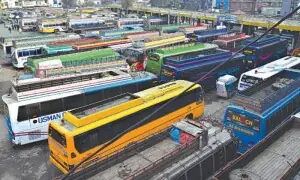
If one looks around the city, one will find that a lot is happening in the traffic management sector. New flyovers are being planned and built while the old ones are being renovated and expanded. This has become necessary because hundreds of new automobiles are registered every day in geometric progression that increases the congestion on the city roads that are already inundated with vehicles.
The vast majority of the population is forced to commute in sub-human conditions to and from its work place without any hope of obtaining relief. In this scenario, it is obvious that the government has been attempting to focus on isolated mega projects. This approach has largely proved to be ineffective.
The fact is that massive investment in the transportation sector is not making any improvement in the life of the common man. Since the government has refused to recognise the gravity of the problem, the situation is becoming worse by the day. What is vital to note is that improvement in the transportation system does not need any hi-tech or capital-intensive solutions.
Effective traffic engineering and management, incentives for transporters to procure buses, segregation of local and through traffic and enforcement of the law are some of the simplest but urgently needed steps that must be adopted without delay.
The existing capacity of local institutions related to transportation is entirely insufficient to deal with the emerging problems. Take the traffic police. For more than 1.5 million vehicles and 10,000 kilometres of city roads, the net strength of the personnel in the cadres of the traffic cops is only around 3,000. Of them, many staff members are on clerical duties, managing VIP motorcades and doing other non-operational tasks.
The dearth of proper hardware, vehicles, tracking devices, digital equipment and even adequately equipped field offices further reduce the capacity of the police to manage routine traffic. As a consequence, the anarchy on the roads multiplies fast, eventually leading to severe loss of efficiency.
City and town administrations lack the capacity to plan appropriately. It is disappointing to note that a city of Karachi’s size is being run without a scientifically laid down road rehabilitation and expansion plan. Whatever works are undertaken are ill-timed and badly coordinated. Repairs are begun close to the monsoon rains that completely upset the normal performance of vehicles.
The time schedules are inappropriately worked out that lead even small works to be completed in months, even years. For nearly two years, Rashid Minhas Road and University Road have been dug up with work going on at a snail’s pace. It will take another year to complete simply the essentials of the assigned task.
Given the clout of the road lobby, the railways are being eliminated as a means of transport. Had the freight railway service been in full operation to transport containers from ports to upcountry destinations, many of the traffic and bypass roads may not have been required.
The transport sector is being held hostage by oil marketing giants, the automobile manufacturers and military’s NLC. The press has reported that the oil companies have made an extra profit of Rs100bn in the past five years. When the stakes are so high, any immediate reform is difficult to achieve.
Exclusive reliance on road transport for communication is an unsustainable proposition. Even traditionally car-based countries such as the United States are now contemplating initiating appropriate plans for public transport based on the railway system.This is logical from several points of view. Universal access and affordability, low consumption of fuel (per capita), cost effectiveness, economic utilisation of land and conservation of environmental quality in urban areas are a few important merits. It is also vital that public control and management of the transportation sector ensures that its benefits accrue to low-income communities.
For long-distance commuting, relying on an efficient railway system is much better than expanding roads. The system has the possibility of transporting heavy cargo and liquid raw material without pollution and congestion. Many professionals have suggested the creation of a cargo terminal at the suburban location of Pipri to be serviced through fast-moving train links. Technically termed as “cargo processing zones”, such areas are quite extensively located in the developed countries as also in many cities of the Third World.
It may be noted that the revival and expansion of the entire railway infrastructure in Karachi and the surrounding region will not cost more than what a single mega road project such as the Lyari Expressway would. It depends on the wisdom and foresight of policymakers to take cognisance of this fact and respond to common sense, a quality rarely found in our city planners.
The writer is professor and chairman, Department of Architecture and Planning, NED University, Karachi.
nahmed@neduet.edu.pk
Terrorism: lessons from Germany
ON September 5, German police raided a house near the village of Oberschledorn, about an hour’s drive east of Dusseldorf, and arrested three suspected Islamist terrorists. They had accumulated enough hydrogen peroxide to build a bomb with the explosive power of 550 kg (1200 lbs) of TNT, and they had scouted potential targets like Frankfurt International Airport and the huge US Air Force base at Ramstein.
As usual, the German police released only their first names and initials: Daniel S, age 22; Fritz G., 28; and Adem Y, 29.
It was the closest call yet for Germany, which has so far escaped attacks like those in Madrid and London. More attempts will doubtless follow, for Germany has peace-keeping troops in Afghanistan and Lebanon, and the disaster in Iraq has poisoned the well so badly that western troops in any Muslim country look like part of the “Zionist-Crusader assault on Islam” to some young Muslims. But the response of the German media was instructive.
There was, inevitably, the “blame the immigrants” gang, like Jacques Schuster in Berliner Morgenpost: “...the government must increase the pressure on Muslims to integrate. Even peaceful parallel societies cannot be tolerated.” Which kind of missed the point that two of the three men arrested were ethnic German converts to Islam. (The other was a Turkish citizen long resident in Germany.)
But the most trenchant comment came from Richard Meng in Frankfurter Rundschau: “It was Fritz and Daniel who were arrested with Adem, not Mohammed or Mustafa. It can no longer be denied that it is foolish to regard immigrants as a greater security threat than the indigenous population. It is even more foolish to make sweeping judgments about Islam.” Exactly.
“Islamist” extremism is a political phenomenon, and it has precisely the same appeal to the disoriented and the alienated as previous millennial doctrines, from the Hashishin (Assassins) of the 12th century Middle East to the anarchists and Bolsheviks of 20th century Europe. Like many such doctrines, it wraps itself in religious symbolism: most religions are, after all, millennial. But terrorism is not religion, and “Islamism” is not Islam.
First- and second-generation immigrants from Muslim countries who have not found their feet in western countries are prime recruits for “Islamist” doctrines, of course, but so are alienated people in the host society, like Fritz G. and Daniel S. in Germany or the Jamaican-born, British-raised London bomber Abdullah Shaheed Jamal (né Germaine Maurice Lindsay). Those people thought they were converting to Islam, but they were actually attracted by the violent, apocalyptic fervour of the extremists. Emotionally, all forms of political extremism are virtually interchangeable.
So what lessons can we draw from this? First, the potential terrorists are already in the West, and all the border controls in the world will not stop them. At least 90 per cent of the terrorist attacks in western countries come from people who live in those countries, not outsiders trying to get in.
True, a lot of them go to camps in the more lawless parts of Pakistan for “training.” The training is obviously not very good, for few of the bombs have worked, and few of the terrorists have even got to the point where they actually tried to blow something up. And it was travelling to Pakistan that first put them on the watch lists of western security forces: all of those “terrorist training camps” are obviously infiltrated by people who hand over lists of the foreign visitors to western controllers.
This is a twenty- or thirty-year game of spooks and terrorists that will be played out on the margins while most people’s lives continue virtually undisturbed, except for the unfortunate few who get caught in a real terrorist incident. Border controls are of minor importance in the game, and invading foreign countries is almost invariably counter-productive.
Osama bin Laden created the template, so in that very limited sense every “Islamist” attack has an Al Qaeda link, but the organisation itself is no longer a major player. The sporadic terrorist attacks in western countries will continue, but they will be far less destructive than those in Muslim countries, and they will certainly diminish if western troops pull out of Muslim countries. So the German approach is just right: do the intelligence work, don’t over-estimate the threat, and above all don’t panick. ––Copyright
| © DAWN Group of Newspapers, 2007 |