0
0

Fighting militancy
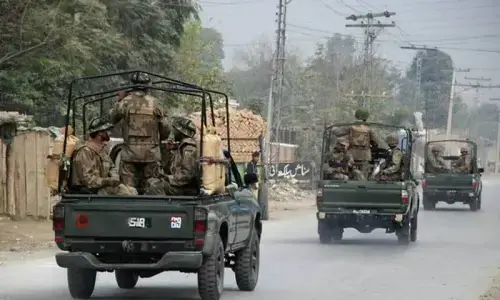
THAT a new plan should be prepared for combating militancy in Fata and the NWFP’s settled districts means that the strategy so far followed has failed to work. Some 80,000 troops are already in place to combat religious militancy, and the government is now thinking of a “surge”, besides planning to give the security personnel modern equipment, including unmanned reconnaissance planes. The idea is to make “focussed operations” against militant commanders on a fast-track basis. If this is the aim of the new “fast-track” strategy, what has then been the aim of the policy followed all these years?
The tactics so far have been a mix of force and “deals”. While relying entirely on force is not going to help in an area which has traditionally resisted authority, the “deals” are not without an inherent contradiction. Basically, it is a sound policy to strike an understanding with tribal elders and militant commanders to secure peace in a given area. This can be done by making them responsible for peacekeeping, by strengthening the position of those elders who have a positive outlook, and making use of the resentment the presence of foreign militants has created among the Fata people. For instance, the government used tribal elders in parts of South Waziristan to flush out foreign, especially Uzbek, militants. Since then, even though some foreign militants are still there, there has been a marked decline in militant activity. However, the flipside is that deals do not always work, or work unsatisfactorily. What is worse, militants get time to reorganise and regroup, and thus the deals often prove counterproductive. Yet, there is no alternative for the government. It has to secure the cooperation of the people of Fata — in fact of the entire NWFP — to combat a phenomenon that is gradually spreading and threatening the people’s peace and security. The people of the NWFP, like those in the rest of Pakistan, have been practising Islam in a way that has never been a threat to anyone. However, religion as defined and preached by the Taliban and Al Qaeda is in danger of turning into a fitna — a Quranic term for mischief that could grow and turn into anarchy. On the whole, it is a nightmarish situation, for militancy is no more confined to Fata but has spread to the “settled” districts as well. It is both a force and a threat, and the people’s active cooperation alone can reverse the trend.
A related question is the devolution plan of this government. While the plan, the brainchild of Gen (retd) Tanvir Naqvi, may have merits elsewhere in the country, in the NWFP it has undermined coordination between the authorities in Fata and those in the districts. At present, the Fata Secretariat looks after the tribal area, while the provincial Home Department is responsible for law and order in the rest of the NWFP. The abolition of the traditional district management system inherited from the colonial era has led to the exclusion of proper coordination needed between these two administrative units at a time when the entire administrative machinery needs to be battle-fit for the task ahead. The government is now thinking in terms of setting up Regional Coordinators to liaise between the Fata Secretariat and the Home Department. Let us hope this works.
Higher NSS returns
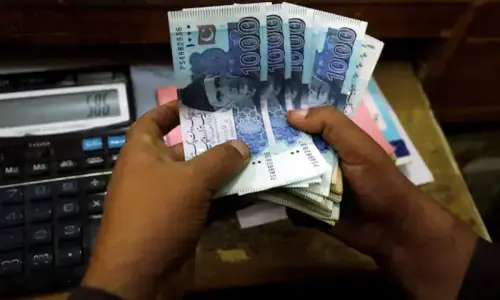
THE government has marginally increased the profits on the National Savings Scheme (NSS) from June 23, using the yield on the 10-year Pakistan Investment Bond, issued about a week earlier, at 10.12 per cent, as the benchmark. The rates were also fixed keeping in view return on similar financial investments. The upward revision announced on Monday includes Defence Savings Certificates from 10 per cent to 10.15 per cent, Special Savings Certificates/ Accounts from 9.17 to 9.25 per cent and Pensioners Benefit Account and Bahbood Saving Certificates from 11.52 to 11.64 per cent. The NSS profits would not appear attractive to individual investors in lower and middle income groups because of double-digit food inflation and consumer price index rising at about eight per cent. It was because of low return that the net investments in NSS declined sharply for three successive years, recovering to net sales of Rs2.5 billion in fiscal 2006.
This year’s robust net sales up to March 2007 at Rs40 billion can be attributed partially to institutional investments, particularly those of government organisations which were earlier barred from investment in NSS. The NSS profits have not improved because the financial market reforms have not been extended to the Central Directorate of National Savings. The CDNS has not been turned into a corporate body — Pakistan Savings, as approved by the prime minister about one and a half years ago. As a department of the ministry of finance, the CDNS cannot avail itself of the opportunity and is denied the resources to bring about automation of its operations or provide new avenues for improving investors’ service and ensuring better returns. The individual investors thus get a raw deal most of the time. As a corporate body, it could also enter into joint public-private partnership with leading market players to launch mutual funds, long-term pension funds or set up real estate investment trusts, in which supervision of the government is necessary in the current erratic phase of the development of the market. The urgent need is that the CDNS should be allowed to profit from the financial sector boom for the benefit of small investors.
Where torture is common
TORTURE is commonplace in Pakistan, so much so that those who have never experienced the horror airily dismiss it, like corruption, as just another aspect of life as we know it. Talk instead to those who have been thrashed to within an inch of their lives or been sexually abused in front of their children. On the 20th anniversary of the UN Convention Against Torture, Amnesty International has called on all states to put an end to such barbaric practices. Pakistan should take note, for ours is a country where torture is institutionalised. Lacking professional skill as well as resources, police ‘investigations’ here are dependent heavily on confessions extracted under duress. The jails are full of people who confessed to all manner of crime after a few hours under the custody of the police. In a country where capital punishment is still in practice, there is no knowing how many people have been imprisoned or hanged for crimes they did not commit.
The police are not alone in this resort to terror. The country’s intelligence agencies routinely pick up ‘miscreants’ on whimsical grounds, keep them incommunicado for months and even years on end, and subject them to brutality that defies description. It is said that many among the hundreds of Pakistan’s ‘disappeared’ are now untraceable simply because they could not survive the beatings handed out by security personnel. Those who somehow managed to survive have been reduced to zombies, unfit to resume their role in society. Torture is also the calling card of terrorist organisations all over the country and Karachi, in particular, is no stranger to these tactics. The abjectly poor, meanwhile, are sometimes tortured only to thrill the tormentors, usually landlords and tribal influentials. We are yet to emerge from the dark ages.
‘Knight’ at the end of the day
SIR Salman Rushdie — it has a certain ring to it, doesn’t it? A faintly ridiculous ring, much like Sir Mick Jagger or Sir Ian Botham, and not a million miles removed from Lord Ahmed or Baroness Uddin.
The British honours system is an undemocratic anachronism that ought to have been abolished decades ago, yet it seems many people in Britain and across the lands once colonised in the name of the crown still covet the silly titles and the right they thereby gain to embellish their names with initials that invoke a non-existent entity: the British empire.
Lord Anybody and Sir Anything cannot expect to be taken too seriously in the 21st century, any more than those whose lopsided lexicon is heavily laden with terms such as apostasy and blasphemy. And after the cash-for-honours scandal that has rocked the Blair administration in recent years, it is surprising that anyone with an ounce of self-respect would wish to supplement their surname with a KBE, MBE, CBE or OBE.
However, it seems relatively few recipients are able to resist the temptation. Fewer still are able to imbue their rejection of a title with the sort of outrage that the poet Benjamin Zephaniah expressed a few years ago: “OBE me? … I get angry when I hear that word ‘empire’; it reminds me of thousands of years of brutality. … Mr Blair and Mrs Queen, stop going on about empire.’
Over the decades, the refuseniks have ranged from performers such as John Lennon and Roy Bailey (both of whom returned MBEs they had earlier accepted, in a protest against British foreign policy), to an apolitical knicker manufacturer by the name of Joseph Corre, who this month proved himself more conscientious than the purported doyen of post-colonial novelists, who greeted his knighthood by pronouncing himself “thrilled and humbled to receive this great honour” and “very grateful that my work has been recognised in this way”.
Why, wondered The Guardian’s Michael White, “would a leftie who had abandoned Britain for New York in a huff want a knighthood from the British establishment?” There could be several answers, but one is constrained to question the premise of Rushdie as a leftist.
Some of these answers were provided by Cambridge academic Priyamvada Gopal, who pointed out in the same newspaper that Ayatollah Khomeini’s fatwa played a role in turning the talented writer into Sir Salman, a servitor of the Bush regime who enthusiastically supported the invasions of Iraq and Afghanistan.
“Rushdie,” he says, “has abdicated his own understanding of the novelist’s task as ‘giving the lie to official facts’. Now he recalls his own creation Baal, the talented poet who becomes a giggling hack coralled into attacking his ruler’s enemies.”
It wasn’t always thus. Rushdie’s acerbic wit and mastery of the English language was once employed in anti-establishmentarian endeavours, in taking to task not only a former British prime minister whom he dubbed “Mrs Torture”, but also subcontinental leaders, some of whom were inclined to sue him for defamation.
Indira Gandhi, for instance, took issue with ‘Midnight’s Children’, which brought Rushdie to the attention of the reading public after it won him the Booker Prize in 1981 (and, a decade and a half later, the Booker of Bookers).
I recollect finding ‘Midnight’s Children’ less than unputdownable: it took me months to finish, and after all these years it’s easier to recall the delight occasioned by Rushdie’s refreshing style — he relished word-play and employed it to devastating effect — than anything significant about the characters or the plot.
In contrast, it took me two days to lap up ‘Shame’ a couple of years later. It was partly a matter of necessity — the fact that the book had been banned in Pakistan inevitably meant there were plenty of other readers imaptient to get their hands on it — but also an enjoyable experience, not least because the author repeatedly lapsed into extended asides in which he eloquently eviscerated the obscurantist miasma that had enveloped the nation under Ziaul Haq.
I have a nagging suspicion that the contemptible contribution of the late military dictator’s son to a National Assembly debate on Rushdie’s knighthood had as much to do with ‘Shame’ as with ‘The Satanic Verses’. Be that as it may, the spectacle of Virgin Ironpants riding to the rescue was an amusing bonus. Benazir Bhutto’s broad swipe against Ejazul Haq may primarily have been prompted by a chance to score brownie points in the West, but her critique was entirely apt.
For the record, I was fairly unimpressed by ‘The Satanic Verses’. Khomeini’s unusual recommendation made it a must-read; when the opportunity presented itself, I ploughed through it within three or four days, and was left wondering what the fuss was all about. But then, it was taken as a given that those baying for the author’s blood hadn’t bothered to acquaint themselves with the ostensible cause for their homicidal wrath.
‘The Moor’s Last Sigh’, published a few years later, was a better read, but it was followed in due course by the thoroughly disappointing ‘The Ground Beneath Her Feet’, in which Rushdie made a complete mess of highly promising ingredients. I failed to finish it, and haven’t bothered to look up ‘Shalimar the Clown’.
Apart from the decline in the quality of his literary output, which may well be related to the personal exigencies he faced following the fatwa, it was off-putting to find him literally swathing himself in the Stars and the Stripes at the outset of the so-called war on terror. That particular image occasioned a diminution of respect; in contrast, his acceptance of a knighthood stirs pity rather than derision.
However, any doubts that may reasonably be entertained about Rushdie’s literary canon or the appropriateness of a knighthood pale into insignificance in the face of the intemperate tirades unleashed in Iran and Pakistan by clerics and petty politicians eager for a distraction.
It isn’t hard to understand why the troubled governments of the two countries are eager to craft a mountain out of what isn’t, strictly speaking, even a molehill. But does either of them realise how petulant it makes them seem when the British ambassador or high commissioner is summoned to the foreign ministry for a dressing down in this context?
There is no evidence that the committee which recommended Rushdie for a knighthood intended it as a calculated insult to Muslim sensibilities or contemplated the possibility of a backlash.
Notwithstanding one’s reservations about the effete British honours system, Rushdie is no less worthy a knight than any of his co-recipients. It is not so much the knighthood that has once again focused sustained attention on Rushdie and ‘The Satanic Verses’ as the injuries of the would-be avengers.
If there is a silver lining in this sordid affair, it lies in the evidence that most Muslims have thus far sensibly chosen to ignore it. Despite concerted efforts to whip up a frenzy, demonstrations in Pakistan and Britain have attracted dozens rather than thousands of protesters. Parliamentary resolutions in Tehran and Islamabad haven’t been echoed by mass action.
Among the follies that stand out, pride of place must go to the suggestion from Pakistan’s ancestrally compromised religious affairs minister, Ejazul Haq, that a suicide bombing would serve Rushdie right (he unconvincingly recanted shortly afterwards).
The speaker of the Punjab Assembly, Afzal Sahi, went a step further by hinting at personally carrying out such an attack. Meanwhile, the Sindh chief minister, Arbab Ghulam Rahim, appears to be under the illusion that there is some symbolic value attached to the medals awarded to the Raj toadies among his forebears.
Enterprising fundamentalists have put a price on Rushdie’s head. Above all, it must be hoped that common sense will prevail at the popular level, and the puniness of the protests will continue to bear out their irrelevance.
In the final analysis, the British government owes no explanations to anyone in honouring whomever it deems worthy.
By the same token, everyone else has the right to disagree with him, vociferously or otherwise. But no one — least of all those who are convinced that he will anyhow be punished in the hereafter — has the right to cause or threaten any harm to his person.
Should the need arise, the Bush administration will, hopefully, offer Rushdie at least the same level of protection that the Tory establishment in Britain provided, sometimes a trifle grudgingly, through much of the 1990s. It must also be hoped that the diplomatic row unnecessarily stirred by Iran and Pakistan will not escalate.
At any rate, Tony Blair, whose prime ministership is history as of today, must have been relieved to bequeath the problem to Gordon Brown. Blair, after all, has had fundamentalist issues of a more personal nature to worry about. His final official engagement abroad was an audience with the Pope, at which he sought benediction for a formal conversion to Catholicism. It has been surmised in the British press that Benedict was scathing in his critique of Blair’s role in the Iraqi cataclysm. There has been no word on whether Blair was suitably contrite. More to the point, his confessional shenanigans in the dying days of his tenure make it incumbent upon anyone who has ever thought of Blair as exceptionally intelligent to reconsider their brash verdict.
mahir.worldview@gmail.com
| © DAWN Group of Newspapers, 2007 |