Interesting but unlikely
‘SUSPENSION’ of the Chief Justice of Pakistan and the circumstances surrounding that event have led many observers to conclude that the country is seized of a judicial crisis. Several hundred lawyers have been out marching on the streets in various towns and boycotting the courts as gestures of protest against the government’s action. Opposition politicians insist that it is at once a judicial and a political crisis.
It is a political crisis only inasmuch as these politicians see the Chief Justice’s suspension as a more promising rallying point against General Musharraf’s government than any they have had to date. That this is a valid calculation remains to be seen. Proceeding from the assumption that the crisis can be made to yield political dividends, Qazi Hussain Ahmed, president of the MMA, has made certain proposals that deserve to be considered.
These are: (1) dissolve the present assemblies “in order to end the ongoing judicial and political crisis”; (2) but before dissolving them, call a joint session of parliament to adopt a package of constitutional amendments to provide for an independent election commission and create an “enabling environment” for holding free and fair elections; (3) General Musharraf to step down and the Senate chairman, Mohammadmian Soomro, to take charge as acting president and head of an interim government, which will hold elections within three months; (4) abolish the political cells in intelligence agencies to preclude their intervention in the elections; (5) until all of this happens, the people to continue coming out to express their solidarity with the suspended chief justice. (Dawn, March 20, 2007).
Ms Benazir Bhutto does not wish to be seen holding hands with Qazi Hussain Ahmed and his associates regardless of their mission in any given situation. She has her own formula for defusing this “unprecedented political and judicial crisis” that is simpler but just as problematic.
Addressing a gathering of Pakistanis in Brooklyn, New York, she advised General Musharraf to apologise to Justice Iftikhar Mohammad Chaudhry and restore him honourably to the high office from which he was so rudely evicted.
Left to himself the general will do no such thing. He may follow Ms Bhutto’s counsel if he has no other option, that is, if the Supreme Judicial Council finds the charges against the chief justice to be unfounded and vindicates him. We will have to wait and see what the Council does.
It seems to me that Qazi Hussain Ahmed, like many other Pakistani politicians, is given to announcing generalities without giving attention to matters of detail. Neither he nor any other politician has ever told us in what way the existing constitutional provisions dealing with the election commission’s independence are wanting, and what additional provisions would they specifically add. They have never addressed the question of whether it is the personal infirmity, or susceptibility to pressure, of the commission’s chairman and members, or some deficiency in the law, which allows cheating in our elections.
Leaving aside the fact that the presence or departure of the assemblies can have no bearing on the judicial crisis, his recommendation in this regard implies that he wants them to be dissolved forthwith. That
can happen if Prime Minister Shaukat
Aziz advises the president to dissolve the National Assembly.
There is no reason to think that he will do any such thing. He seems to be happy with the role, howsoever modest, he has in the country’s governance and the comforts it brings him. He is not likely to throw all of this away, unless we make the assumption that his perception of the national interest and its requirements is the same as that of Qazi Sahib. That, I think, is not the case.Constitutional amendments require two-thirds majority support in the two Houses of parliament to pass. Even if all of the opposition parties came to a meeting of the minds as to the kind of measures that would create an “enabling environment” for holding free and fair elections which, given the esoteric nature of the subject, is most unlikely, they simply do not have the numbers needed to pass constitutional amendments.
Qazi Sahib could not have been serious in advancing this proposal for he must have known that it would not be taken as anything other than idle talk, at best wishful thinking.
There is general agreement in non-governmental circles that intelligence agencies should be taken out of domestic politics, for their intervention in this area is liable to violate the citizen’s fundamental rights and vitiate democracy. But we know also that those who support this position are likely to change their mind if and when they get to form, or become part of, the government.
Intelligence agencies, both civil and military, have been watching, making and unmaking, politicians and their combinations since Ayub Khan’s time. The Bhutto regime used them extensively to manipulate the election held in March 1977.
The governments that followed have also employed them, more or less, to serve their partisan political ends. Their role as overseers of domestic politics may have become even more extensive under the present “dispensation”.
This is undoubtedly all wrong, but who is going to right it? In the “charter of democracy” they signed last year, Mr Nawaz Sharif and Ms Benazir Bhutto assured the nation that, if and when they came to power, they would not use intelligence agencies for their partisan ends. I imagine we will have to look to the government that emerges from the next election to do the needful. Let’s hope it does.
I have been discussing the likely course of events in the country with friends and neighbours. Some of them believe that of the options available to General Musharraf the one best for him and the country would be to do what Qazi Hussain Ahmed recommends: yield office to the Senate chairman, go home and play with his grandchildren. In order to take this train of thought forward, let us ask what will happen if he does so.
It will not do for the general to quit right away. For in that event Mr Soomro cannot hold new elections unless he dismisses the Assembly by invoking the despised Article 58-2 (B) of the Constitution, an action that the courts may not sustain. If he is to hold new elections in the normal course, the general’s departure and Mr Soomro’s induction as the acting president should happen close to November 15 when the term of the present assemblies expires.
Let us assume that is the way it will go. Mr Soomro takes charge and appoints an interim cabinet. Are there compelling reasons to expect that he will be a disinterested, non-partisan head of government?
I am not aware of any. Mr Soomro is not another Justice Bhagwandas. He comes from a well known family of Sindhi politicians, is a politician himself, has been governor of Sindh and thus a part of the present ruling establishment. I cannot believe that pressures for rigging the election, both at the micro and macro levels, will cease simply because General Musharraf has left the president’s house. How will Mr Soomro respond to them?
If a president has effective power, and if he so desires, he can let the word go out to the intelligence agencies, civil and police officials in key positions that they are not to participate in electoral rigging. It is well understood that an interim president, holding office for only three months, does not have effective power.
The more relevant question then is not whether Mr Soomro will allow rigging but whether he will be in a position to stop it. In my view neither he nor his interim or caretaker prime minister will be able to control the process and keep it clean. The same goes for the interim governments that may be placed in the provinces.
The intelligence agencies will intervene in the election one way or another according to their own lights, without reference to the wishes or views of the interim president. Their choices will be made on the basis of their assessment of the current political situation and what the “traffic” will bear. If by some chance they decide to leave this coming election alone, rigging will be “decentralised” and moved to the local level. Politicians will use their local connections and influence to mobilise voters in their favour. Public officials may act according to their party affiliations if they have any, their perception of the way the tide is going and their desire to be on the winning side, or the rewards being offered to them by various candidates here and now.
Realistically speaking, the question then is not whether the election will be entirely honest but how crooked and dirty it will be. The composition of the interim government and the identity of its head may not have any significant bearing on the process and its outcome. We may then ask if organs and forces other than the interim government may have a role in minimising electoral fraud.
Some observers writing in this newspaper believe that the recent judicial crisis has had a generally improving effect on the national elite’s disposition towards issues of political ethics, propriety, and the rule of law. In other words, a new environment is evolving that will discourage electoral rigging.
Let us hope this refreshing change that these observers see on the ground will last for a time. If it does, it may not matter who the president is when the election comes along. It may then be more productive for organs of civil society, including political parties, to devote themselves to the maintenance and further strengthening of the nation’s move towards higher levels of integrity and probity in public transactions. Qazi Hussain Ahmed and other well meaning politicians may wish to reconsider their choice of the “basket” in which their “eggs” are to be placed.
The author is a visiting professor at the Lahore School of Economics for the spring semester.
Email: anwarhs@lahoreschool.edu.pk
Need to reinvent the madressahs
THE Taliban fighters are citizens of Afghanistan but almost all of them, including their supreme commander Mullah Omar, are former pupils of madressahs in Pakistan. In addition, they are all Pashtuns and Sunnis of the hard, orthodox variety. The indoctrination they received at the madressahs has been reinforced by bonds of ethnicity and religion with tribes living along the undemarcated Durand Line or straddling it.
The charge against Pakistan of harbouring insurgents or “not doing enough” to curb their movement tends to stick despite official denials because our madressahs and their political patrons continue to teach and preach that the Taliban are not terrorists but jihadis.
The insurgency in Afghanistan seems set to run a long course and there is little that Pakistan can do to quell it except to guard its own frontiers and persuade its own tribes not to get involved. Pakistan, however, can do a great deal more to transform its madressahs into institutions which produce scholars and teachers and not bigots and fighters as most do. In fact the way of life the Taliban militia represents is fast gaining ground in Pakistan’s tribal areas. It has its outposts all over, even in the capital of the country. The madressahs may be producing storm troopers for sectarian parties and audiences for their meetings but no scholars.
The government effort should be directed not at modernising madressahs but to make them as they used to be in the mediaeval times of Muslim glory. As a place of learning in more recent times the institution of madressahs has glorious antecedents in the Indian subcontinent.
Col William Sleeman, (known for the suppression of thugs in central India) on a visit to Delhi during the reign of Bahadur Shah Zafar a few years before the 1857 uprising noted that Indian youth at the madressahs learned “through the medium of Arabic and Persian languages what young men in our colleges learn through those of Greek and Latin – that is grammar, rhetoric and logic. After his seven years of study the young Mohammadan binds his turban upon a head almost as well filled with the things which appertain to these branches as the young man raw from Oxford – he will talk as fluently about Socrates and Plato, Hippocrates, Galen and Avicenna, and what is much to his advantage the languages in which he has learnt what he knows are those which he most requires through life.”
It was a network of such madressahs that compelled Col Sleeman to observe that “perhaps there are few communities in the world among whom education is more generally diffused than among Mohammadans in India”.
Imagine, he said it just 150 years ago. The founders of the famous Deoband Darul Ulum established in 1867 were alumni of the madressahs and schools of Delhi. The goal they set was to preserve the teachings of faith under a non-Muslim rule but adopted the institutional forms derived from the places where they themselves were educated with the difference that Urdu instead of Persian or Arabic was used as the language of instruction.
It seems the first rector and spiritual guide of the Darul Ulum, Mohammad Qasim Nanautwai, and its first chancellor, Rashid Ahmad Gangohi, planned to run this pioneering institution on the lines of the madressahs at Delhi. However, under the influence of the reformist movement of Shah Waliullah and Syed Ahmad Barelvi, Deoband became a centre only of religious education, though of a very high order, and in the course of time became rigidly doctrinal and also got involved in national politics.
In the freedom movement the majority of its faculty led by Hussain Ahmad Madani opposed the partition and saw Pakistan “as a creation of the westernised forces and an enforced confinement of Muslim influence.” Some lesser figures like Shabbir Ahmad Usmani and Ehtishamul Haq Thanvi, however, supported Jinnah and came over to Pakistan.
Pakistan’s madressah education, by and large, represents the doctrine, culture and politics of Deoband and the Taliban are its product. The efforts of the government to register the madressahs and model their syllabi on the lines of the nineteenth-century madressahs of Delhi (which prompted Col Sleeman to equate them with Oxford) have so far made little headway and no impact at all. The money thrown at them will not transform their pupils from fighters to professionals engaged in peaceful, productive pursuits.
The number of madressahs in the country is roughly put at 16,000 but could be higher. The investment in their courses and faculties should be directed only at the larger ones among them. Small madressahs attached to mosques in rural areas and in urban slums shall have to be treated differently.
For the large madressahs (some are said to have up to 10,000 students on their rolls) the government should establish an autonomous university on the pattern of Cairo’s al-Azhar which is, undisputedly, the greatest mosque-university in the world and a centre of Islamic culture and religious learning.
In a millennium of existence it has extended its range of research and instruction to cover the Fatimid, Ismaili Shia, Shafi and Hanafi doctrines. Besides theology it imparts instructions in law, languages and the social sciences.
Al-Azhar examines nearly 200,000 students every year. Its campus in the heart of Cairo draws students from almost every Muslim country in the thousands. The standards for enrolment are so exacting that very few students reared in Pakistan’s madressahs are able to get in and fewer still leave with a degree or certificate.
The graduates of the madressahs affiliated with Pakistan’s own version of al-Azhar should be treated at par with the graduates from the secular universities for jobs in the government and private sectors. Dr Attaur Rehman should be persuaded to earmark one of the six world-class universities he has in mind for religious (not just Islamic) learning in collaboration with the 1,000-year old al-Azhar.
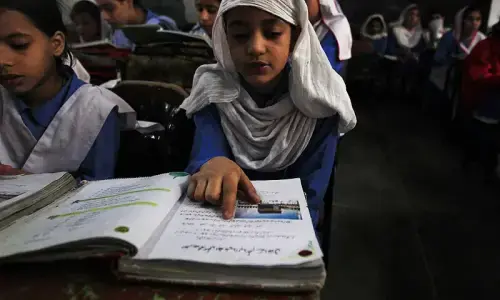
Small madressahs are numerous, keep multiplying and attract pupils only because they are free and accessible. Alhamd, a poor locality of Lahore, is reported to have four free madressahs but only one government school and that is crowded.
In Karachi’s Lyari town, seven government primary and secondary schools are housed in one building. According to Hamida Khuhro, Sindh’s education minister, 50 per cent of the children of the province have no schools to go to. The fee of private schools being beyond their means, the parents send their children to a free madressah rather than roam the streets.
Registering madressahs or putting them on dole would neither stop terrorism nor improve standards or access to education. The gap between the rich and poor is widening in money terms but widening much faster in education. The generations to come are thus condemned to live a life of degrading poverty and extremist violence.
To curb extremism generated in the madressahs and on the streets the government should consider: spending a substantial portion of the millions of dollars pledged by the US for madressah reforms in establishing a university rivalling al-Azhar; increase the expenditure on education from the two to four per cent of GDP; put half of zakat collection into a national fund for books, meals and clothing for children living below the poverty line; and bind private schools by law to admit 10 per cent poor students on merit basis.
Having said all that in hope, cynicism instantly takes over. Who has the time or the will to build new schools or reclaim old ones encroached or crumbling down in an age of mega projects and high spending? The murmur in the education departments is all about the jobs of teachers being apportioned by ministers and chief ministers to their relatives, friends or flatterers.
A dose of innovation
FOR obvious reasons, pharmaceutical companies generally don't rush to develop drugs for use in poorer countries. These businesses face strong financial incentives to seek profits formulating the next Viagra for sale in developed countries with paying customers and robust patent laws.
Meanwhile, funds to buy drugs for the developing world are often unreliable as donations follow development fads, which means that if a drug company did decide to produce, say, a new sleeping sickness medication for sale in impoverished nations, there is a risk that it would not find a viable market from which it could recoup even its research investment. That's a hard sell to shareholders.
But recently, public health experts have been experimenting with innovative ways of encouraging research and production of medications for so-called neglected diseases. Two such experiments have generated results that promise to save untold numbers of lives in the developing world.
A partnership consisting of the Drugs for Neglected Diseases initiative and the Paris-based pharmaceutical company Sanofi-Aventis announced that it has developed and will produce at cost a new anti-malaria drug. Sanofi-Aventis agreed not to seek a patent for the medication, meaning that generic drug manufacturers can immediately and legally produce the medication on their own, too, which promises to suppress the drug's already low price. Health advocates hope other pharmaceutical companies will follow.
This may remain a unique success, however. Most of the research and development of the new anti-malarial occurred before the partnership was formed; the scientific breakthrough in this case was in how Sanofi-Aventis combined two existing drugs. This made the development relatively inexpensive.
—The Washington Post
| © DAWN Group of Newspapers, 2007 |