Patch-up at White House
IT HAS happened many times in the past. Presidents Pervez Musharraf and Hamid Karzai have met, pledged to bury the hatchet and fight terrorism jointly. Yet, soon thereafter, each time they fell out, the latter oftener than the former going public with his list of complaints against the other. Now a patch-up has been effected over a White House dinner by President George Bush, who called both of them “personal friends of mine”. The meeting took place against a background full of events. Both leaders gave their own versions to the General Assembly, both met President Bush separately, and both said a lot of nasty things: President Karzai likened Islamabad’s policy to feeding a serpent, while President Musharraf likened the Afghan leader’s policies to those of an ostrich. The latest exchange of barbs began when Pakistan signed the deal with the tribal leaders of North Waziristan earlier this month. This prompted accusations from Kabul that Islamabad had all but given sanctuary to the Taliban. There were misgivings in Washington, too. But as the proceedings of the joint Musharraf-Bush press conference last week show, the American side seems to have accepted Pakistan’s decision to involve tribesmen in dealing with Al Qaeda and the Taliban. The decision was pragmatic and was prompted by the realisation that more than two years of military operations had not produced results and that there had to be a simultaneous political effort. The decision in Washington by the two sides to call grand jirgas which the two presidents will address vindicates Pakistan’s position.
As the British and Russians learnt to their cost, making war on the tribesmen is to shoot oneself in the foot. The British finally solved the problem by giving special status to the tribal belt provided the tribesmen pledged peace and kept out of the “settled” areas. Pakistan more or less followed the British approach, until the Soviet invasion of Afghanistan and Pakistan’s subsequent involvement with the US-led “jihad” completely upset the traditional pattern of relationship between the tribesmen and the central authority. The ISI’s support to the Taliban and the arming and funding of militant parties took Pakistan’s involvement deeper into Afghanistan’s internal affairs, and that is the reason why, despite the U-turn in its policy after 9/11, the world still has doubts about Pakistan’s commitment to the war on terror, the latest leak in Britain about the ISI being just one example of it.
Unfortunately, conditions in Afghanistan have not helped matters. President Karzai is all mouth, for he has nothing concrete to show by way of his country’s consolidation. There is a lot negative that is happening. Poppy cultivation was never higher, not only the warlords, even ministers are involved in the drug trade, and this has helped the Taliban and mercenaries of all sorts. His government’s writ now does not seem to run even in the capital city, and all that he can do is to blame Pakistan for his failure to restore even a semblance of peace and stability in the country.
The aim behind holding the jirgas is laudable. While Pakistan’s Ambassador Durrani said the idea was to “strengthen the tribal political system within their countries”, Afghan Ambassador Said Tayeb said the decision was aimed at “empowering tribal leaders to fight terrorism”. These are fond hopes, but it is obvious that the mere ceremonious holding of the jirgas will not end terrorism unless Islamabad and Kabul first call a halt to their war of words.
CII’s ruffled feathers
THE government would find itself in quite a predicament were the members of the Council of Islamic Ideology to carry out their threat to resign collectively unless their reservations are addressed. One member, Dr Javed Ahmed Ghamdi, is reported to have already resigned. The CII has been locked in an argument with the religious affairs ministry ever since the Women’s Protection Bill created a rumpus in the National Assembly and had to be dropped in the face of opposition from the MMA. The CII’s main contention is that the government bypassed it by setting up an extra-constitutional committee of religious scholars to vet the bill which was being dubbed unIslamic by the religious parties. One can understand why the CII members are upset. They feel the religious parties have been allowed to encroach on the council’s role of determining the Islamic authenticity of the bill.
Constitutionally, the CII’s role is an advisory one and under Article 230 it is expected to give its opinion only when asked to do so. Considering its sensitivities, the government involved it fully in the drafting of the amendment bill. Hence its objection is understandable when the MMA entered the scene. The CII sees itself as having been sidelined by the MMA’s ulema. What we have is in effect a clash of ideologies as well as egos. The government will find it hard to please all parties. The best approach would be for the National Assembly to repeal the Hudood Ordinances and restore the provisions on rape in the PCC as was the case in February 1979 before the Hudood laws were promulgated. If there are gentlemen of the clergy who feel that something more is needed to make our society more Islamic, let them work on a new bill and seek its passage in Parliament. It will never be adopted. The point to ponder is: was Pakistan any less Islamic before the Hudood laws were promulgated by a military dictator in 1979? If one were to take the cases of rape and injustice to women, their incidence has increased enormously in the post-Hudood laws period. That can hardly be considered Islamic.
Oval victory for Pakistan
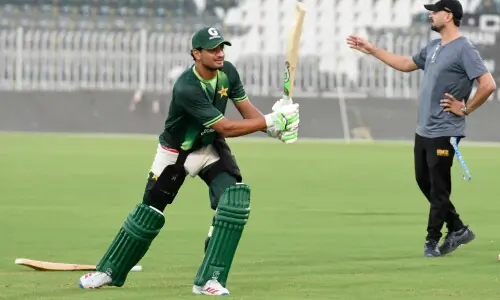
STANDING tall comes naturally to Inzamamul Haq, but what transpired at the Oval on Thursday raised his stature as a cricketer several notches higher. From the Pakistani perspective, “bringing the game into disrepute” was by far the lesser, if not inconsequential, charge against the team captain. Inzamam was found guilty on that count — something that was inevitable given his initial refusal to take the field against England on August 20. Even then, the punishment meted out by the ICC adjudicator amounts to little more than a rap on the knuckles, and all that the skipper must do is shrug and serve the penance of sitting out the Champions Trophy in India. There is compensation enough for this passing privation. With Inzamam cleared of the more damning charge of ball-tampering, the captain and his team have emerged from the hearing without a stain on their character, the ‘disrepute’ conviction notwithstanding. That punishment related to actions taken in response to accusations that were found to be wholly without merit. As such, it could be said that Inzamam occupies the high ground there as well, at least morally.
Meanwhile, umpire Darrel Hair stands exposed as an arrogant and officious man who, despite all that he has done to disfigure the game, still appears convinced of his infallibility. And that is the kind view. Many will argue that it was not just hubris but an innate bias that coloured his judgment on that fateful Sunday in August. Pakistan cricket has been vindicated, as the PCB chairman put it, but there is still the unfinished business of deciding what to do with Darrel Hair. If there is anybody who has brought the game into disrepute, it is Hair whose attitude is clearly at odds with the spirit of cricket. The sport’s governing body must rid itself of this canker once and for all.
Arms imbalances in the subcontinent
THE supply of non-nuclear technology to India under the Indo- US Agreement on Nuclear Cooperation gives India access to hundreds of nuclear labs and nuclear R&D institutions in the United States. The significance should be obvious.
Benefiting greatly from US nuclear technology, the 22 Indian nuclear reactors could continue producing weapons grade uranium for several years. After that, 14 reactors will come under the safeguards of the International Atomic Energy Agency, but eight unsupervised Indian reactors could produce an unlimited amount of weapons grade uranium.
In effect, India could manufacture hundreds of nuclear weapons to fit on intercontinental ballistic missiles, intermediate-range ballistic missiles and tactical missiles. In Pakistan, which is involved with internal problems, this development is not getting the attention it deserves.
The other more serious development is that the US defence industry, taking advantage of the Indo-US nuclear pact, is trying to secure defence contracts worth billions of dollars from the Indian armed forces. Advanced technology F-16 and F-18 fighter aircraft, latest scanned array radars (AESA), multi-role helicopters, submarines, frigates, Long Range Maritime Patrol (LRMP) aircraft, and AWACS have been offered to India. Arming India to the teeth would impact on India’s neighbours especially China and Pakistan. At present, 70 per cent of Indian military weapons are of Russian origin. There is a realisation that America has the best high-tech weapons, especially fighter aircraft and air defence equipment, which could enable India to establish hegemony in South Asia and primacy in the region.
One of the biggest deals underway involves India’s plans to buy 126 new multi-role jet fighters for the Indian Air Force, valued at around 10 billion dollars. Lockheed Martin, the biggest aircraft manufacturing company in the world, has made an offer to sell 126 Block 50-52 F-16 fighters jets, with technology transfer. Boeing Co the biggest manufacturer of passenger jetliners has offered AE/F Super Hornet fighters at a comparable price.
It is worth mentioning that while the US has agreed to sell 36 F-16 fighters to Pakistan at the exorbitant price of five billion dollars, 126 F-16s are being offered to India for 10 billion dollars only.
The government needs to clarify, why Lockheed Martin is charging Pakistan, a non-Nato ally, a price that is far higher than the one being offered to India.
India is negotiating a deal with Lockheed Martin to build most of the F-16 jet fighters by HAL at Bangalore. Why has Pakistan failed to negotiate a similar agreement to assemble/build F-16s at the Pakistan Aeronautical Complex at Kamra? Was technology transfer a requirement taken up with the Bush administration and with Lockheed Martin? And what was their response? Are the US and Lockheed Martin taking Pakistan for a ride by charging a much higher rate? In the past, $658 million were paid to Lockheed for the supply of 28 F-16 fighters. The supply of the F-16s was blocked and the huge amount paid was not returned.
The Indian Air Force has 230 modern frontline combat aircraft — 190 Russian SU-30 MK and 40 Mirage 2000 strike aircraft, compared to only 32 F-16s with the PAF. With 126 additional fifth-generation fighters, the IAF’s fighter strike and combat capability will increase to 356 highly multi-role aircraft, capable of striking deep into Pakistan. With 36 additional F-16 Falcons, the PAF will have a total of 68 F-16 aircraft after 10 years. The five to one imbalance of combat aircraft, will tilt the ratio of air power dangerously in favour of India.
Lockheed Martin aims to outsource aircraft components to enable India to sell its highly successful C-130 transport aircraft for the Indian Air Force. The IAF transport fleet is already four times the size of the PAF transport fleet of C-130 Charlies. The PAF has been operating the C-130 most successfully, especially in the Northern Areas, since decades. Besides increased airlift capability, C-130 aircraft will enhance the Indian army’s para-drop capability.
The American avionic firm Raytheon has already confirmed its readiness to supply India with its most advanced “electronically active scanned array radar (AESA), which steers radar beams at nearly the speed of light. The system is much lighter and more accurate than conventional radar systems. This electronic asset would significantly enhance the war fighting capabilities of the Indian Air Force.
Neither AESA nor the F-18 Super Hornet has been offered to Pakistan. The discrimination against Pakistan is more than clear. The US has offered the Patriot Anti-Missile Missile System to India, while India is negotiating the purchase of Arrow AMM’s from Israel. Indian Air Force AWACS and the new AMMs and AESA radars will enhance the IAF’s capability to intercept incoming missiles and intruder aircraft.
Bell, the American aerospace giant, has almost settled an order for the supply of 197 multi-role helicopters, including large numbers of gunship helicopters for the use of the Indian army and air force. The Bell helicopter deal is valued at $500 million. Bell has also offered India assistance for the development and manufacture of attack helicopters at home. The Indian army wants to buy 64 Bell attack helicopters immediately. The remaining 137 will be manufactured under licence at HAL Bangalore. With 197 new Bell helicopters and 250 Chetaks and Cheeta helicopters, the army’s offensive capabilities will significantly enhance.
The Indian navy’s shopping list includes six submarines, three frigates, eight Long Range Maritime Patrol (LRMP) aircraft and Boeing’s Multi-Mission Boeing jets. The 737 is not available until 2009, so the Indian navy is likely to opt for P3C Orions.
The Northrop Grumman Corporation has offered sea-going vessels for the Indian navy’s coastal fleet. It has already signed a deal with HAL Bangalore to supply the components of the Hawkeye AWAC’s offered to the Indian navy and air force.
India’s defence budget has been steadily growing with its economy. There are indications that the defence budget will increase to 22 billion dollars during the coming fiscal year. Capital expenditure on new weapon acquisitions has increased from 25 per cent in 2000 to 42 per cent during the current fiscal year.
This massive arming of India will create a serious security situation for countries in the region including Pakistan, China, Iran, Indonesia, Bangladesh, and the Near and Far East as well as the Middle East region. The matter should have been discussed at the Non-Aligned Summit in Havana. Something must be done to stop the arms race being triggered by the United States in South Asia.
The writer is a retired air marshal of the Pakistan Air Force.
An outbreak of peace
MARGARET Thatcher’s Bournemouth party conference speech in 1990 was one of her best, all observers agreed. Her biographer John Campbell thought the speech “confident, wide-ranging, by turns scornful and visionary”.
Lady Thatcher herself thought its rapturous reception by the party faithful “stronger than ever”. The conference, recalled her speechwriter Ronnie Millar, acclaimed her at the end with “a salute to end all salutes”. And so it turned out. Six weeks later she resigned.
Labour in 2006 is a very different kind of party from the Conservatives in 1990. Yet it is worth recalling the events of autumn 1990, if only to underline how illusory the mood of a party conference can sometimes be, and how quickly things can change.
Both Tony Blair and his party had a good week - especially when compared with the week they might have had.
Mr Blair made a memorable speech that was deliriously received. The party’s welcome all week had been conspicuously warm. Yet power drains away very quickly and the unresolved tensions and issues that haunted Labour at the start of the month have not been banished as September draws to a close.
Labour’s great achievement this week has been to retreat from the fratricidal abyss into which it seemed intent on rushing only a few weeks ago. Artificial and misleading the self-denying unity at Manchester may in some ways have been, but it was imperative for Labour to show that it is serious about keeping power.
That meant a ban on political brawling and ego-tripping - and the ban worked. The party would be foolish not to apply that lesson over the months ahead. Its disputes and contests have to be conducted in the same spirit if Labour is to benefit, rather than suffer, from the post-Blair transition.
That’s a warning that the unions should also heed - not just the candidates and their entourages.
The clear sense among delegates was of a successful conference, both in the hall and on a particularly vigorous fringe. Yet the mood was also brittle. That showed in the defeats that the party leadership suffered on health and housing - and that it also would have suffered if foreign policy had been properly on the agenda.
There was also a sense of controlled unease, which should not be exaggerated, about the party’s future under the probable leadership of Gordon Brown. Mr Brown had damaged himself before Manchester.
—The Guardian, London