A ‘ray of hope’ for the issueless
THE centuries-old Pooran Di Khuee (the well of Pooran) situated at a far-off border village, Karol, in Kotli Syed Ameer sector, remains a ray of hope for the issueless who believe that the Allah Almighty will bless them with children if they take a bath around it every Sunday night in the moonlight of each Islamic month.
Dozens of issueless people, therefore, visit Pooran Di Khuee every Sunday night and perform these rituals.
Women hang their colourful ‘dopattas’ on the centuries-old tree near the well and the temple of Pooran, hoping that their prayers for children would be granted. Several people told Dawn that Allah Almighty gave them children after they had repeatedly visited Pooran Di Khuee.
Before partition, the issueless Sikhs and Hindus used to visit the place to pray for children. Now, couples from all over Pakistan visit it throughout the year for the same purpose.
According to Tareekh-i-Sialkot (the history of Sialkot), compiled by historian Rashid Niaz, Pooran was the son of the then ruler of Sialkot, Raja Salbahan. Pooran was very handsome and innocent. Raja Salbahan’s wife Rani Loonan, the daughter of the ruler of Jammu state, was issueless. The Raja felt the need of a son who could inherit his kingdom. So he married a poor and pretty girl, Ichchran. Rani Ichchran became much beloved of Raja Salbahan when she gave birth to a son named Pooran. Raja Salbahan declared Pooran as his successor. On this, Raja Salbahan’s first wife Rani Loonan become jealous of her stepson.
Raja Pooran turned a handsome and charming youth full of innocence. His stepmother, one day, under a plan, accused him of trying to criminally assault her. She also misguided Raja Salbahan, terming the innocent boy a vagabond. On this, Raja Salbahan became very angry and without verifying the accusation ordered his lieutenants to throw his only and beloved son into a well (Chah-i-Zindan) after cutting his arms and legs. Pooran was not given a chance to clarify his position.
Tareekh-i-Sialkot revealed that Raja Salbahan’s men threw Pooran into Chah-i-Zindan after cutting his hands and legs. This was what Rani Loonan had wanted.
Chah-i-Zindan was located on the banks of the river Chenab. The same day, Sikh saint Guru Gorakhnath, with dozens of his disciples, reached the well. They found Pooran in it and took him out in a critical condition. Later, Pooran told his entire story to the Guru, who adopted him as his disciple.
It is said that Pooran regained his legs and arms with the special worship and prayers of his Guru. Pooran started worship of God under his supervision and became a Bhagat preaching the teachings of his Guru.
Hearing the fame of Pooran’s miracles, Raja Salbahan and Rani Loonan went to Pooran Bhagat and requested him to pray to God to bless them with a child. Pooran Bhagat introduced himself as Raja Pooran, their son, and proved that he was not guilty as his issueless stepmother, Rani Loonan, out of jealousy had blamed him for trying to rape her. Pooran asked his stepmother to accept her fault if she wanted a child.
Rani Loonan admitted before Raja Salbahan that she had unjustly blamed her stepson who was innocent. Raja Salbahan felt ashamed and asked him to come back and take charge as a new ruler of his kingdom. Refusing to go back, Pooran Bhagat prayed to God to bless them with a child. Later, he gave them the good news that God will give them a handsome boy and his name would be Raja Rasalu.
Tareekh-i-Sialkot revealed that Raja Salbahan constructed a temple, Lungar Khana, Ashnan Ghar and Dharam Shala at the place where his son, Pooran Bhagat, had lived and preached.
According to another history book, Mutiny in Sialkot, Pooran Bhagat’s Samadhi remained there till 1857. It disappeared with the passage of centuries, leaving behind only a small well Pooran Di Khuee and a small temple there which are being looked after by issueless people, who visit the place.
Living in fear of being robbed
Recent reports in the press say that incidents of burglary and robbery have increased in the federal capital during 2002 as compared to the year before. Indeed almost every other day if not every day there are reports about such crimes in Islamabad. And there are other cases that are not reported to the police.
For the police, every robbery reported may just be an addition to the crime statistics. But for the residents, every robbery that they experience, read or hear about heightens their sense of insecurity.
“You can’t imagine the shock and anger that grip the burglary victim when he returns home to find his house broken into and ransacked, and the possessions that he has obtained with hard-earned money for his family’s comfort all gone,” says a resident, Asad, whose house was burgled last Monday, the second time in less than two years.
Asad considers himself lucky this time. The robbers only managed to get away with Rs1,070 which they took from his little daughter’s purse that was lying in the drawer. It was money that she had collected last Eid and on her recent birthday. Asad didn’t bother to call the police this time.
In the same week, at least three other robberies took place in the residential sector where Asad lives. Two of them were reported in Dawn: in one, gold jewellery and cash (in local and foreign currency) were stolen while in the other, cash and other valuables were reported stolen. The third robbery, in which a car was stolen from a house in the middle of the night, took place just two houses away from Asad’s home.
The spate of robberies in commercial premises in the capital in the last week of January only reinforced the sense of insecurity felt by residents like Asad. The hits were against a soap factory, a pipe factory and a trading company, all three robbed of cash totalling some Rs1.6 million.
While most commercial robberies take place when the day’s collection of cash is being transported to a bank, homes like Asad’s are usually burgled when the occupants are away.
Asad believes that he escaped lightly this time only because he had many precautions after his house was robbed the first time in early 2001. That was just two years after his family first moved into a modest house which Asad had bought and furnished after working abroad for five years.
“The first time, the burglars had entered by breaking down the front door and they took away practically every electronic item that we had bought over the years — the television, the VCR, the VCD, the laptop, the video camera, the still camera, and all my wife’s jewellery or whatever little that she had,” Asad said.
“My two children were very upset and insisted that we moved out of Pakistan. For weeks, they wouldn’t sleep in their bedroom. In the evenings, they sat glued to their seats in the family sitting room, afraid to go anywhere within the house alone, even to the bathroom. I had to do something to make them feel reassu
“I had iron grills made for all the four exit doors of our house. Since then, I have also been paying Rs17,000 a year, apart from an initial Rs20,000 installation fee, for a security alarm system that I got installed on these doors and the front gate.”
Asad works in a semi-government institution and his salary is Rs30,000 a month. “We decided to ‘pay’ heavily for our security as the thought of burglars entering the house when we are asleep gave us sleepless nights after that first burglary”.
But still, they did not feel secure. There were frequent burglaries in their sector and elsewhere in Islamabad. Their neighbour’s house next door was broken into while the elderly couple was away for iftar during Ramazan. A doctor who lived in a corner house at the end of their street had his house burgled twice. Then he shifted to another house in the next street, but that was again burgled.
Even more unnerving was the news about dacoities in their sector. A basement departmental store in their market was robbed of cash at gunpoint in broad daylight. A house in the next street was robbed by gunmen who broke in the middle of the night alarming the sleeping occupants.
A year ago, one of Asad’s sisters who lives in another residential sector had a narrow escape when two robbers forced their way into her house in broad daylight, holding her little daughter who had been playing outside. While the robbers were trying to force a neighbourhood lady, who was visiting her at the time, to take off her gold bangles, Asad’s sister managed to run into a bedroom, struggled to close the door and lock herself in, and shouted for help from the window.
Six months ago, Asad’s eldest sister, who lives in yet another residential sector, had her house broken into while she and her family was away for two hours visiting a relative. The burglars entered by breaking the front door and ransacked the whole house. They were only looking for cash and jewellery as the other valuables were left intact.
In the next street where Asad’s eldest sister lives, every one of the 12 houses along the main road has been burgled before, several of them more than once.
Now Asad and his sisters no longer go out that often, especially after dark, or visit each other as frequently as they would like to. Going out of the city for several days for a wedding or even a funeral is unthinkable for them now unless they can get someone to look after the house while they are away.
Even when they have to go out, they usually take with them whatever valuables that they can carry with them like jewellery (whatever that is not kept in the lockers in the bank) and cash.
Now, Asad says he will have to consider installing alarms also on the three air-conditioning openings in his house in addition to those already on the four exit doors. This will mean more expenditure for him but his children have been living in terror since last week of burglars crawling into the bedroom through this opening while they are asleep.
Asad also has nightmares that his car, even though it is alarm-proofed, would be stolen one day, either on the street or from his home. Since his neighbour’s car was stolen a couple of nights ago, Asad has resorted to disabling his car during the night by taking out the wire connecting the battery. He says he can’t afford to buy another car, unless he goes abroad to work again.
His cousin, a retired teacher, had his car stolen when he and his family were visiting a children’s park in Islamabad nearly two years ago. Seven months ago, a friend of Asad had his newly bought second-hand car stolen as he was getting the registration documents done. His friend, who is working abroad and was then on a six-month vacation in Islamabad with his family, cut short his visit.
“We used to blame these robberies on the Afghan refugees. When the refugee repatriation programme started last year and especially with the police reforms too, we thought that we would finally see a climbdown in robberies. We are very disturbed that quite the opposite has happened,” says Asad.
But, crime can be brought down, so said a senior Pakistani police official in a newspaper article published three weeks ago. He cited the example of how the 9/11 fame Mayor of New York, Rudolph Giuliani, and his police chief managed to reduce crime and increase public safety in their city between 1994 and 2001 through a firm policy of better policing and accountability.
But until reducing crime and public safety become the goal and mission of the federal territory administration, and unless the federal police buck up on performance, families like Asad’s will continue to live in fear of being robbed.
A Palestinian model for Kashmir
IT was a real treat listening to Ghada Karmi, the London- based Palestinian emigre, intellectual and political activist who recently visited Pakistan on a lecture tour. For me as a Pakistani, her nearly hour-long talk on ‘Palestine in the shadow of war’ was intellectually stimulating but also embarrassing in terms of our pathetically routine and patently ‘de- intellectualized’ projection of the Kashmir case. Over half a century of the running dispute with India has not produced any powerful speaker, writer or politician to present a sober account of the case as something larger than a territorial dispute.
During the period between 1949-1950, there were at least three bright young Kashmiri activists who held out a lot of promise to emerge as exponents of their case at the intellectual level like Ghada Karmi. They were Yusuf Buch, Mehmood Hashmi and Agha Shaukat Ali. They had all the makings of committed revolutionaries endowed with the gift of persuasive speech and simple, well-reasoned writing and, above all, the advantage of youth.
However, none of them quite came up to the level expected of them as Kashmiri freedom fighters and thinkers. Mehmood Hashmi did a book or two on the early stages of the Kashmir tragedy; Yusuf Buch settled to become a speech-writer and back-stage PRO for Pakistani delegates to the UN, rising to ministerial rank under Zulfikar Ali Bhutto; and Agha Shaukat Ali was lost to the soulless routine of professional public relations.
The last time one met Mr Buch was at a seminar in Muzaffarabad in 1998. Still in full possession of his mental and physical strength, he hardly seemed to fit the picture of an activist. Agha Shaukat was not even a shadow of his once robust self when we met last some nine years ago. Of Mehmood Hashmi, about the most creative of the trio and a master of Urdu prose, I can recall only his face, reflecting an unusual mix of a smile and a half smile. Their one additional and largely unshared advantage was that unlike the large number of Punjabi-speaking Kashmiris from Jammu, Mirpur, Poonch (etc), they were all vintage Valley-wallahs.
Yet another blue-blooded Valley-wallah was my dear friend, the late K.H. Khurshid who rose to be president of Azad Kashmir and lost his true place as a writer, intellectual and political activist. In his short memoirs (edited by Khalid Hasan) Khurshid, with the amount of knowledge he had about Kashmir of the pre- and post-dispute generation (and the courage to speak of it too) has told the bitter truth, that others would not wish to either touch or accept.
One of the incidents referred to by him is the tribal invasion of Kashmir, master-minded by Khan Abdul Qayyum Khan, the then NWFP premier and Pakistan’s “strongman”. Qayyum enjoyed a three-fold advantage as custodian of the ‘razor-edge frontier’ as principal civilian executive close to the headquarters of the Frontier Corps, and as one in the confidence of both the Quaid and prime minister Liaquat Ali Khan.
“The tribal invasion sealed the fate of Kashmir”, writes Khurshid in his memoirs. It did indeed. The lightning advance of the leaderless lashkars on Srinagar and their swift, disorderly retreat from there while just a few miles away from Srinagar airport more than amply prove the truth of Khurshid’s statement.
Our Kashmir case has been ever since tossed to and fro between legal / political battles and actual wars — worse still, an ever-impending threat of war — with no real end in sight.
Talking of an amicable settlement of the dispute on the basis of the relevant UN resolution (advisory as opposed to mandatory under Article VI of the UN Charter) is all very well and proper. It remains our unquestionable legal and moral right. But is it enough to arouse the world’s conscience in support of our case and in sympathy for the Kashmiris? Hardly.
What we seem to have sadly been unable to do is to lend a rational intellectual dimension to the issue as committed Palestinian scholars and political activists have been able to do in their own case. The brave Kashmiri resistance since 1990 is a just and worthy rival to the Palestinian intifada. But what about the role and contribution of the Kashmiri Diaspora and home-based individuals and groups toward a mature projection of their case beyond the usual PR pulp? What do all those Kashmir committees, liberation cells and sponsored foreign trips have to show in terms of any worthwhile results?
Way back in 1949, during my days as a press reporter, I happened to meet the celebrated editor of the weekly The New Statesman and Nation, Mr Kingsley Martin. He had been on a conducted tour of Azad Kashmir. The PRO escorting him fed him with so many stories of Indian atrocities that Mr Martin had virtually to shut him up. What he was looking for was a sensible brief on the Kashmir case rather than all those weird tales and atrocity stories.
The Kashmir committees formed under various governments started with a bang but ended on a whimper. Reportedly, the last such committee formed with a flourish of trumpets under the Mujahid-i- Awwal (The First Crusader) Sardar Abdul Qayyum Khan, is about to be disbanded to meet the fate of its predecessors.
Would it be wrong then to assume that a single committed intellectual and activist like Ghada Karmi could serve the Kashmir cause better than all the Kashmir committees, liberation cells and delegations on trips abroad? Ghada Karimi has indeed set a model for us to follow in projecting our Kashmir case at a mature intellectual level, larger than harping on it as an inter- state territorial dispute (“Kashmir Bane Ga Pakistan!”). Dr Karmi herself put Palestine and Kashmir together, describing them as victims of the “abuse of smaller nations’ rights by big powers.” — The writer is a retired Brigadier of the Pakistan Army.
Politics should not be allowed to intrude into cricket
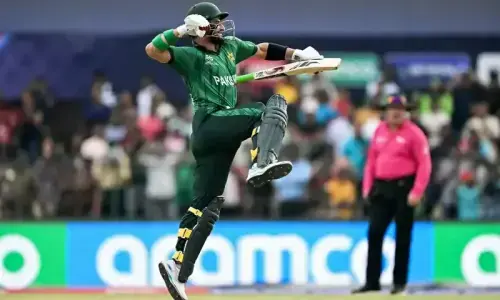
The World Cup has got underway and it will be cricket, and one fervently, hopes nothing but cricket till its grand finale on March 23, which also happens to be Pakistan’s Republic Day. A good omen? Leading up to the start of this cricket’s most sought after prize, have been events of a most unsavoury kind and we need to put them behind but not forget them entirely.
The next World Cup will be in the West Indies and who knows what the world will look like then. Certainly such matters like contracts should be settled now, and, perhaps, it should be firmly established, that politics will not be allowed to intrude into cricket. One hopes too that the world will be a calmer place and England, Australia and New Zealand will not feel it necessary to express security concerns or try and torpedo the tournament in the developing world.
Australia has been installed as firm favourites. This is conventional wisdom. But cricket has never been a slave to conventional wisdom.
The one-day game can be a lottery and the most improbable upsets are possible, India in 1983, Australia in 1987, Pakistan in 1992, Sri Lanka in 1996 all bear testimony to the fickle nature of the game. It is a long tournament and there’s many a slip between the cup and the lip.
I was interviewed by Pakistan Television and I was asked to gaze into my crystal-ball and predict the likely winner. I made the point that there are 14 teams in the tournament and only one can win.
We could safely eliminate Namibia, Netherlands, Kenya, Canada, Bangladesh and even Zimbabwe, though Zimbabwe had the capability of causing at least one upset that could deprive one of the main challengers of vital points. That left Australia, South Africa, Pakistan, India, West Indies, England and New Zealand in the fray. Any one of these teams could win the World Cup though England, West Indies and New Zealand looked less likely.
Pakistan, I feel, has no outstanding chance. It is being described as “the most dangerous” team. There is no doubt that Pakistan has the ability of reaching great heights but does it have the consistency?
It reached the final in 1999 but choked and Australia romped home in what turned out to be a damp squib for Pakistan supporters. But the present Pakistan team is far better one than the 1999 team and Australia, still a power-house, will be without Steve Waugh at the helm. It will make a difference. Pakistan’s match against Australia will have been played when this column appears in print but it probably won’t be the only time that the two teams will meet.
I was a little dismayed that in the last of practice matches, Pakistan conceded 40 extras with a proliferation of wides, as if, they were gift items. One hopes that the coach has taken serious note of this. The bowling of wides and no-balls need to be ironed out at the nets and, which, in turn means that net practice has to be taken seriously, like a war-game with live bullets.
This and the fielding generally needs to be tightened up. But Pakistan is a well-balanced side and was picked studiously and well received by Pakistan’s cricket and even the professional, ‘carpers’ had little to say by way of criticism.
India is the other team that looks good. It certainly has the batting and Srinath’s inclusion strengthens the seam attack. The general feeling is that given the nature of South African wickets, it will be a fast bowlers World Cup. I don’t agree. Both Saqlain Mushtaq and Harbhajan Singh will profit from the extra bounce, as will Shane Warne and spinners will have their role to play.
The World Cup is a marriage between commercial greed and national pride.
More so in India and some of the commercials that I have seen on television appear to me as if national pride has been privatised. India will feel the pressure of this hype, and of the expectations.
But the greatest pressure will be on South Africa, the host. No host country has won the World Cup. Shaun Pollock says that records are meant to be broken. He means the jinx. South Africa blew its chances in 1999. They will be mindful of this.
Their match-winner Lance Klusener is lucky to have made the squad.
The key, however will be Jacques Kallis, and it will be around him that South Africa will make its challenge. South Africa is a definite contender and has the home advantage. But it’s too early to call and there is the weather factor and Duckworth & Lewis, the Pythagoras theorem of one-day cricket, beyond the understanding of mortals.