0
0

Darkness at dawn
ONE has lived since the last three years of the 20th century with positive hopes and aspirations for the new century and millennium that were to follow the bloodiest and most destructive century in recorded history. The end of the cold war in 1989 had seen the rivalries and proxy wars that succeeded the horrors of the Second World War give place to a world order dominated by the US.
Recalling the role of that Great Power in the creation of the League of Nations, and later the United Nations, one drew comfort from the notion that the leadership of the world was in the hands of a country that represented a unique mixture of practicality and idealism.
The events of September 11, 2001, have been followed by trends and events that are rapidly eroding confidence in a peaceful and stable world that would concentrate its energies and resources on improving the lives of all its citizens. Even before the 9/11 incident, the Bush administration had adopted a unilateralist approach that had aroused widespread resentment and concern. The very concept of the Ballistic Missile Defence (BMD), launched on May 1, 2002, without advance consultation with allies and friends, was tailored to acquiring hegemony of an unprecedented character by combining “the strongest shield with the sharpest spear”, as the Chinese put it.
The concept of the BMD had encountered resistance and reservations among a wide variety of countries, including most members of the EU, as well as Russia and China. President Bush, who is surrounded by advisers linked to the military industrial complex in the country, had showed little inclination to pay heed to the critics of the BMD, among them many US analysts who believed that the unique superpower already possessed adequate power to counter any challenge from “rogue states.” President Bush and the hawks around him appeared determined to acquire the kind of supreme authority warranted by the country’s unchallenged technical and military edge.
US unilateralism appeared to have been tempered by the need to evolve a global coalition following the terrorist outrage of September 11. That coalition is still there, and its practical manifestation exists in the form of joint operations in Afghanistan by the military forces of numerous countries, ranging from Britain and Germany to Turkey and Australia. Both Pakistan and India are its members though India is engaged in a coercive diplomacy against Pakistan in the name of anti-terrorism. However, the obvious Indian goal is to have a free hand to crush the Kashmiri freedom struggle, very much along the lines of what Israel under Ariel Sharon is doing in Palestine.
There is a general recognition of the fact that the US is indeed the only superpower, the only one able to project its power to any part of the globe. Its military expenditure, which had been brought down during the Clinton years, has risen exponentially since the terrorist attack, and is approaching $400 billion — greater than the next eight largest military powers combined. In economic power, its only rival is the European Union. Not since Rome as a single power enjoyed such superiority, but Rome dominated only one part of the world. The expression used by the French foreign minister Hubert Vedrine, about America being a “hyperpower” is apt.
The US, since the end of the cold war, has perfected the art of exercising its influence in all spheres, ranging from political to economic to military. The expression used by Madeleine Albright, President Clinton’s secretary of state, about the US being an “indispensable power” is also apt. The agony of Bosnia went on for three years till the US stepped in to stop the bloodshed. It again took US leadership to prevent Milosevic from doing another Bosnia in Kosovo. Even the UN cannot intervene effectively in the discharge of its mandate, till the US gets involved. The rub is that the US is tending to make the UN either subject to its dictates, or irrelevant.
It had taken President Clinton his first term that was focused on domestic concerns, to realize the potential of America’s role as the unique superpower. He not only facilitated the Dayton Accord in Yugoslavia, but involved himself personally in the Arab-Israeli dialogue in the last year of his presidency, that nearly brought off a definitive solution at Camp David II, in July 2000. The Bush Administration was expected to do better, because of his personal equation with many Arab rulers.
However, the initial stance adopted by him was not to get dragged into mediation between the Israelis and the Palestinians, as Clinton had been. Subsequently, the power of the Israeli lobby in the US, and the skilful use made by Ariel Sharon of the terrorist threat to justify his unspeakable horrors against the Palestinians, have led Washington to play a role that even its European allies see as biased.
As Timothy Garton Ash, Director of the European Studies Centre at St. Antony’s College at Oxford states in a recent article in the New York Times, “America today has too much power for anyone’s good, including its own”. The writers of the American Constitution had wisely insisted on checks and balances. However, in the situation created by the September 11 events, Bush enjoys the kind of popular support for his policies, that has virtually eliminated any real check on his power.
His imposition of tariffs on steel imports in violation of the WTO rules was cited as an example. Dr Ash’s own recipe for the exercise of a check on US power was by Europe, which is an economic equal to the US, and has long diplomatic and military experience.
The exercise of total and unchecked power by the US looks different to the developing world, and in particular to the Muslim countries. The standards being set and he traditions being established cannot but be a source of deep disquiet for thinking people in Pakistan. We are directly affected by the impact of US power and policies in the region stretching from the Middle East to the Straits of the Moluccas.
Pakistan took a principled position following the September 11 events, and not only has been our cooperation important for the US-led military operations against terrorist networks in Afghanistan, but President Musharraf has taken courageous decision regarding the country’s ideological direction.
In doing so, he has taken on powerful religious groups, and undertaken daunting tasks. Not only has the system of education to be revamped, but the roots of agitation and extremism addressed through an economic rebirth. There is an external dimension to the disquiet and discontent in the country, in the form of India’s resolve to suppress the legitimate struggle of the people of Kashmir by brute force.
The US has clearly taken a policy decision to develop a strategic partnership with India, which is seen as the leading power in the Indian Ocean region, that claims to be threatened by the forces of Islamic fundamentalism, and is ready to play its part in the containment of China. The US is increasing the scope of military cooperation with India, with which it has entered into an agreement for the joint patrolling of the Molucca Straits.
The developing nexus with India has produced a disturbing case of double standards, so far as India’s own religious extremism is concerned. Whereas the Jihadist response to repression in Kashmir is reflective of dissatisfaction with genocidal repression by 700,000 strong Indian forces, to deny rights guaranteed in UN resolutions, the BJP is engaged in denying basic human and democratic rights to India’s large Muslim minority. The failure of the Bush administration to criticize the complicity of the Vajpayee government in the state sponsored use of terror tactics against the Muslim population, has a disturbing resemblance to its attitude over Ariel Sharon’s state terrorism in Palestine.
Even more disturbing is the US attitude towards the UN, an organization located on the American soil, which symbolizes the aspirations of mankind for a just and peaceful order. Ever since the Bush administration took power, it has used the UN to gain legitimacy for its own actions, notably in the war against terror. However, several recent decisions of the unique superpower have shown that the UN is not its chosen instrument for ensuring justice and peace.
After Sharon launched his unrestricted warfare against the Palestinians in the name of anti-terrorism, and carried out massacres in the Jenin refugee camp, the UN Security Council passed Resolution 1405 to send a fact-finding mission to Jenin. Sharon’s government refused to permit such a team to come, giving flimsy reasons, and got away with it, plainly because the US chose not to use its weight in support of the UN. Another decision taken in repudiation of a commitment by the Clinton administration was that of dissociating the US from the International Criminal Court, whose creation has been agreed by the international community.
The conclusion one is driven to reach by analyzing the policies and actions of the Bush administration is that Washington is determined to shape the world in the new century on the basis of its power, which is already preponderant and will be made overwhelming, rather than the ideals enshrined in the UN Charter. The BMD concept will give total military superiority to the US. The nuclear policy review advances the concept of the US using nuclear weapons against seven countries that may challenge US interests or concerns, that include four Muslim countries, Iraq, Syria, Iran and Libya, besides North Korea, Russia, and China. An attack against Iraq is seen not only as a possibility, but as a probability.
For us in South Asia, the influence of the US example in basing its policies on sheer military power is visible in the new arrogance by the Hindu extremist dominated government of India. It is keeping 800,000 troops massed on our borders, in the name of anti-terrorism, while letting massacres and genocide continue in Gujarat and stepping up state terrorism in Kashmir. In the meantime, we get advice from the IMF to lower our defence expenditure.
The US has a creditable history of bringing to bear the democratic and humanitarian principles of its founding fathers on the international scene. President Bush bases his war against terrorism on the challenge it poses to democratic order in the world. But, sadly, the regression to total reliance on power since the September 11 events is enabling the likes of Ariel Sharon and Narendar Modi to get away with complete contempt for human rights and democracy. Such trends cast a dark shadow on the bright dawn that was awaited at the start of the new century.
One can only hope that the influence of more moderate forces within the US will lead to a shift by the sole superpower towards its traditional role of promoting a world of peace and cooperation rather than one where scarce resources would against be diverted to a race for producing engines of war and destruction. The dark clouds hovering over the dawn of the new century and millennium will be driven away by winds of change that will address the causes of terrorism, rather than its symptoms.
Chacha Zindabad
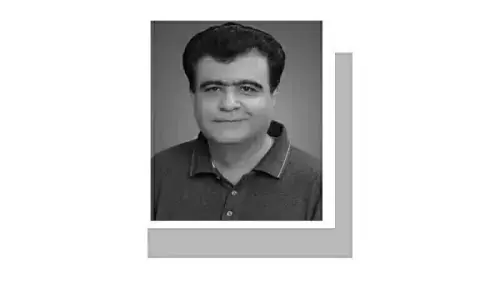
F.E. CHAUDHRY, Chacha Chaudhry to every journalist, is just seven runs short of his first hundred. The cool, unperturbed manner in which he is playing through what for others would be the nervous nineties, leaves little doubt that he will reach the magic mark with the same ease and lack of fuss with which he used to take his pictures for the Pakistan Times.
In a country where everything seems to change for the worst, Chacha remains one of the few remaining signs that perhaps not everything has gone down the tubes. Chacha, who has been decorated more than once by different governments for his outstanding contribution to photo journalism, does not need a title, but were one to be found for him, surely it could only be Baba-i-Press Photography.
He was Pakistan’s first serious, full-time press photographer who worked freelance until he was snapped up by Mian Iftikharuddin soon after the Pakistan Times began publishing in 1947. He stayed with the newspaper almost until its closure, through good times and bad, working in his own inimitable style and snapping pictures, many of which have come to form the pictorial history of Pakistan. Had Chacha done nothing but recorded the upheavals of Partition and the arrival of thousands of refugees from across the newly-drawn dividing line between India and Pakistan, he would have assured for himself a place in the history of pictorial journalism.
Chacha, proud father of the 1965 war hero Cecil Chaudhry, who is currently the principal of Lahore’s St. Anthony School, lives by himself, as he has always done, at 7/10 Jail Road, Lahore. For years, his children, especially Cecil, have tried to persuade him to move in with one of them; and every time Chacha has said no. He says he is perfectly capable of looking after himself and though he may no longer hop on his Quickly motorbike and go cruising down Lahore’s roads in search of a story, he prefers to live by himself.
He may move slowly and some of the bones in his body might creak now and then, but he loves his independence. His needs are few and he is quite happy in his own space. Every newspaper in the city sends him a complimentary copy and his mornings are spent reading.
Some time ago when Chacha was taken ill, Cecil insisted that he move in with him. However, the day Chacha felt well enough to amble around, he returned to his own place. He lost his wife, a remarkable lady who had amazing collections of matchboxes and dolls, to name just two, a few years ago. Her things are exactly where they always were and nothing has been moved.
Chacha’s vast collection of negatives is also tucked away here and there in the house, as are his albums of newspaper clips dating back to the early 1930s. Next time you are in Lahore and want to read about the rise of Hitler, all you have to do is visit 7/10 Jail Road. Chacha has them all, yellowed and somewhat brittle, but still there, Swastikas and what have you.
Chacha described to me the other day his first meeting with Faiz Ahmed Faiz. The Pakistan Times had just started publishing and was housed in the same building on the Mall as its rival, the Civil and Military Gazette. Chacha had already sold some pictures to the new newspaper that the Quaid-i-Azam himself had founded, as some years earlier he had founded Dawn. Faiz said to Chacha, “Mr Chaudhry, can you take a picture of the front of the building which should show the names of our two newspapers, PT and Imroze, but you must make the building appear longer than it is. Chacha said it could not be done unless the picture also showed the C & M.G. sign.
That, Faiz said, would not do, adding, “I know you can do it.” Chacha did do it by including two trees that stood in front of the building and brushing off the last letters of the rival paper’s name from his negative. Faiz was thrilled and ordered 10 copies. When Chacha brought them in, Faiz told the accountant to pay Chacha Rs 12 for each print. “I will only charge what I charge others, three rupees a print and not a penny more.” That may have been yet another reason that Chacha, who also taught chemistry at St. Anthony’s to supplement his earnings from freelance press photography, was engaged as the staff photographer of the Pakistan Times.
Only once during his long and remarkable career at the newspaper, did Chacha come close to leaving. He recalled that story for me the other day. Mian Iftikharuddin had asked Chacha to cover an event at the Aitchison College, which Chacha had duly done, despite earlier having gone to attend the 10th anniversary celebrations of the PAF, where he had downed more than one glass of snake juice.
Some days later, Iftikharuddin asked Chacha why he had not covered the Aitchison function. Chacha said he had. Iftikharuddin, who must have had a bad morning, told Chacha he was “lying”. “No one tells me I am lying. If you don’t read your own newspaper then that is your problem. And I no longer want to work for you. My dues should be sent to my home,” Chacha said as he stormed out of the room. “You can’t leave,” Iftikharuddin said. “Then try to stop me,” Chacha replied as he strode out of the office, with the owner and chief executive of the Progressive Papers Ltd. running after him. Next morning, the doorbell rang quite early. “Who the heck can it be?” Chacha said to his wife. As he opened the door, who should be out there but Mian Iftikharuddin in his car, accompanied by his chauffeur. “What do you want?” Chacha asked. “Chaudhry, I have come to take you back. How can you leave!” he implored. But Chacha was unmoved. “I am a Rajput and no one tells me I am lying,” Chacha replied. Iftikharuddin told Chacha he wasn’t leaving until Chacha changed his mind. “The answer is no,” Chacha replied with finality, “because I am an employee of the Pakistan Times, not one of the tillers on your lands.”
That was when Chacha’s wife pulled him inside and said, “Look the Mian has come himself. What more do you want?” Chacha relented but said to Mian Iftikharuddin, “All right, but only on certain conditions. You will not order me around. My orders will only come from my editor who is my boss, and not from you.” The Mian said that was the way it would be from now on, adding, “Let’s go now.” “It is too early, no one is in yet, go home,” Chacha said as a relieved and beaming Mian Iftikharuddin drove off.
My advice to the young journalists of today would be not to try this sort of thing with their owners, most of whom are also editors. They would be shown the door before they have counted three. There are no more Mian Iftikharuddins in this country, and hardly any F.E. Chaudhries alive to invoke their memory.
And one last bit. Chacha was the one at the Pakistan Times we always borrowed money from. His memory is still sharp as a razor, so it is strange why he did not ask me to refund the tenner he had lent me back in 1968 on a strict promise of return within a week. All I can say is: Chacha Zindabad.
Written in despair
WHEN the history of our benighted times comes to be written, it will be noted that the Pakistan army was the one institution which served the nation most meritoriously in its hour of greatest need. It intervened to save the country at the darkest hour when we had almost given up hope.
General Musharraf appeared on the scene like a deus ex machina. When he seized power on October 12, like millions of my compatriots, I welcomed the change and heaved a sigh of relief. Our long national nightmare was over. It was morning again in Pakistan. Pakistan had found its saviour in General Musharraf.
After the trauma of Nawaz Sharif, the emergence of General Musharraf was widely regarded as an opportunity for a new start. Boundless hopes and expectations were invested in the unsullied young military general. For a brief ethereal moment, the country fell in love with him. His first address to the nation was a welcome relief to a people torn apart by corrupt leadership, rising crime wave and a sinking economy. His quiet dignity and lack of pretence provided exactly the stabilizing force that people sought.
In popular perception, what happened on October 12, was not a coup but a bloodless revolution triggered by a combination of factors including Kargil and nomination of General Ziauddin as army chief by Nawaz Sharif. It was not a simple substitution of existing authority by fresh authority. It sounded the death-knell of a corrupt, rotten socio-economic order. It was the expression of a revolution of expectations that had already taken place in the minds of the people. It was the embodiment of their fears, apprehensions, hopes and aspirations.
That is why they welcomed it with tears of joy in their eyes. They gave it their full support because they regarded it as the dawn of a new era. The old order represented by corrupt politicians had collapsed and was dead and gone, or so we thought. General Musharraf now had a unique opportunity to design and build a new structure on the ruins of the old in fulfilment of the dreams and aspirations of the people of Pakistan. What the people wanted was not a cosmetic change, but a purifying, cleansing, surgical operation to purge the country of all robber barons — politicians, civil servants, judges and generals. Times were ebullient, and yeast was in the air. The old order had discredited itself. We would conjure up a new and better one in its place. On October 12, General Musharraf assumed an awesome responsibility and faced a daunting task. He had one big advantage; his accession to power was hailed with jubilation and quite genuinely acknowledged as the only way out of the mess left behind by Benazir and Nawaz Sharif. Now that he was in power, he had to demonstrate to the people and the outside world that the assault on “democracy” and suspension of the Constitution was fully justified by his subsequent performance and that his military rule was qualitatively superior to civilian rule.
Unlike his democratic predecessors, he commanded absolute power and had no excuses. There was no reason why he could not challenge and demolish, brick by brick, the corrupt system he had inherited. Nothing could prevent him from bringing about an egalitarian economic and social order. Nothing prevented him from identifying himself completely with the poor people of Pakistan who looked upon him as a messiah. They did not expect a new heaven and a new earth but nothing prevented him from confronting their main anxieties.
“As we approached the October 12 anniversary, the hopes raised on that day dimmed and faded away. Even revolutions have a “morning after”. The euphoria following the dismissal of Nawaz Sharif’s government soon gave way to the sobriety of the morning after. Unrealistically high expectations were awakened on October 12 and when these expectations remained unfulfilled, frustration set in. The revolution we all expected and which seemed so certain at the time, has evidently not taken place. The economy shows little sign of recovery. Poverty has deepened. Investor’s confidence has not been restored because the law and order situation shows no sign of improvement and nobody knows what Pakistan will look like two years hence.
A year ago, ruthless accountability of corrupt holders of public office was on top of General Musharraf’s agenda. What prevents him from making good on his promise to arrange for the expeditious and ruthless accountability of all those who bartered away the nation’s trust and plundered the country’s wealth. Why are so many known corrupt holders of public office still at large? Why have so many got away? And why exempt corrupt judges and corrupt generals?
The contrast between the current tide of public shock and disappointment and the grass-root enthusiasm two years ago is stark. Two years ago, President Musharraf was being widely heralded as a people’s champion. Today, he risks being dismissed as the latest in a long line of easily forgotten rulers. To paraphrase Churchill, the last two and a half years of his rule were the years that locusts have eaten. His prospects of changing Pakistan are dimming fast although he continues to mouth the rhetoric of reform.
The electorate feels betrayed and is reverting to its customary cynicism and apathy. It sees President Musharraf as a prisoner of the forces he vowed to tame. Instead of crushing the corrupt, he has been captured by them and they have become his political allies. People are asking; is he really up to the job? Can we trust him now? Does he know where he wants to go? Do we want to go there? Does he have a central focus? In short, do we like what we see... or suffer from buyer’s remorse?
Few people had been offered the opportunity that lay open to General Musharraf. It is our misfortune that he did not walk through the door resolutely. On April 30 that door closed in his face with a bang. On that day, he took the fateful plunge in search of legitimacy. Whoever advised him to hold the referendum in order to extend his rule by another five years, did great disservice to him and to the country. On that day the silent majority sent a message, loud and clear, with a vengeance.
The referendum numbers stink, he gets terrible press at home and abroad. His credibility is shattered and lies in ruins. He has lost the high moral ground he once occupied. Power he always had and still has but his bid to acquire authority from the people boomeranged and failed miserably. With one throw of the dice he lost all that he had gained. Suddenly, the president who soared by standing on integrity, seemed to have been replaced by one who had failed to prevent manipulation and massive rigging of results.
Manipulation of referendum results has its own dynamism. It cannot be controlled and sometimes produces unintended results. It virtually invalidated the Referendum and denied the president the fruits of his pyrrhic victory. Disaster now roams the country’s political landscape. Pakistan is once again on the skids. How did we get into this clinch with ignominy? How will Pakistan now take the high road out of this moral squalor? Or will it go on wallowing in it?
We have been through many difficult times. The only difference is in the past we more or less knew through which tunnel we were trying to move, and what kind of light we expected to see at the end of the tunnel. Today we don’t even know if we are in a tunnel. We are in a mess. Are we at the beginning of a long slippery climb up a steep mountain or are we hurtling into the chasm beyond any hope of rescue? Either way it is a grim prospect.
The historian Charles Beard once said, that a life time’s reflection on history had taught him four things: “when darkness comes, the stars begin to shine; the bees that rob the flowers provide the honey; whom God wishes to destroy, he first makes mad; the mills of God grind slowly, but they grind exceedingly small”.
I passionately believed in General Musharraf when he seized power on October 12. But in the end, and I say it with deep anguish, he left us with nothing in which to believe, nothing to be proud of, and all too much to hold in contempt.
All that is new about rape, George Fernandes
YOU can take some people out of boarding school, but you can’t take the boarding school out of some people. Kamal Nath’s little sideshow during the debate on Gujarat in the Lok Sabha, when he passed on gum or a clove or Heaven knows what to his leader Sonia Gandhi, had all the sophistication of a private giggle during chapel.
However, mastication is not a crime. What was irritating about the incident is that it distracted attention from a singular fact of that long night in the parliament. Television and newspapers should have associated George Fernandes with just one thing during this debate, and that was not chewing gum.
It was a sentence that must stand out as the most revealing photograph of the mind of a man who has turned into a poseur, a fighter who has become a dwarf, and an idealist who has become a fraud. That sentence is stark. It is brutal. And it is confirmation of a deep political and intellectual corruption that has taken over what once used to be a heart.
The five words that George Fernandes uttered will haunt his conscience, if he has one left: What is new about rape?
Every womb is new about rape, George Fernandes. / Every woman is new about rape, George Fernandes. / Every scream is new about rape, George Fernandes. / Every death is new about rape, George Fernandes. / Every child who smelt burnt flesh is new about rape, George Fernandes.
George Fernandes began his career training to become a priest. He left the frock but for long years in politics he retained that commitment to morality that must have taken him towards the church to begin with.
The explanations — and they only came days later, couched in cliche — do not wash. There is no explanation for the vulgarity and insensitivity of such a statement, precedence being the least of them. To his credit L.K. Advani understood this instantly, and sought to distance himself and presumably his government from the hectoring, senseless statement made by Fernandes through an intervention after the infamous speech.
But this is not the kind of sentence that can be forgotten after a minor rap on the knuckles. It echoes. For it accurately reflects the attitude of authority to the colossal tragedies that have occurred in Gujarat. That sentence is a justification for administrative indifference and bifocal morality. It also proves the old adage that when you start to defend a lie, you end up — inadvertently — telling the truth. Good criminal lawyers know this all too well. That sentence is a blinding flash of light that has exposed much more than the decay of George Fernandes. Gujarat has already given us a new name for Narendra Modi: Narendra “Milosevic” Modi. George Fernandes will henceforth be known as George “Rape” Fernandes.
There is nothing new about governments telling lies to cover up rape; nothing new anywhere in the world. I am engrossed at the moment in a superb book written by an old friend Phillip Knightley, The First Casualty: The war correspondent as hero and myth-maker from the Crimea to Kosovo. The title originates in a comment made by an American senator, Hiram Johnson, in 1917, that the first casualty, when war comes, is the truth. It details how precisely government after government, across the world, used every mechanism of power (and whipped-up sentiment can be as much a weapon of power as any other) to suppress facts, from the Crimean war to the Americans in Vietnam and Iraq, taking in world wars, China, Russia, Korea and Algeria along the way.
The book is the story of journalists being forced by circumstances, or sometimes ideology, to participate in this cover-up; but it is also the story of an Edgar Snow who both reported and understood the consequences of the Japanese rape of Nanking, “when 300,000 Chinese civilians were murdered by Japanese soldiers in an orgy of rape and plunder”.
History has never seen such rape and plunder as it witnessed across Asia, Europe and Africa in the first fifty years of the last century. Even the Mongols of Chengiz Khan and Hulegu might have shuddered at what happened between Germany and the Soviet Union and Japan and China. We Indians were fortunate in that the second world war stopped at the Burmese door in the east and never reached Iran and Afghanistan to our west. But we made our evil contribution to this history of horror with our savage conflicts during the partition of India.
The justification for George Fernandes’ indifference can go as far back as recorded time and as near as the Congress hypocrisy that inflamed him more than Narendra Modi’s proven culpability. Maybe there were generals and colonels on those second world war battlefields of central Europe who did shrug, what is new about rape? Was George Fernandes displaying the mentality of a serving general on the battlefields of the communal conflicts of India, in which case his place by the side of Narendra “Milosevic” Modi is secure. But these generals will not have one comfort, that of censorship.
The censorship policy of any army was well summed by an American censor who said that he would rather not tell the people anything until the war was over and then tell them who had won. India’s media, fortunately, is not going to be cooperative. The horrors that interfere with our sanity will be reported, as will be the state of George Fernandes’ mind.
Perhaps, and I cannot use a word with more certainty, that Fernandes statement on rape upset the applecart of moderation that the BJP has been selling in the last few days. The early callousness, best exemplified by Narendra Modi himself, has given way to a let’s-heal-together rhetoric and peace marches where the one man who looks completely out of sorts is Modi himself. The relentless pursuit of the story by the media, the direct sallies of Sonia Gandhi, and the unwillingness of the world to ignore such blatant inhumanity has had its cumulative effect.
The contortion became official when the Gujarat debate shifted to the Rajya Sabha. The BJP declared itself its own opposition, joined the demand to exercise Article 355 in Gujarat and — incidentally or coincidentally? — sent K.P.S. Gill to start the long effort towards the restoration of law and perhaps also some order. It was an appointment two months too late, but better late than never.
Can the BJP think tank discover any rationale for the party’s existence other than the demonisation of Indian Muslims? That is the crux of its dilemma, and the challenge before it as well. Much as they might want to believe it, the Modis did not bring the BJP to power; and they will not be able to retain the power that others have handed to them. Hatred is combustible, but it also burns itself out very quickly, particularly if it is not refuelled constantly. It also leaves regret where it once resided, except in those committed to hatred as a philosophy or a belief. The dribble has started on the Modi boom; and if the Gujarat elections are held early next year, as seems probable, the BJP might discover that Modi’s blood bank of votes is bankrupt.
How long will the BJP keep asking Indian Muslims to prove that they are Indians as well as Muslims? Obviously the hangover of partition will continue to be a dull pain; and there will be some Muslim “leaders” who are hysterical, and others who indulge in the rhetoric of hatred. But the broad mass of Indian Muslims has never been lured by the politics of extremism. Osama bin Laden’s Al Qaeda organization had recruits from all over the world, including Bangladesh, South East Asia and America! But there were no Indian Muslims in the organization. We have faced our battles in Kashmir, and armed recruits to the cause of Kashmiri separation have come from Pakistan, Afghanistan and even occasionally the Arab world. But non-Kashmiri Indian Muslims never joined that cause. They do not want India to suffer another wrench, for this is their country as much as anyone else’s. They are indignant when confronted with allegations from the past. They are irritated when asked to produce certificates of loyalty. And they are devastated when a Gujarat occurs.
This has become a story without an end. For years — since that harsh winter of 1992 and 1993 — this monster slept, so that we became complacent. After a decade it woke up and another generation of children saw life tortured to death before their eyes. hat is what is new about rape, George Fernandes.
The writer is editor-in-chief of Asian Age, New Delhi.
Tell-tale? No, all too true
IT’S no secret that we oppose secrecy. It’s no secret because of the regular spectacle of some government agency, official body or private institution — a church, for instance — hiding embarrassing information behind a curtain of secrecy. Now comes a most amazing example, one that could top a news parody show — except that it’s true.
The National Zoo refuses to release medical records for Ryma, a beloved but departed giraffe. We had to read that twice too. It’s true. Zoo Director Lucy Spelman says releasing medical information on the dead animal would violate the animal’s privacy rights, especially the client-patient relationship between caretakers and care receiver. Uh-huh. Anyway, she adds, regular people wouldn’t comprehend records written by professional vets.
Thank goodness we have real professionals to protect the privacy of dead giraffes. —Los Angeles Times