• Dar briefs Iranian counterpart on Makkah Joint Defence Agreement; receives update on Hormuz talks with Oman
• Tehran doesn’t feel ‘threatened’ by pact
• Baghaei says Ghalibaf, Araghchi will visit Pakistan ‘at an appropriate time’
• PM Shehbaz maintains defence accord will be ‘source of strength for Muslim world’
• Cabinet praises PM Shehbaz, CDF Munir, DPM Dar’s efforts to secure three-nation pact
ISLAMABAD: Pakistan on Monday explained to Iran the objectives of the recently signed trilateral mutual defence agreement with Turkiye and Saudi Arabia, while Tehran updated Islamabad on progress in its dialogue with Oman over arrangements for navigation through the Strait of Hormuz.
The development came during a telephone conversation between Deputy Prime Minister and Foreign Minister Ishaq Dar and Iranian Foreign Minister Abbas Araghchi, with the two sides also discussing regional developments amid continuing efforts to de-escalate tensions in the Gulf.
“DPM/FM shared the contours of the recently signed Makkah Joint Defence Agreement between Pakistan, Saudi Arabia and Turkiye, underscoring its objectives of strengthening strategic cooperation and contributing to regional peace and security,” the Foreign Office said. The contact took place after Mr Dar spoke to his Saudi counterpart Faisal bin Farhan on what the FO described as “multilateral cooperation and regional developments”.
The Makkah Joint Defence Agreement was signed on Friday by Prime Minister Shehbaz Sharif, Saudi Crown Prince Mohammed bin Salman and Turkish President Recep Tayyip Erdogan, establishing a trilateral collective defence framework under which an armed attack against any one of the three countries would be regarded as an attack against all.
The agreement also provides for enhanced defence cooperation and collective deterrence, while the three countries have stressed that it does not replace their existing bilateral or multilateral arrangements. Mr Dar has described the accord as defensive in nature and said it was not directed against any country.
“The Makkah Accord is not an instrument of confrontation, but an expression of our collective commitment to peace through strength, solidarity and mutual respect,” he said.
The pact, concluded against the backdrop of heightened regional tensions and the continuing five-month-long US-Iran conflict, has generated speculation about its strategic implications, particularly whether it was intended to provide a new regional security framework in response to Iran and uncertainty over the role of external powers.
‘Not a threat’ to Iran
Iran, however, took a cautious position on the pact, and in its first formal reaction on Monday indicated that it did not regard the agreement as an immediate threat. Foreign Ministry spokesman Esmail Baghaei said the pact reflected a changing regional perception of US and argued that countries in the region could no longer rely on Washington for their security in the manner they had in the past.
He also said Tehran had no reason to believe the agreement was directed against Iran, pointing to what he described as deep religious, historical and civilisational ties between Iran and the three signatories.
The Dar-Araghchi conversation also provided an opportunity for Tehran to update Islamabad on its dialogue with Oman concerning the future management of the Strait of Hormuz.
According to an Iranian statement, Mr Araghchi briefed his Pakistani counterpart on the latest status of bilateral talks with Oman on determining an appropriate route for the safe passage of ships through the strait and reaffirmed Iran’s determination to continue the process.
Iran and Oman are currently in the final stages of discussions on temporary shipping lanes and navigation arrangements through Hormuz, although Tehran has maintained that a bilateral understanding with Oman by itself would not be sufficient to fully reopen the waterway, with wider US - Iran differences, including the US naval presence and blockade, remaining unresolved.
The strait has remained at the centre of the regional crisis since the US and Israel launched attacks against Iran in late February, after which Iran restricted maritime traffic through the waterway, a critical route for about a fifth of global oil and liquefied natural gas supplies.
Pakistan had invited Mr Araghchi and Iranian parliament Speaker Bagher Ghalibaf to Islamabad for consultations about 10 days ago as part of its continuing diplomatic efforts to facilitate de-escalation between Iran and US.
Mr Baghaei said the invitations had been received and that the visits would take place “at an appropriate time”, without providing a date.
He nevertheless underlined the importance Tehran attaches to its relationship with Islamabad, saying bilateral ties had become “even more important than before” since the outbreak of the war, with Pakistan playing a key mediating role.
‘Source of strength for Ummah’
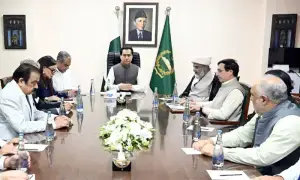
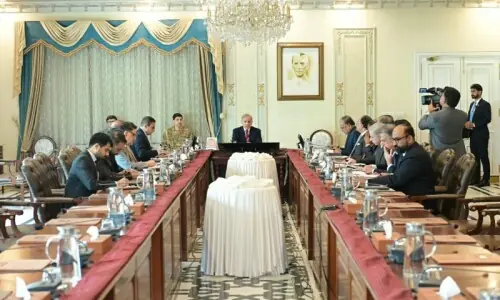
Meanwhile, taking his cabinet and the nation into confidence over the recently-signed pact, PM Shehbaz insisted that the purpose of the Makkah Agreement was purely defensive.
“Its purpose is definitely not that any aggression occurs. It is entirely for defensive purposes, for peace, tranquillity and progress in the region,” he said, adding that the agreement would be a source of strength for the entire Ummah.
In his remarks at the cabinet meeting, PM Shehbaz recalled the bilateral defence pact, signed with Saudi Arabia last year, adding that “Friday’s agreement is another extension of it, with a trilateral agreement signed”.
Also on Monday, the federal cabinet unanimously passed a resolution paying tribute to PM Shehbaz, DPM Dar and Chief of Defence Forces Field Marshal Asim Munir for their wise and far-sighted leadership, for raising Pakistan’s global image and effectively defending the national interest.
Published in Dawn, August 11th, 2026