• Development spending cut to Rs291.55bn; no new taxes in resource-strapped province
• Federal transfers remain mainstay of provincial finances
• Balochistan expects Rs800.13bn from NFC, federal receipts
• Education gets Rs157.29bn; health allocated Rs74bn
• Public order, safety affairs get Rs108bn; social protection spending falls to Rs15.14bn
• 1,200 schools to be activated; 164 non-functional BHUs to be made operational
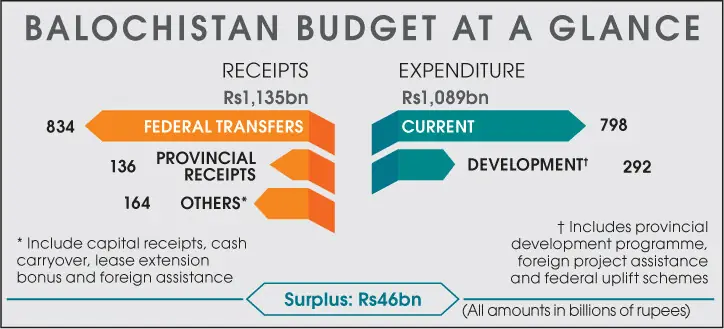
QUETTA: The Balochistan government on Wednesday rolled out a Rs1.13 trillion budget for fiscal year 2026-27, with total expenditure set at Rs1.09tr, leaving the province with a budgeted surplus of Rs45.57 billion for a sixth consecutive year.
The overall development expenditure, however, has been budgeted at Rs291.55bn, down from Rs336.58bn originally budgeted and Rs352.60bn revised for the current year. The development spending is aimed at upgrading infrastructure, strengthening climate resilience, modernising governance and accelerating the province’s transition towards digital and green economies.
Provincial Finance Minister Mir Shoaib Nosherwani presented the budget, continuing a run of surplus, tax-free budgets for the resource-strapped province.
The total budget outlay comprises Rs1.1tr in projected receipts and a Rs30.61bn cash carryover from federally funded projects. Despite efforts to expand local revenues, Balochistan will continue to rely heavily on federal transfers.
The province expects to receive Rs800.13bn through its share in the National Finance Commission Award, the divisible pool, straight transfers and other federal receipts.
While speaking to the cabinet, Chief Minister Sarfraz Bugti described the budget as balanced, realistic and people-friendly, emphasising that despite limited resources, the government had prioritised welfare, sustainable development, job creation and improved basic services. He highlighted health, education, clean drinking water, infrastructure and employment as top priorities in the development programme.
In his speech, the finance minister listed several strategic initiatives being undertaken by the Bugti government. They include the construction of two additional rooms in 3,000 government schools across the province, operationalisation of 164 non-functional basic health units to strengthen primary healthcare facilities and establishment of two new hospitals.
He said 1,200 schools across the province would be activated through the Balochistan Education Foundation at a cost of Rs2.5bn, while the network of community schools would be expanded. “To improve the effectiveness of law enforcement institutions and maintain public order, Rs500m has been allocated for PIFTAC,” he said.
During fiscal year 2026-27, the expansion of fibre-optic connectivity will continue in schools and colleges to improve internet access and digital learning opportunities for students, he added.
Mr Nosherwani said the BLZ project was one of the government’s key initiatives aimed at developing the province’s reserves of baryte, lead and zinc. A sum of Rs700m has been allocated in the upcoming fiscal year for the initiative. He said a micro-grid system would be established in remote areas to ensure provision of affordable energy, while construction of 200 kilometres of roads under the integrated infrastructure initiative was under way. He also promised to soon launch the planned People’s Train Service.
In FY27, the government will establish Safe City projects in various districts to improve law and order. A comprehensive project for the supply of clean drinking water will also be launched.
Revenue
On the resources side, revenue receipts are budgeted to rise to Rs1.02tr, up roughly 9pc from this year’s original estimate of Rs932bn. Transfers from the federal government under the NFC Award remain the mainstay of provincial finances at Rs834.45bn, including Rs771bn from the divisible pool of federal taxes, Rs23.74bn in straight transfers and a combined Rs39.3bn in development and non-development grants.
The government has set an ambitious own-source revenue target of Rs170.09bn for the next fiscal year, reflecting its stated goal of reducing dependence on federal resources and improving fiscal autonomy.
Provincial tax collection is estimated to rise to Rs72.41bn, while non-tax revenue, including a Rs34bn lease extension bonus, makes up the remainder. Capital receipts are pegged at Rs85.28bn, featuring a fresh Rs30bn line for project financing that did not exist in the current year’s books.
The new numbers also show how far this year’s budget has drifted from its original targets. Against an originally budgeted Rs1tr in total receipts for 2025-26, the revised estimate came in at Rs887bn, a shortfall of more than 11pc.
The gap was driven largely by provincial own receipts, which fell to Rs82.47bn against a budgeted Rs124.88bn after the lease extension bonus fetched barely Rs368m against the projected Rs24.6bn.
Combined with revised expenditure of Rs982.56bn, the outgoing year’s accounts point to a shortfall of roughly Rs95.84bn against the Rs51.83bn surplus originally planned.
Spending
On the spending side, current revenue expenditure for next year is set at Rs771.43bn, up about 26pc from this year’s original budget.
General public service costs more than doubled from the revised estimate to Rs270.53bn, the single largest jump in the budget and a likely reflection of higher salary and pension outlays for government employees.
Education remains the largest social-sector allocation among current expenditure heads, at Rs157.29bn.
Health spending climbs to Rs74bn, while public order and safety affairs, covering policing and security in the militancy-affected province, has been budgeted at Rs108bn. Social protection spending, by contrast, is set to fall sharply to Rs15.14bn from a revised Rs29.11bn this year. Capital expenditure outside food operations holds steady at Rs22.62bn, split between Rs9.22bn for principal repayment of debt and Rs13.4bn for pension and other investments. Including a renewed nearly Rs4bn allocation for state trading in food, total non-development expenditure climbs to close to Rs798bn, an increase of nearly 25pc over the current year’s original budget.
Development spending tells the opposite story. The overall development expenditure has been budgeted at Rs291.55bn, down from Rs336.58bn originally budgeted and Rs352.6bn revised for the current year.
Within that, the Public Sector Development Programme falls to Rs206.61bn from this year’s Rs249.45bn, even as foreign-funded projects rise to Rs40.38bn and federally funded projects outside the PSDP are trimmed to Rs44.56bn.
Published in Dawn, June 18th, 2026