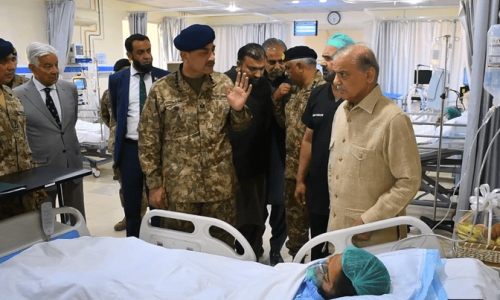
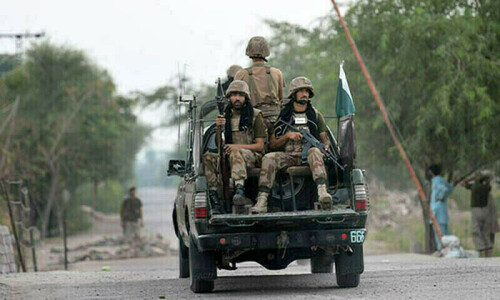
NO cause can justify the murder of innocent non-combatants, particularly children. That is why Wednesday’s suicide blast targeting a school bus in Khuzdar is particularly abhorrent.
Among the five confirmed victims were three children. A large number were injured — some of them are in critical condition. The military’s media wing and the Prime Minister’s Office have said India, through its proxies, is responsible for the terrorist act. Apart from attacks on security forces, numerous non-combatants have been killed in Balochistan’s separatist insurgency. The slayings of non-Baloch workers by separatist militants have been a particularly gruesome aspect of the ongoing insurgency.
The Balochistan chief minister has said the administration had intelligence that India was about to carry out destabilising activities, while ISPR had earlier this week stated 12 terrorists belonging to “Indian proxy” outfits had been eliminated in separate operations in KP and Balochistan.
While no group has as yet claimed Wednesday’s attack, there can be little argument with the fact that India and other hostile actors have been involved in fomenting trouble in Pakistan. The Kulbhushan Jadhav affair is just one glaring example. Given this trajectory, the state has reason to link yesterday’s atrocity to such proxies, especially if it has strong evidence that establishes their guilt.
The recent example of our eastern neighbour carries lessons: New Delhi started blaming Pakistan for the Pahalgam tragedy without a shred of proof. The Modi administration’s hysterical reaction to the atrocity in held Kashmir brought both states to the brink of a full-blown war. Pakistan must pursue a more rational course. Whatever evidence it possesses of Indian involvement should be taken up with New Delhi, and shared with the international community.
This would be the right course — unlike India’s post-Pahalgam narrative, which does not appear to have any serious takers in the comity of nations. The fact is that there is a real problem in Balochistan, and Pakistan needs to implement long-term measures to fix it so that no external or internal actors can exploit the situation. The issue then must be approached with sagacity by the Pakistani state.
There needs to be a counterterrorism component, as well as a political one, to Balochistan’s militancy problem. Those involved in killing innocents must surely be punished for their crimes. But without a political solution to decades-old grievances, a sustainable counterinsurgency strategy cannot be formulated.
For this, Balochistan’s nationalist parties must be brought on board. Simply branding all critics as ‘anti-national’ or ‘Indian agents’ will not bring peace to Balochistan. A process of reconciliation is sorely needed in the province — one involving non-violent political elements that agree to work within the bounds of the Constitution. A solely militarised response will be insufficient.
Published in Dawn, May 22nd, 2025