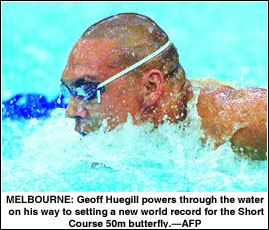
 MELBOURNE, Dec 8: Geoff Huegill completed his collection of men’s 50 metres butterfly world records by setting a short-course best of 22.84 seconds at the World Cup meeting in Melbourne Saturday.
The 22-year-old Australian, the long-course world champion and world record holder, beat the previous best of 22.87 set by Britain’s Mark Foster in Sheffield, England in January 2001.
Huegill now leads the race for a $50,000 World Cup points score bonus.
The Melbourne meeting is the fifth of the nine-leg World Cup series.
Under the ranking system which awards points based on times, a swimmer would need a world record swim in a final and to compete in all three participation zones in the series to rival Huegill’s points score.
Huegill said he was capable of further improvement.
“You’d have to think so. We’ll see what happens,” he said.
“We’re only halfway through the World Cup series, there are still another four events after this, so we’ll just take it day by day, meet by meet, just go from there.
“Hopefully I can keep swimming well leading into the Commonwealth Games trials (in Brisbane in March).”
Australia’s Adam Pine was second in 23.61 ahead of Russian Denis Pankratov, the 1996 Olympic gold medallist, in 24.22.
Huegill said he had looked up to see his time was 22.84 without knowing he had set a world record.
“I thought oh gee, that’s pretty quick. Then I looked up and I saw it (the world record) was 22.87. I was very, very pleased,” he said.
He shaved 0.07 seconds off his personal best.
Australia won six of the 11 finals after taking seven of the 12 on Friday’s first day of the three-day meeting.
The United States won five on Friday and four on Saturday.
Australia’s Michael Klim, swimmer of the meet at the 1998 world championships, won the 200 metres freestyle in 1:44.24 ahead of countrymen William Kirby and Antony Matkovich.
Double Olympic and world champion Yana Klochkova was fourth in the women’s 400 metres freestyle final behind American Lindsay Benko, Australia’s Elka Graham and American Rachel Komisarz.
Klochkova, 19, from the Ukraine, had only arrived in Australia on Saturday morning two hours before the heats following a 27-hour flight from Moscow.
Australia’s Matt Welsh won the men’s 200 metres backstroke in 1:54.23, more than two seconds outside his own world record of 1:51.62.
“If I’m swimming this fast now, I’m going to blitz them at the world short-course (championships),” said Welsh, who resumed four weeks ago after an eight-week lay-off.
Saturday’s results:
WOMEN’S:
400 metres freestyle: 1. Lindsay Benko (US) 4 minutes 03.38 seconds; 2. Elka Graham (Australia) 4:03.42; 3. Rachel Komisarz (US) 4.04.55.
100 metres butterfly: 1. Rachel Komisarz (US) 57.45; 2. Melanie Houghton (Australia) 59.16; 3. Diane Bui Duyet (France) 59.35.
200 metres breaststroke: 1. Amanda Beard (US) 2:23.47; 2. Sarah Poewe (South Africa) 2:24.47; 3. Brooke Hanson (Australia) 2:24.73.
50 metres freestyle: 1. Sarah Ryan (Australia) 25.27; 2. Janine Pietsch (Germany) 25.55; 3. Marieke Guehrer (Australia) 25.77.
100 metres individual medley: 1. Brooke Hanson (Australia) 1:02.17; 2. Lori Munz (Australia) 1:02.72; 3. Megan McMahon (Australia) 1:03.65.
100 metres backstroke: 1. Charlene Wittstock (South Africa) 1:00.16; 2. Janine Pietsch (Germany) 1:00.25; 3. Clementine Stoney (Australia) 1:00.58.
MEN’S:
50 metres butterfly: 1. Geoff Huegill (Australia) 22.84 (world record); 2. Adam Pine (Australia) 23.61; 3. Denis Pankratov (Russia) 24.22.
100 metres breaststroke: 1. Ed Moses (US) 59.29; 2. Morgan Knabe (Canada) 1:00.09; 3. Jim Piper (Australia) 1:00.47.
200 metres freestyle: 1. Michael Klim (Australia) 1:44.24; 2. William Kirby (Australia) 1:44.76; 3. Antony Matkovich (Australia) 1:46.32.
200 metres individual medley: 1. Justin Norris (Australia) 1:58.16; 2. Dean Kent (New Zealand) 1:59.38; 3. Jens Kruppa (Germany) 2:00.94.
200 metres backstroke: 1. Matt Welsh (Australia) 1:54.23; 2. Ray Hass (Australia) 1:55.73; 3. Sebastian Halgasch (Germany) 1:57.27.—Reuters