0
0

AN article in The New York Times has revealed that tensions between the Pakistan and the US are increasing once again on account of Pakistan's alleged support for the Afghan Taliban leadership taking refuge in Balochistan “The issue of the Taliban leadership council, or shura, in Quetta is now at the top of the Obama administration's agenda in its meetings with Pakistani officials.” In addition to the long-standing American and Afghan comp- laint that Pakistan-based Afghan militants are creating trouble in the south of Afghanistan, the article also quotes unnamed officials linking the worsening security situation in parts of northern and western Afghanistan to the so-called Quetta shura. Is the American perception correct? The matter is not as straightforward as American and Afghan officials appear to believe. First, it is true that Quetta and the areas around it and parts of the Pak-Afghan border in Balochistan have become safe havens for some among the Afghan Taliban. But is there such an entity as the Quetta shura and is it playing a central role in the insurgency inside Afghanistan? On the existence of the Quetta shura, the Times story quotes a western official as saying “It's much more of an amorphous group that as best we can tell moves around. They go to Karachi, they go to Quetta, they go across the border.” So there are clearly uncertainties about the nature of the Quetta shura.
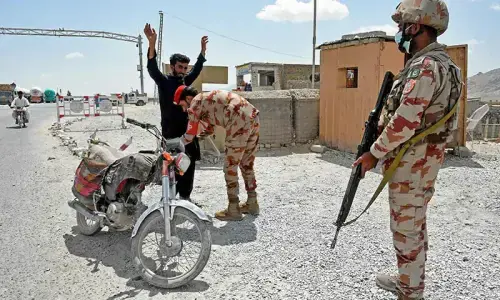
Second, the insurgency in Afghanistan draws its strength primarily from inside Afghanistan. The McChrystal report has noted “While the existence of safe havens in Pakistan does not guarantee ISAF failure, Afghanistan does require Pakistani cooperation .... Nonetheless, the insurgency in Afghanistan is predominantly Afghan.” So does that mean Pakistan doesn't need to do more to clamp down on Afghan militants operating from Balochistan? No. But there is a problem with the 'do more' demand, one that is purely pragmatic. The Pak-Afghan border in Balochistan is remarkably porous, with an estimated 50,000-60,000 people crossing it every day. Stopping that flow is beyond the capabilities of the security forces on either side of the border at the moment.
Also, with a low-level local insurgency continuing in Balochistan and the state's resources stretched thin by operations against militants elsewhere, there is reason to be cautious in opening another front at the moment. American and Afghan officials, therefore, need to understand the very real constraints that the Pakistan security forces are operating under. Equally, however, the Pakistani state must not be complacent. After all, there is no guarantee that in the long term the Afghan militants taking refuge inside Pakistan will not turn their guns on Pakistan.