



 0
0

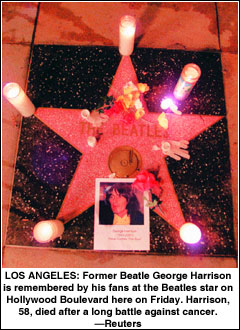 LONDON: We do not expect pop stars to die in their beds after a long fight to survive into old age. Belonging to a profession and generation in which many took experimental drugs which killed them, George Harrison spent his final years trying out bright new pills which might keep him alive. On Friday, they failed.
While he was only the third most famous of the Beatles, Harrison had a life and career which oddly combined a version of everything which happened to the band: sublime compositional skills (Something), mysticism, addiction (though, in his case, the worst was to tobacco, which killed him), the post-60s musical experiments (the Travelling Wilburys), the controversial first marriage (Patti Boyd left him for Eric Clapton) and even a terrifying confrontation with a stalker, although, unlike John Lennon, Harrison survived his.
Harrison’s problem was that for almost two-thirds of his life he was unable to live as an individual: he mattered because he had been part of a quartet. This was true for Paul and John as well but, being more extrovert, they had made more of an individual impression on the mass imagination.
George must have known that every article about his passing would have near its top the qualifying phrase ex-Beatle. It probably was not a coincidence that, when Harrison became a film producer, he chose first to back Monty Python, the only other English group who suffered equivalent problems of nostalgically driven collective identity and pressure to reunite.
But the difficulty of what to do after the Beatles was merely an extreme example of the dilemma of all pop stars who survive past their 30s. Perhaps because pop is bought by people in their teens and 20s - and, now, bought again by those people in their 40s - most of the great pop music is written by people who have only owned a driving licence for a few years. Harrison managed his post-fame activities with more dignity than most, but he would have known that he was heading for one of those poignant obituaries in which most of the illustrative footage was 30 or 40 years old.
In most professional disciplines, there seems to be one practitioner whose achievements disproportionately dwarf the efforts of everyone else who tried: Shakespeare in playwrighting, Bradman in cricket, Mozart in classical music. And the Beatles in pop music. No songwriters have remotely matched the melodic and lyrical consistency of the catalogue of Lennon & McCartney and Harrison. He also believed in reincarnation. But what Harrison’s death means, at least in this life, is that the Beatles are never coming back, except in the afterlife of air-play and CD sales. —Dawn/The Guardian News Service.



























