0
0

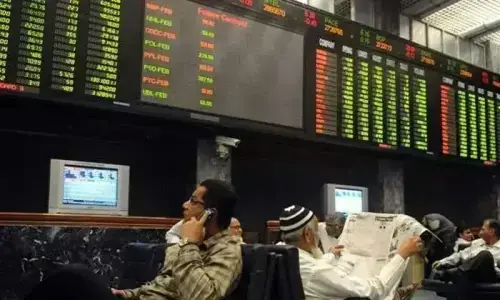
KARACHI, March 8: The apparent improvement in investment sentiment “remains fragile — as well as hostage to the investor anxiety” about political transition in the aftermath of October 2002 elections, say financial analysts at a leading foreign bank.
In a report, written before Wednesday’s strong protest by the opposition when the copies of the Constitution incorporating the LFO were circulated in the parliament, these analysts had noted that the anxiety was “gradually diminishing”. These fears have been rekindled by the confrontation between ruling coalition and a united and vocal opposition on some of the LFO provisions.
A study on the capital market by a local brokerage house notes that “anti-Musharraf parties have gained considerable strength and can pose a significant problem to the President and the continuation of his policies. A constant cycle of breaking and forming of coalition governments is also a possibility and this will hurt the market.”
The market has exhibited subdued sentiments about the domestic political scenario, hoping that the new political set-up would not become a source of uncertainty.
Some businessmen also complain that decision-making has slowed down in the transition from the military rule to the civilian set-up.
“Although we believe that the shots are still called by the President, the new political government will create more bureaucratic channels resulting in slowdown of the reforms,” say market analysts.
Officials have their own explanations to offer. They believe that decision-making is affected initially when governments change. But no less worrying is the slow pace of transfer of power. The Senate has not been reconstituted so far and the opposition MNAs have threatened not to take oath under the LFO, for which no date has been fixed as yet.
The turnaround in the external sector is beginning to impact on the economic growth that needs to be sustained by the political stability.
The first requirement is a smooth transition from the military rule to the constitutional governance. But some provisions of the LFO tend to create a political divide, deep enough, to nurture the seeds of instability.
The political economy has its own imperatives. In the past three years, a major effort has been made to move away from crony capitalism to an even playing field for all economic agents and to strengthen the emerging free market. The corresponding outcome of these economic reforms in politics should be pluralism based on national reconciliation and consensus. After all, the representative democracy and the market economy sustain each other. Instead, the country is seeing a confrontation between the opposition and the government within the parliament that should be focusing on economic and social reconstruction.
The combined opposition secured more votes than the major partner of the ruling coalition, PML-Q, in the October elections and they have sizable strength in the parliament to claim some say in the country’s affairs. This calls for governance by parliamentary consensus.
Some hopes are being raised that the government and the opposition will move towards a compromise before the President of Pakistan addresses the joint session of the parliament that may lead to gradual democratization of the constitution, reducing the risk of instability.
The political stability and continuity in the economic policies provide a congenial environment for investment-led economic growth. Constitutional governance reinforces the writ for the rule of law and sanctity of commercial contracts. Foreign investors, particularly Europeans, prefer to invest in democracies. For the past few years, investment has been directed mainly towards strengthening existing businesses or in the privatized units. Focus on new investment and businesses has been lacking.
The issue of political stability is deeply linked to the process of national reconciliation and governance by consensus. And the way forward lies in dialogue between the opposition and the government. For too long, the economy has suffered because of political confrontation, regional tensions and absence of rule of law. The people need political stability to prosper.