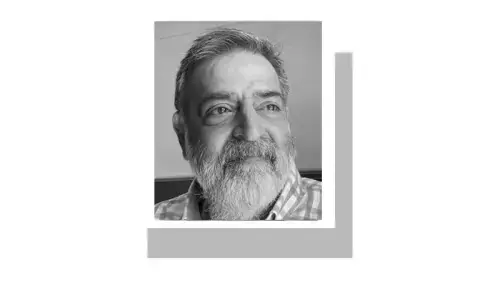
He influenced almost three generations of Pakhtoon poets and writers through his powerful writings and long political struggle. His controversial political stint never eclipsed his literary stature in the eyes of literary critics; he even admitted that his involvement in active politics was probably an aberration.
He once told this scribe 'I think I would have better served my people through my poetic work because I was a restless soul right from my childhood and poetry was a passion for me. My first poem was published in a magazine called Pakhtoon, in 1944, while my first poetry collection Da Ghirat Chagha (The cry of honour) came out in 1958.'
Born on September 15, 1925 at Akora Khattak, a small town in district Nowshera, Ajmal Khattak was deeply impressed by the Khudai Khidmatgar Tehrik of Bacha Khan and become an active member of the Quit India Movement.
He was forced to leave school due to his involvement in politics, however, he completed his education privately and obtained a masters degree in Persian from the University of Peshawar. The author of 18 books, he left an indelible mark on Pushto literature and Pakhtoon politics.
His maiden poetry collection Da Ghairat Chagha was banned both in Pakistan and Afghanistan because it challenged the status quo; ultimately it even landed him in prison. His unique firebrand style set the tone for a new trend among Pushto writers to stand up to the oppressors and raise a cry in support of the oppressed. Da Ghairat Chagha became the bible of Pushto resistance poetry and earned Khattak the title of Baba-i-Nazm.
'Pakhtoon men of letters should forget about praising rosy cheeks, locks of black hair and fairy tales in their writings. Time has come that we should struggle for the rights of the poor and highlight their problems in our poetry. The old-fashioned embellished style will no more inspire the people with empty stomachs,' he remarked while addressing a literary gathering in the early 1960s. He held this view till his death.
He further said 'The progressive writers' movement was not a violent withdrawal from the healthy traditions of the past; it was actually meant to give a new dimension to literary trends. I still strongly believe that poets and writers should pick up social issues and problems of the masses and bring about reformation through their writings.
'That is why we fondly remember Khushhal Khan Khattak, Fridousi, Saadi, Khayyam, Shakespeare, Voltaire, and many other great poets and writers even today because they gave a new vision and new hope to their respective nations.'
He considered Faiz Ahmed Faiz a great progressive poet, but maintained that Sahir Ludhianvi's poetry 'always impressed me due to the simplicity and sincerity of his unbridled emotions.'
During school holidays, his cousin Mohammad Umar took him to Fatehpur where he studied in a religious seminary. He later met Sajjad Zaheer, Ismat Chughtai, Saadat Hasan Manto, Prem Chand and Surjeet Singh and held many literary discussions with them. He also enjoyed cordial relations with Kaifi Azmi and other literary luminaries.
'It is not Marxism which failed, rather it was the Marxists who badly failed. Khushhal Khan Khattak is in my blood, Marxism is in my mind, while Islam is in my heart. When you have a sound economy you feel a remarkable change in your way of life which ultimately affects your culture and civilisation,' he used to say.
Khattak served as editor of different literary and political journals and newspapers including Shahbaz, Adal, Anjaam, Rahbar, Bang-i-Harum and also worked as a scriptwriter for the Pakistan Broadcasting Corporation in Peshawar for five years.
Ajmal lived in exile in Afghanistan for over a decade after the Liaquat Bagh firing incident in 1973. His years away from home inspired him to compose poems that were later compiled in a collection titled Jalawatan Kee Shairee.
Many years later, in 2000, when the ANP leadership called for an explanation regarding his closeness with General Pervez Musharraf he gave vent to his feelings in a poem, indicating his withdrawal from the party with which he had been associated for so long. However, in 2006 he declined to accept the presidential award, the Sitara-i-Imtiaz, from a dictator's hand.
His popular books include Gul Perhar, Batoor, Guloona Takaloona, Daa Zah Paagal Wom, Zhusand Auo Fun, Kachkol, Da Afghan Nung, Da Wakht Chagha, Da Zhusand Chagha and Qisa Zama Da Adabi Zhusand.
'Language is a great identity marker. Marxism and Leninism could not take away my Islam and Pakhtoonwali from me. I have lived and will die with them close to my heart and soul.' Ajmal Khattak passed away on February 8, 2010.