0
0

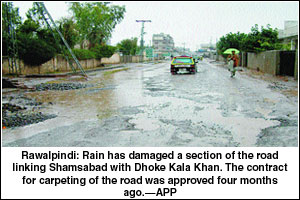 RAWALPINDI, Feb 17: Most of the streets and roads remained inundated with rainwater due to poor sewerage system in the city.
Rawalpindi received 68mm of rain from the post-Eid rain spell, which has been continuing in the whole country since last Saturday evening, says the Meteorological Department.
Majority of the roads of Dhoke Mustaqeem, Gulshan Naveed Colony, Naseerabad, Qadria Coloney, Fazlabad, Jauharabad, Dhoke Kala Khan, Rehmanabad Chowk and Mareer were presenting flood-like situations. The residents said they were facing severe problems, as they remained stuck up at their homes due to continuous rain.
However, a large number of people also complained about the insufficient measures taken by the water and sanitation agency (Wasa) to control the situation.
The situation was so grave that the district Nazim had to order the Wasa authorities to drain water from Satellite Town Block-A, Sidiqqui Chowk and Double Road through machines. But the agency failed to solve the problem.
The district courts were also inundated with rainwater and people, who came to the courts in connection with their cases, had to face a lot of problems. Even a big pool of water could be seen in front of Bakhshi Khana on Monday.
The rain also affected the business and transport system. According to Met officials, the rain would increase the water level in city reservoirs. The snowfall in Murree and upper parts would also be helpful in this regard, they said.
They added that most parts of the country received widespread rains during the last two days and the wet spell was likely to continue for another 24 hours. According to the last weather report on Monday, Islamabad had received 72mm of rain, while, Rawalakot, Peshawar, Murree, Dir, Balakot, Muzaffarabad and Abbotabad received 194mm, 129, 80, 95, 58,67 and 72mm of rains respectively.
APP ADDS: The rain continued for the second consecutive day on Monday enhanced the prospects of Rabi crops particularly of the wheat to meet the set target of its production during current year.
The rain-fed areas were badly suffering in the wake of less rains and the wheat sowing was affected in these areas, considerably reducing the overall sowing areas.
The rain is also very useful in the irrigated areas, as it is most beneficial for enhancing per acre yield of the commodity.