0
0

BEIRUT: Syria’s main opposition group has elected an interim prime minster to run what amounts to an administration in exile, tasked with bringing disparate rebel military groups under the control of a credible civilian leadership.
Ghassan Hitto, who had lived in the US for the past 30 years, narrowly won a ballot to lead the nascent political body, the Syrian National Coalition, which has remained under pressure since its inception to offer an alternative to the totalitarian rule of the Assad regime.
Hitto, an IT executive, was elected from relative obscurity, having made his name in opposition circles over recent months, in which he played a lead role in a burgeoning humanitarian effort that has led to increased supplies of aid delivered into northern Syria. However, another stated core goal of the interim administration — to unite opposition interests that have largely remained disparate and factionalised — remains unfulfilled, to the chagrin of Arab and western states who have conditioned their backing on clear lines of command and control being established.
Hitto’s appointment generated little interest inside Syria, where rebel groups remain engaged in a bitter fight with regime forces for control of the country’s key cities. Political efforts have been largely derided by the myriad opposition fighters, who claim they have done little to change the situation on the ground.
With the civil war into its third year and much of the nationwide battlefield now in stalemate, a consensus is emerging in rebel circles that a more unified effort is necessary to shift the balance in its favour.
Hitto said: “We will work to return all Syrian refugees to the freed provinces.” He was referring to the rural north and east of the country, which have been in rebel hands for close to six months. In a direct message to Syrian military leaders, he added: “We urge all of the commanders in the regime’s military to defect and join the civilians.”
He also called for the opposition coalition to be given a seat at the UN and on other international bodies, such as the Arab League, which suspended Syria, a founding member, after the violent state response to the uprising launched more than two years ago.
He said the Syrian National Coalition was “a legitimate representative of the Syrian people” and refused to enter a dialogue with the regime — a key demand of stakeholders, such as Russia, which remains strongly supportive of President Bahsar al-Assad.
The embattled Syrian leader last week told a Lebanese delegation in Damascus that the regime remained on the front foot militarily, despite some defeats in key parts of the country. He acknowledged the heavy economic toll the war had taken on Syria, but insisted it could ride out its troubles. The conflict has seen an exodus of at least two million people, around one million of whom are registered as refugees in neighbouring Turkey, Lebanon and Syria.
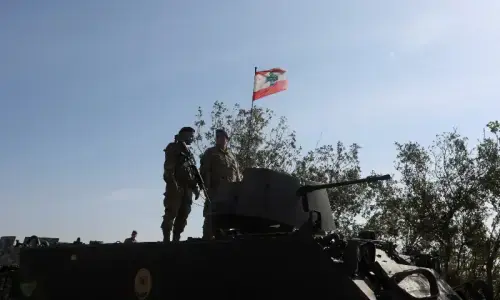
Lebanon continues to buckle under the strain of its powerful neighbour’s woes, amid which Syrian jets fired rockets into an area three miles inside Lebanese borders on Monday, for the first time since the war began. The rockets hit an area near the border town of Arsal in the Bekaa Valley, which has been used at times to smuggle opposition fighters and weapons over the frontier.
They caused no injuries, but drew widespread condemnation from the US and France, both of which described the attack as a “serious violation” of Lebanon’s sovereignty. Elsewhere in Lebanon, authorities are trying to contain the fallout from an assault on four Sunni sheikhs, which has stoked sectarian tensions that have been simmering for many months. The chief of the Lebanese Army, Jean Kahwagi, said on Tuesday the country had passed through one of its “direst days”, referring to the attack, which led to two of the sheikhs being admitted to hospital.
Meanwhile, in Aleppo, regime and opposition groups are accusing each other of firing rockets loaded with chemicals into an opposition-held neighbourhood. The Khan al-Asal area was hit by a large ballistic rocket on Tuesday morning, witnesses said. The region was seized from regime forces during the past fortnight.
Rebel groups in Aleppo strongly denied responsibility for the attack. “These are our own people,” a commander of the largest militia in the city, Liwa al-Tawheed, said via Skype. “We do not have scuds, we do not have chemicals. If we had either we would not even use them on an enemy.”
Syrian state media alleged the attack had killed 16 people and wounded about 90.
By arrangement with the Guardian