QUETTA: Thousands of men and women on Monday refused to bury the victims of a deadly bombing which claimed 84 lives, mostly ethnic Shia Hazaras in Quetta.
Up to 4,000 women began their protest Sunday evening in the provincial capital of Balochistan, blocking a road and refusing to bury the dead until authorities take action against the extremists behind the bloody attack.
The sit-in continued Monday at Hazara Town and near a local station, said Wazir Khan Nasir, a senior police official.
The Shia demonstrators have put forth a list of nine demands, which include the demand for protection of the Hazara Shia community and the deployment of the Army throughout the provincial capital. A targeted operation against the culprits of the bombing and a crackdown against militants involved in targeted killings of Shias as also among their demands.
“Until our demands are met, our protest would continue,” said Syed Dawood Agha, president of the Balochistan Shia Conference.
The protestors also call on the authorities to sack officials within security forces having sympathy with the militants.
Saturday’s deadly bombing was claimed by the banned Lashkar-e-Jhangvi.
The bomb, containing nearly a tonne of explosives hidden in a water tanker, tore through a crowded market in Hazara Town, a Shia-dominated area on the edge of the city. It was the second deadly blast in the city in little over a month.
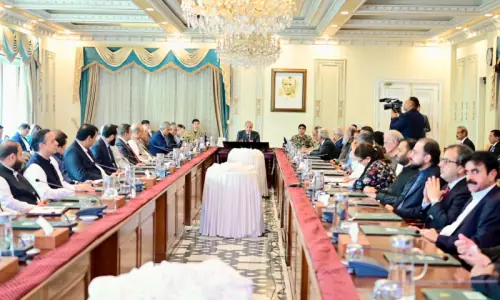
A high-powered meeting was underway Monday evening at the Governor House in Quetta, attended by Governor Balochistan Zulfikar Magsi, Chief Secretary of Balochistan Babar Yaqoob Fateh Mohammad, and senior officials of the police and the paramilitary Frontier Corps (FC).
According to sources, the meeting was held for consultations to convince the protestors to bury the victims of the bloody bombing.
There is anger and frustration at the apparent inability or unwillingness of the authorities to tackle the LeJ. Activists say the failure of the judiciary to prosecute sectarian killers allows them to operate with impunity.
Balochistan governor Zulfiqar Magsi pointed the finger at the security forces over the latest atrocity.
“Repeated occurrence of such attacks is a failure of our intelligence agencies,” he told reporters late Saturday.
“Our security institutions, police, FC (paramilitary Frontier Corps) and others are either scared or cannot take action against them.”
Balochistan has increasingly become a flashpoint for surging sectarian bloodshed.
Saturday’s attack takes the death toll in sectarian attacks in Pakistan this year to almost 200 compared with more than 400 in the whole of 2012 – a year which Human Rights Watch described as the deadliest on record for Shia.
- With additional reporting by Syed Ali Shah from Quetta.