0
0

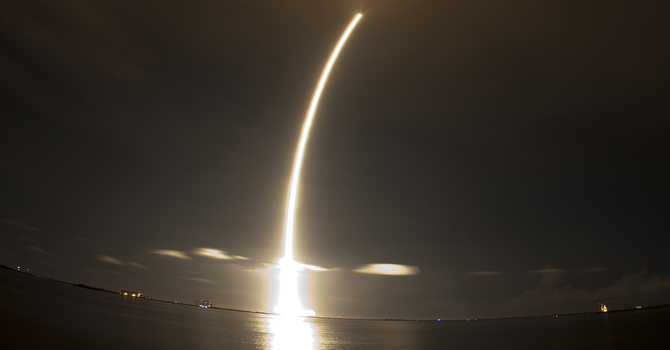
CAPE CANAVERAL, Fla., Oct 9 - A prototype communications satellite flying as a secondary payload aboard a Space Exploration Technologies Falcon 9 rocket was sent into the wrong orbit because of a problem during launch Sunday evening, officials said Tuesday.
One of the nine Merlin engines powering the Falcon 9 rocket shut down early, though the other engines burned longer to make up for the loss of thrust, saving the primary mission of delivering a Dragon cargo capsule to the International Space Station for NASA.The rocket blasted off at 8:35 p.m. EDT Sunday (0035 GMT Monday) from Cape Canaveral Air Force Station in Florida, restoring a U.S. supply line to the $100 billion orbital outpost, a project of 15 nations, following the end of the shuttle program last year.
The Dragon freighter is due to arrive at the space station, which flies about 250 miles above Earth, on Wednesday.
Space Exploration Technologies said its rocket, which was created by Internet entrepreneur Elon Musk and his team at SpaceX, as the company is known, could lose two engines and still make its intended orbit.
"Like the Saturn 5 (moon rocket) and modern airliners, Falcon 9 is designed to handle an engine-out situation and still complete its mission. No other rocket currently flying has this ability," privately owned SpaceX said in a statement.
But that flexibility didn't help satellite communications provider Orbcomm, which owned a prototype OG2 communications satellite flying aboard the Falcon 9.
The satellite was deposited in a lower-than-intended orbit, Orbcomm said in a statement.
The company declined to release details, but Jonathan's Space Report, a website that tracks space launches, says Orbcomm expected its satellite to be placed into an elliptical orbit with a low point of 217 miles and a high point of 466 miles from Earth. That would later become a circular orbit at 466 miles from Earth.
Instead, it ended up in an orbit that ranges from 126 miles to 200 miles.
Orbcomm said an analysis has begun to determine if the satellite can use its onboard propulsion system to boost its orbit.
"Orbcomm will not be able to get to its operational 750 x 750 kilometer orbit, but there's a chance they'll get a few month's of system tests out of it," concludes Jonathan McDowell, a Harvard University astrophysicist who publishes the Space Report.
The company still plans to launch 17 more OG2 satellites on two Falcon 9 rockets in 2013 and 2014.
Those spacecraft will be primary payloads and delivered directly into their operational orbits, Orbcomm said.
SpaceX declined to release financial details of its contract with Orbcomm, and Orbcomm did not respond to requests for comment.