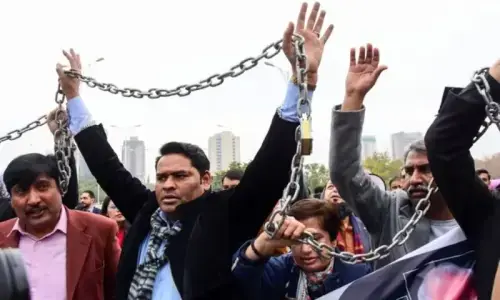
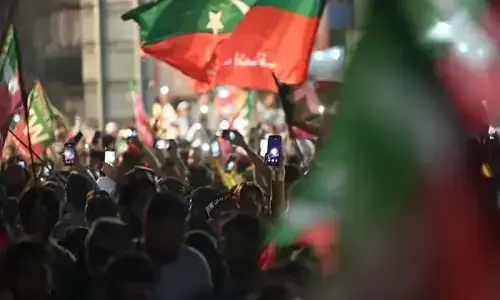
ISLAMABAD, Oct 5: Activists of the infamous and banned Sipah-i-Sahaba (SSP) organisation held an unlawful rally under the banner of Ahli-Sunnat Wal Jamaat (ASWJ) at Aabpara on Friday, under the nose of the ISI and unchallenged by the police.
A successor to SSP, the ASWJ too was banned but its top leaders, Maulana Mohammad Ahmed Ludhianvi and Maulana Khalid Dhillon were there to fire up the rallyists despite restrictions on their movements.
Maulana Ludhianvi declared at the Shuhda Conference that preceded a planned march on the U.S. embassy to protest the infamous anti-Islam film that ASWJ would contest the coming general elections in every constituency.
His deputy Maulana Dhillon elaborated the announcement by telling the nearly 3,500 followers and supporters, mainly young seminary students, that ASWJ would seek “seat adjustments with like-minded parties” in the electoral contest.
By like-minded he meant “people who are ready to push for an international law that punishes blasphemy against any prophet by death”.
Maulana Dhillon also dwelt on the sectarian violence by pleading to Chief Justice Iftikhar Mohammad Chaudhry to revive the suo motu proceedings that one of his predecessors, Justice Sajjad Ali Shah, had started years back. His plea had reference to the Shuhda Conference that was arranged in memory of slain SSP leader Maulana Azam Tariq, who fell victim to sectarian warfare in 2003.
Maulana Samiul Haq, president of his own faction of Jamiat Ulema-i-Islam party as well as the Difa-i-Pakistan Council, warned on the occasion that “blasphemous acts by miscreants and extremists in the Western world are hurting the religious sentiments of the Muslims that can provoke Third World War”.
Other speakers also echoed the foreboding and criticised and warned the government for what they saw as its inaction in the face of Western provocations.
Surprisingly, the speeches did not fire up the rallyists to storm their way to the U.S. embassy. Police had sealed off the diplomatic enclave with containers anyway.
But what brought the rally to a peaceful end was said to be a tacit “don't riot, won't touch” agreement reached between the Islamabad administration and the organisers overnight.
Instead of marching on the U.S. embassy, the organisers nominated four persons who, escorted by police officials, went and handed a memorandum of protest to a security officer of the embassy at the enclave's Shams Gate entrance.
An officer at the scene confided to Dawn though the rally was unlawful, the Islamabad administration feared a showdown if it tried to stop it.
“We have clear instructions to keep away from the Aabpara rally and avoid a confrontation,” added a police officer. Policemen in plainclothes, however, mingled in the crowd, gathering intelligence. What the police worried about was that Malik Ishaq, a leader of the banned Lashkare Jhangvi, does not sneak into the rally. Mercifully, he did not turn up there.
Maulana Ludhianvi and Maulana Dhillon, however, came unchallenged all the way from Kamalia and Khanewal in Punjab. Restrictions on them required that they inform the local police before moving out of their city, which would pass on the information to the police of their destination.
Talking to some young seminary participants, officials’ fears about a confrontation appeared misplaced. “I am here to celebrate the martyrdom of our legendary leader Maulana Azam Tariq,” Mohammad Shahzad, a native of Muzaffarabad studying in a seminary at Pirwadhai, told Dawn.
But the boy who wore a headband declaring love for Sahaba, the companions of Prophet Muhammad (PBUH), knew nothing more about the legendary leader.
Another student Azam Khan from Battagram was seen trudging with a friend towards Rawalpindi to their madressah as the bus that the organisers had provided had vanished after dropping them at the venue of the rally.
“We have just Rs40 between us whereas we need twice that much to reach our madressah,” he said.