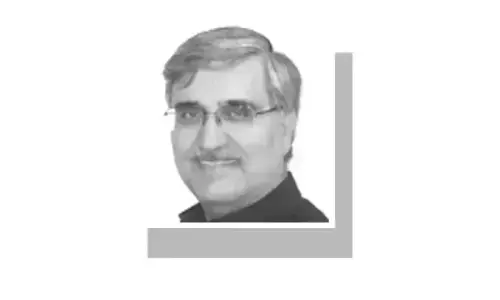
LONDON: Eric Hobsbawm, the eminent British historian who chronicled the extremes of the 19th and 20th centuries from a Marxist perspective, died on Monday at the age of 95, his daughter said.
Hobsbawm was a distinguished but controversial figure due to his long and unapologetic membership of the Communist party, which he maintained despite atrocities in the Soviet Union and eastern Europe.
“He died from pneumonia in the early hours of this morning in London,”Julia Hobsbawm told AFP by telephone.
He had been ill with leukaemia for some time and died at the Royal Free Hospital in the British capital, she said.
“He will be greatly missed not just by his wife of 50 years, Marlene, and his three children, seven grandchildren and great grandchild, but also by his many thousands of readers and students around the world.”
Hobswbawm is perhaps best known for his 1994 book “The Age of Extremes” on the 20th century, which has been translated into around 40 languages, including Hebrew, Arabic and Mandarin, and he received numerous international prizes.
Hobsbawm also wrote a widely-read three-volume series on the so-called long 19th century, “The Age of Revolution: Europe 1789-1848”, “The Age of Capital: 1848-1875” and “The Age of Empire: 1875-1914”.
His Marxist perspective was partly formed by his experiences of living in Germany in the 1930s during the early years of Nazi leader Adolf Hitler's rise to power.
Born on June 9, 1917 in Alexandria, Egypt, to a British father and Viennese mother, Hobsbawm was schooled in Vienna in the inter-war period before leaving for Berlin in 1931 after his parents died in the space of two years.
He fled to London two years later after Hitler became chancellor and joined the British Communist party in 1936.
After reading history at Cambridge University, Hobsbawm began teaching in 1947 at Birkbeck College in London.
He was later invited as a guest lecturer to Stanford University, the Massachusetts Institute of Technology and Cornell University, as well as renowned schools in France and Mexico.
A jazz fanatic, he wrote reviews for the British magazine New Statesman under a pseudonym between 1956 and 1966.
In 1956, it was the Soviet invasion of Hungary that persuaded many other British communists to leave the party in protest.
But Hobsbawm never gave up his membership of the Communist Party of Great Britain, which folded in 1991 following the fall of the Berlin Wall and the collapse of the Soviet Union.
“The Age of Extremes” in particular divided readers along ideological lines in Britain, with many conservatives and liberals saying it ignored Soviet atrocities but many on the left hailing its Marxist sweep of history.
Former British prime minister Tony Blair, whose Labour government appointed Hobsbawm a Companion of Honour in 1998, led tributes to the historian.
“He was a giant of progressive politics history, someone who influenced a whole generation of political and academic leaders,” Blair said.
Current Labour leader Ed Miliband said Hobsbawm was not just an “extraordinary” historian but also a family friend.
“He brought history out of the ivory tower and into people's lives,”Miliband said.
“He was also a lovely man, with whom I had some of the most stimulating and challenging conversations about politics and the world.”Birkbeck College said it had heard of his death with “great sadness”.
Hobsbawm had become president of the college in 2002.
He was appointed a Companion of Honour in 1998 by the government of Labour prime minister Tony Blair. Hobsbawm married twice, first to Muriel Seaman in 1943 until they divorced in 1951, and then to Marlene Schwarz.