0
0

KARACHI, June 15: Legendary singer and the king of ghazal Mehdi Hassan was laid to rest in the Shah Mohammad Qabristan, near Anda Mor, North Karachi, on Friday afternoon. The iconic vocalist had passed away on Wednesday.
All the main arteries leading to the singer’s R-31, Block 20, Ancholi house were closed to general traffic. The street on which Mehdi Hassan lived could only be entered from the Al Noor Road side, and that too had a barrier at the entrance. The black shamiana could be spotted from afar, and the marquee was partitioned as the singer’s coffin was put on that side of the divide which was closer to the house. An ambulance came at 12.30pm and pulled up close to the coffin. The partition was removed and the coffin placed in the ambulance. However, it took the ambulance at least 20 minutes to budge from that spot. When media persons inquired about the delay, they were told someone’s arrival was expected. The volunteers, who were in a far greater number than perhaps required, kept asking the media’s prying cameras and reporters to back off. In between people of renown, including some politicians, writer Anwar Maqsood, actors Nadeem, Anwar Iqbal, Taj Niazi and Qazi Wajid, kept trickling in. It was touching to see the great comedian Lehri enter the premises in a wheelchair. Everybody could notice he was eager to see Mehdi Hassan’s face one last time. He didn’t talk much, understandably so.
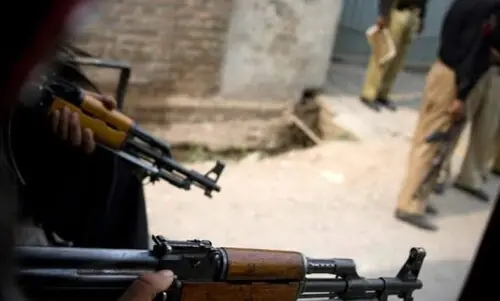
Finally the ambulance moved from the covered shed and slowly reached Al Noor Road. The road was cordoned off by volunteers and they escorted the ambulance — followed by a few more ambulances, police vehicles and a few private cars — to Noorani Ground next to Noorani Masjid. There were security personnel all around, even atop the apartment blocks and houses on both sides of the road. People living in the buildings watched the progress of the procession from their balconies.
Once the funeral procession reached the ground, which had only two spots covered by shamianas (one for the media and the other for the coffin, and the rest of the people stood under the scorching June sun) moving scenes were witnessed. One of Mehdi Hassan’s pupils couldn’t control himself and started to weep in front of the TV cameras. One of the singer’s sons, who had arrived from abroad and because of whom the funeral was delayed for a day, was surrounded by the media. He told journalists that his father was not only a great artiste but was also a great human being.
Tabla player Ustad Bashir Khan, talking to newsmen, recalled that once in India when Khan Sahib had just finished a concert, a business tycoon, Birla, came to him with a blank cheque requesting him to perform at his place the next day. Mehdi Hassan refused his offer. When Bashir Khan asked the legendary man about his refusal, he said he would have accepted his proposition if the businessman had invited him from Pakistan.
The Friday prayers were held at Noorani Masjid after which friends and family members of the late vocalist lined up for the namaz-i-janaza. Here too, for some reason, it took at least 15 minutes to set things straight and someone kept asking people through microphone to settle down and get ready for the namaz-i-janaza. Following the prayers, the coffin was taken to the Shah Mohammad Graveyard near Anda Mor. It was a 10-minute drive.
The grave dug for the late singer was in the extreme right corner of the huge graveyard. While the whole cemetery is marked by shrubbery, the piece of land chosen as Mehdi Hassan’s final resting place was devoid of shrubs. ‘Burial camps’ were set up around the grave with banners on top mentioning that the gravesite was for Shahanshah-i-Ghazal (king of ghazal).
It was a little disheartening to see only a handful members of the artiste community turn up at the funeral. Some of those who did show up appeared to be in a hurry, as if they were just there to fulfil their social obligations.
APP adds: People who attended the funeral included Sindh Assembly Speaker Nisar Ahmed Khuhro, provincial ministers Pir Mazharul Haque, Raza Haroon, Dr Sagheer Ahmed and Rafique Engineer, and Ustad Salamat Ali and Amjad Sabri.